Commonwealth Bank handed down its FY26 results on Wednesday, and the number everyone wanted was there. Cash net profit after tax of $10.982 billion, up 7% on last year. Statutory profit came in at $10.911 billion, up 8%. Operating income lifted 6.2% to $30.2 billion.
That is the easy part. Morgan Stanley had pencilled in roughly $10.95 billion. CBA cleared it. A modest beat, but a beat.
Look closer and the FY26 results carry a message the profit line does not spell out. This was a year the bank won on the ground, not on rates.
How CBA grew when the rate cycle stopped helping
Net interest margin, the gap between what a bank charges borrowers and pays savers, barely moved. It sat at 2.05%, down three basis points on last year. In plain terms, CBA did not squeeze more out of each dollar lent.
So where did the growth come from? Volume. Market share. Grinding.
CBA grew at or above the banking system in all five of its core domestic categories: home lending, business lending, consumer finance, household deposits and business deposits. On the bank’s own reading, that is a first for the group, and the first time any major Australian bank has managed the clean sweep in 15 years.
Home lending grew 7% to $636 billion. Business lending ran at 1.3 times system pace. The bank added 655,000 new retail transaction accounts, and daily app logins passed 14 million.
That is the quiet flex here. Not a bumper margin. A bank pulling customers off its rivals while the economy softens. It kept spending to do it, too, tipping $2.428 billion into technology, fraud controls and AI, including a small-business AI and cyber initiative run with OpenAI.
Key FY26 metrics
| Metric | FY26 | Change on FY25 |
|---|---|---|
| Cash NPAT | $10,982m | +7% |
| Statutory NPAT | $10,911m | +8% |
| Pre-provision profit | $16,469m | +6% |
| Operating income | $30.2bn | +6.2% |
| Net interest margin | 2.05% | −3bps |
| Loan impairment expense | $788m | +9% |
| Return on equity | 14.0% | +50bps |
| CET1 (APRA Level 2) | 12.0% | +30bps |
| Full-year dividend | $5.05 | +4% |
The FY26 buffer that shows CBA is bracing
Here is the part that got less airtime. Loan impairment expense rose 9% to $788 million. Home loan arrears crept up to 0.73%. Personal loan arrears hit 1.72%, up 0.31% from the first half alone.
None of that is alarming on its own. Realised losses stayed low and overall credit quality held. But the bank is watching households strain under cost-of-living pressure.
Then comes the number that tells you how CBA reads the road ahead. It is carrying a $2.7 billion buffer over the losses its own central economic scenario expects. Provision coverage sits at 1.53% of credit risk weighted assets.
Banks do not stockpile that kind of cushion when they feel relaxed. Matt Comyn’s team is padding the balance sheet for a tougher FY27, even while booking a record profit today.
The macro backdrop explains the caution. The cash rate sits at 4.35% after three increases through 2026, and the RBA met the day before CBA reported. In its outlook, the bank flagged higher rates and inflation placing “uneven pressure on household incomes and economic activity.” Home loans make up about 63% of the book, so that pressure lands close to home.
What the vanished buyback and fat dividend reveal
Watch what a bank does with its capital, not just what it says.
CBA declared a final dividend of $2.70 per share, fully franked. That takes the full-year payout to $5.05, up about 4%. The payout ratio landed at 77% of cash profit, near the top of the 70 to 80% target range. Holders got looked after.
But the $1 billion on-market buyback quietly ended. Only $300 million of it was ever spent. It expired on results day and will not be renewed.
That is a decision, not an accident. Rather than keep buying back stock at 27 times earnings, CBA is holding its capital. CET1 finished at 12.0%, well above APRA’s 10.25% floor. The bank would sooner sit on a strong balance sheet than spend it defending a share price that already trades at a heavy premium.
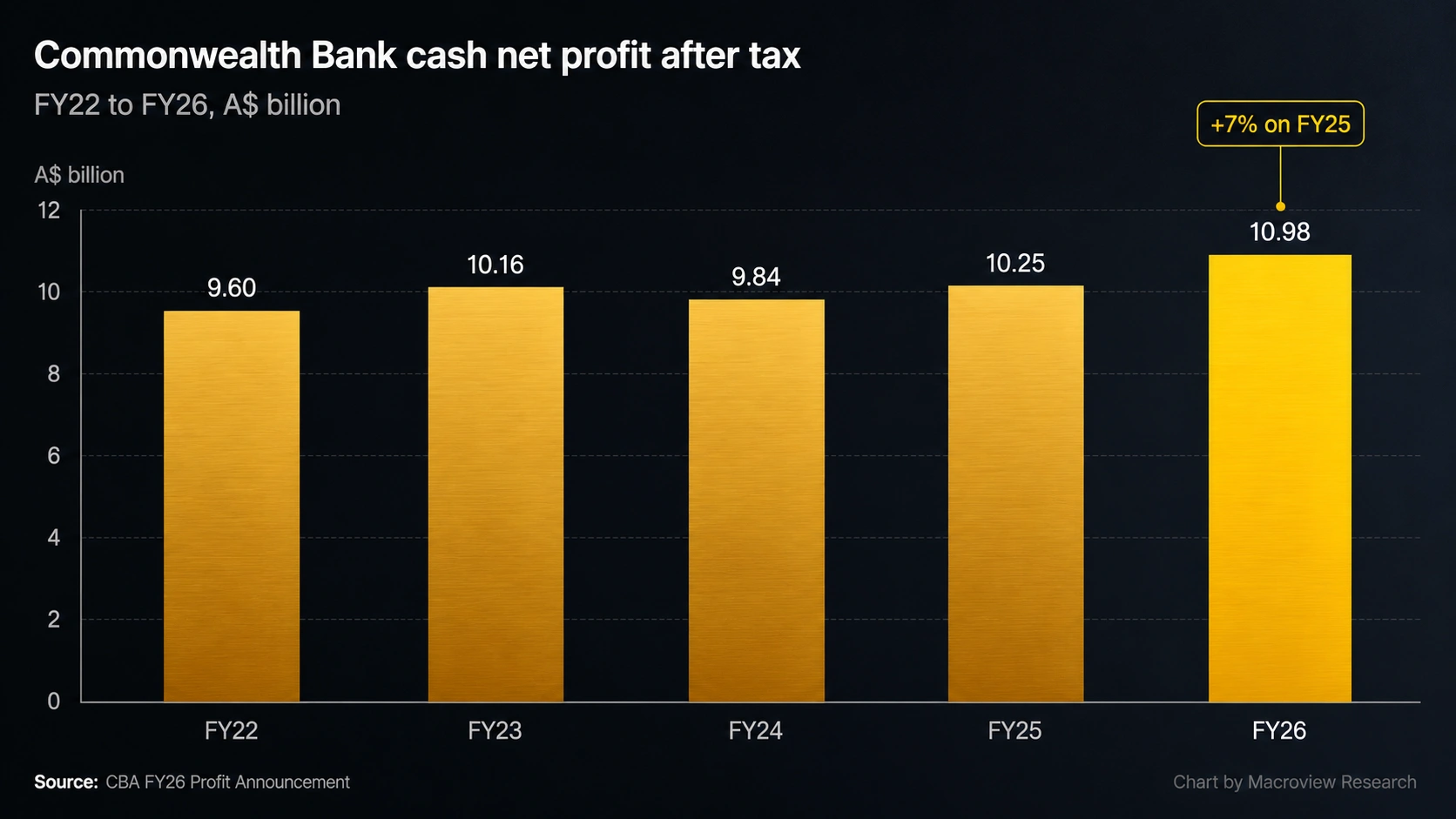
Commonwealth Bank cash net profit after tax, FY22 to FY26 [Source: CBA]
And a premium it is. Compare this with last year’s $10.25 billion cash profit and the growth is real but incremental. Even so, CBA has drifted around 3% lower over the past year while the broader market climbed. It remains the stock investors quietly load up on during market pullbacks, and the one they argue over most.
That spending discipline runs deeper than dividends. The bank has reshaped its technology leadership this year and leaned on AI tools like its Lumos migration accelerator to hold down servicing costs. The moat is being paid for, not assumed.
What FY26 leaves investors weighing up
Strip the noise and the Commonwealth Bank full-year results for 2026 tell you three things.
CBA can still grow without a rate tailwind, which is harder than it sounds. It is preparing for household stress rather than wishing it away. And it has stopped handing back capital for now, picking defence over financial engineering.
For income investors, the $5.05 dividend and roughly 2.9% fully franked yield hold up. For anyone buying the growth story, the question is the one that has dogged this stock for two years. How much more do you pay for the best bank in the country when it already trades like it?
The FY26 numbers do not settle that argument. They just make it sharper.
Also Read: ResMed Q4 Results: Sales Climb 9%, Margins Slip
Life360 Just Said Goodbye to Teammates. An AI Bet Is Why
Challenger Gold Vs Traditional Gold Mines
FAQs
Q: What was CBA’s cash profit for FY26?
A: $10.982 billion, up 7% on FY25.
Q: What is CBA’s FY26 full-year dividend?
A: $5.05 per share fully franked, including a $2.70 final dividend.
Q: Did CBA beat expectations?
A: Yes, cash profit modestly topped the roughly $10.95 billion consensus.
Q: Why did loan impairment rise?
A: Portfolio growth plus cost-of-living and macro pressure lifted it 9% to $788 million.
Q: Is CBA still running its share buyback?
A: No. The $1 billion buyback expired on 12 August 2026 and was not extended.
Disclaimer:
This article is for informational purposes only and does not constitute financial product advice or a recommendation to buy or sell any security. All figures are sourced from Commonwealth Bank’s FY26 ASX announcement and profit announcement. Readers should conduct their own research and seek licensed financial advice before making investment decisions. Past performance is not a reliable indicator of future results.
Source:

Luke Carlino is a seasoned Copywriter, Content Strategist, and Social Media Manager specialising in Mining, Finance, and Business journalism. With more than a decade of industry experience, he brings rigorous editorial standards and commercial acuity to every project.