
The Sun has been putting on quite the show this week. On 23 and 24 April 2026, it unleashed two powerful X-class solar flares within just seven hours of each other, triggering radio blackouts across parts of the Pacific and East Asia, and raising space weather alerts across North America.
For Canadians, this is more than a cool science story. Solar storms can induce geomagnetic currents in Earth’s power grids, overloading transformers and leading to blackouts. Canada knows that better than almost any country in the world.
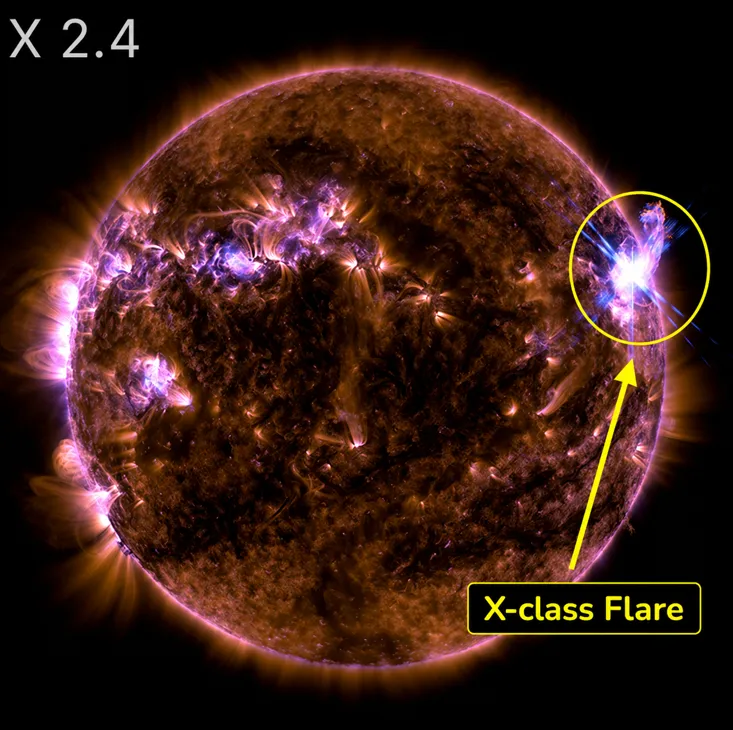
Figure 1: The flare is rated as an X2.4 event, where “X-class” indicates the highest intensity category, and the number (2.4) specifies its relative strength within that class. [Source: NASA]
What the Sun Just Did… And Why It Matters
Two X-Class Flares in Seven Hours
The Sun fired off two powerful X-class solar flares within hours, triggering temporary radio blackouts across parts of the Pacific, Australia and East Asia, according to NASA and U.S. space weather officials. NASA said the first flare, classified as X2.4, peaked at 9:07 p.m. EDT on April 23. A second, slightly stronger X2.5 flare followed at 4:13 a.m. EDT on April 24.
Both eruptions were captured by NASA’s Solar Dynamics Observatory, which keeps a constant eye on the Sun.
These events represent the most significant solar activity recorded in 78 days, as reported by solar physicist Ryan French.
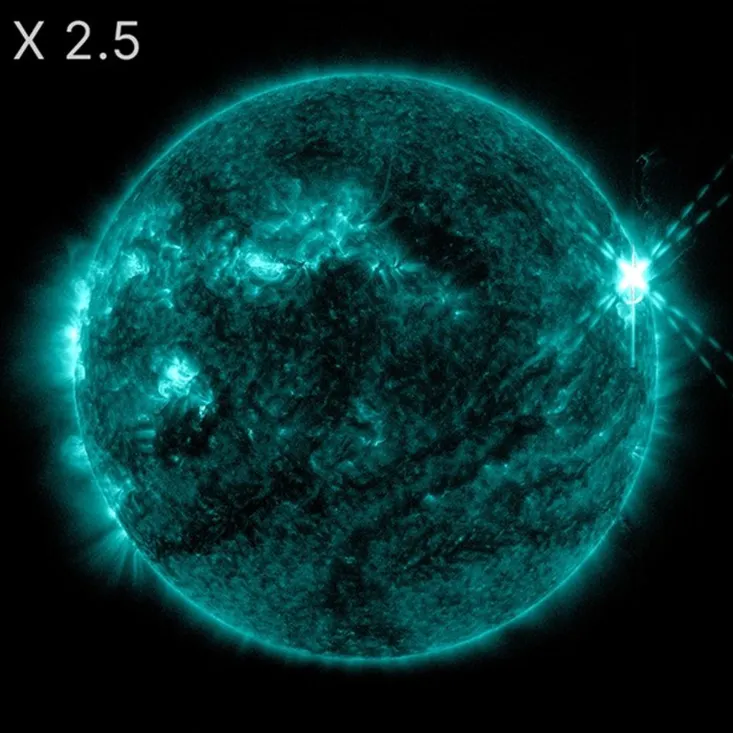
Figure 2: The flare (top right) is classified as an X2.5 event, among the most powerful on the solar scale, with the number indicating its strength within the X-class. The images capture a portion of extreme ultraviolet light, revealing intensely hot material and energetic activity within the flare. [Source: NASA]
Where Did the Flares Come From?
Both eruptions came from a sunspot region on the Sun’s western limb, AR4419. This active region had already been firing off M-class flares. It even produced a rare “sympathetic flare”, where eruptions occur simultaneously in two separate sunspot regions on opposite sides of the Sun.
It’s been putting on quite the farewell show before rotating out of view.
What Are Solar Flares?
Solar flares are intense bursts of radiation, or light, from the Sun. These flashes span the electromagnetic spectrum, including X-rays, gamma rays, radio waves, and ultraviolet and visible light. Solar flares are the most powerful explosions in the solar system — the biggest ones can have as much energy as a billion hydrogen bombs.
Scientists rank them using a letter-based scale:
- A and B class: Minor, with barely any impact on Earth
- C class: Small, with minimal disruption
- M class: Moderate, can cause brief polar radio blackouts
- X class: The most powerful category, capable of wide-scale disruption
Each higher class is a ten-fold increase in energy. So an X flare is 10 times stronger than an M flare and 100 times stronger than a C.
How Do They Knock Out Radio Communications?
When a strong enough solar flare occurs, ionisation is produced in the lower, more dense layers of the ionosphere, and radio waves that interact with electrons in those layers lose energy due to more frequent collisions. This can cause HF radio signals to become degraded or completely absorbed, resulting in a radio blackout.
The radiation from the flares reached Earth quickly and disturbed the ionosphere, the upper atmospheric layer that carries many radio and navigation signals. The first blackout affected parts of the Pacific Ocean and Australia. The second impacted East Asia, according to monitoring data from NOAA’s Space Weather Prediction Center.
Canada Has Felt This Before: The 1989 Quebec Blackout
Canadians don’t have to imagine what a powerful solar storm can do to critical infrastructure. History already showed us.
On March 13, 1989, a severe geomagnetic storm struck Earth, causing a nine-hour outage of Hydro-Québec’s electricity transmission system. The province went dark in under 90 seconds.
Due to the fact that Quebec sits on a massive rock shield called the Canadian Shield, this prevented the current from flowing through the Earth as would be typical elsewhere. The current from the solar storm needed to go somewhere, and it found a better path through the high-voltage transmission lines of the province.
“It was the biggest geomagnetic storm of the Space Age,” says Dr. David Boteler, head of the Space Weather Group at Natural Resources Canada. “March 1989 has become the archetypal disturbance for understanding how solar activity can cause blackouts.”
The province spent $2 billion over the following six years hardening its grid. But the vulnerability that made Quebec so exposed, long north-south transmission lines sitting atop the Canadian Shield, hasn’t disappeared across the country.
Could the Current Solar Flares Hit Canada Directly?
The CME Question
The X-flares appear to have been accompanied by coronal mass ejections (CMEs), large expulsions of plasma and magnetic field from the Sun. However, because the sunspot is positioned on the Sun’s western edge, it’s unlikely these CMEs are heading directly toward Earth.
That said, a glancing blow remains possible. Forecasters anticipate unsettled-to-active conditions through the weekend, with chances for a G1 (minor) geomagnetic storm around April 26.
For Canadians at higher latitudes, which covers a lot of the country, even a minor geomagnetic disturbance can produce visible northern lights. Aurora watchers from Ontario to British Columbia should keep an eye on the sky this weekend.
Why Canada Is Particularly Exposed
Canada’s geography puts it squarely in the line of fire during any serious geomagnetic event. The Canadian Shield’s high ground resistivity, combined with the country’s exceptionally long power transmission lines, creates conditions where geomagnetically induced currents (GICs) can cause significant damage to transformers and grid infrastructure.
Solar storms ionise Earth’s upper atmosphere, interfering with radio signals and GPS accuracy. For a country as vast as Canada, where remote communities, northern aviation routes, and resource industries rely heavily on satellite communications and GPS, that’s a real concern.
We’re at Solar Maximum: More Activity Is Coming
The Sun remains highly active as Solar Cycle 25 continues. NASA and NOAA confirmed in late 2024 that the Sun had entered solar maximum, the peak phase of its roughly 11-year activity cycle. Elevated flare activity can continue even after the peak period.
What that means practically:
- X-class solar flares are occurring far more frequently than in recent years
- The risk of a significant geomagnetic storm hitting Earth is elevated
- Aurora displays are reaching latitudes well into southern Canada
- Space weather agencies across North America are monitoring conditions closely
This week’s twin flares weren’t a one-off. They’re part of a broader pattern of heightened activity that could continue well into 2027.
What Canadians Should Know
For most people, a solar flare poses no direct physical risk. Earth’s atmosphere and magnetic field protect us on the ground. But it’s worth understanding what industries and services face real disruption:
- Aviation: Airlines reroute flights away from polar routes during elevated solar radiation events, which directly affects Canadian carriers operating transpolar routes between North America and Asia
- Northern communities: Remote communities that depend on HF radio for emergency communications are most vulnerable during radio blackout events
- GPS-dependent operations: Mining, forestry, agriculture, and construction sectors that rely on precision GPS can see degraded accuracy
- Power utilities: Grid operators, particularly in provinces with long transmission infrastructure, monitor space weather forecasts closely and adjust operations accordingly
- Satellite operations: Canadian government and commercial satellites face elevated risk during X-class events
For real-time space weather forecasts, NOAA’s Space Weather Prediction Center (spaceweather.gov) is the go-to resource. Natural Resources Canada’s Space Weather group also provides Canadian-specific monitoring and guidance.
Frequently Asked Questions
What happens if the Earth is hit by a solar flare?
Earth’s atmosphere and magnetic field protect people on the ground from direct harm; you won’t feel a solar flare physically. However, a solar flare paired with a coronal mass ejection can cause serious disruption: radio blackouts, GPS degradation, power grid instability, satellite damage, and airline rerouting away from polar routes. In a worst-case scenario similar to 1859’s Carrington Event, a direct hit could knock out power grids and communications infrastructure for weeks.
Can solar flares affect seizures?
The science is inconclusive but not entirely dismissive. Some preliminary research suggests geomagnetic disturbances triggered by solar activity may influence brain electrical activity. A magnetic field of 7 Hz at 0–50 nT, or increased natural geomagnetic activity of 10–70 nT, increased the incidence of seizures in rats prone to epilepsy. However, no large-scale peer-reviewed human study has confirmed a direct link. If you’ve noticed changes in your symptoms during periods of high solar activity, speak with your neurologist. Never adjust medication without professional medical advice.
Is there a hurricane coming to Canada right now?
No. As of 25 April 2026, there is no active hurricane threatening Canada. Atlantic hurricane season begins on June 1 and runs through November 30. Colorado State University’s 2026 seasonal outlook calls for a slightly below-average season, with El Niño conditions expected to suppress activity. Nova Scotia remains the most vulnerable region when storms recurve through the western Atlantic. For live tracking, check Environment Canada’s Canadian Hurricane Centre at weather.gc.ca.
Are solar flares causing problems right now?
Yes. The Sun released two strong solar flares on April 23 and 24, classified as X2.4 and X2.5, which can impact radio communications, electric power grids, navigation signals, and pose risks to spacecraft and astronauts. Radio blackouts affected parts of the Pacific, Australia, and East Asia. A minor geomagnetic storm is possible around April 26. Check NOAA’s Space Weather Prediction Center at spaceweather.gov for live updates.
Disclaimer
The information in this article is intended for general informational and educational purposes only. Space weather conditions change rapidly; always consult NASA (science.nasa.gov), NOAA’s Space Weather Prediction Center (spaceweather.gov), and Natural Resources Canada for the most current data. The content relating to seizures is not medical advice; consult a qualified healthcare professional for any health concerns. Hurricane information reflects seasonal outlooks at the time of writing and does not constitute an emergency weather warning — refer to Environment Canada (weather.gc.ca) for live storm tracking and active warnings.
Sources
- https://science.nasa.gov/blogs/solar-cycle-25/2026/04/24/sun-releases-2-strong-solar-flares-3/
- https://www.spaceweather.gov/node/1481
- https://www.space.com/astronomy/sun/sun-unleashes-2-colossal-x-flares-within-7-hours-of-each-other-knocking-out-radio-signals-on-earth
- https://www.swpc.noaa.gov/phenomena/solar-flares-radio-blackouts
- https://www.spaceweatherlive.com/en/solar-activity/solar-flares.html


