
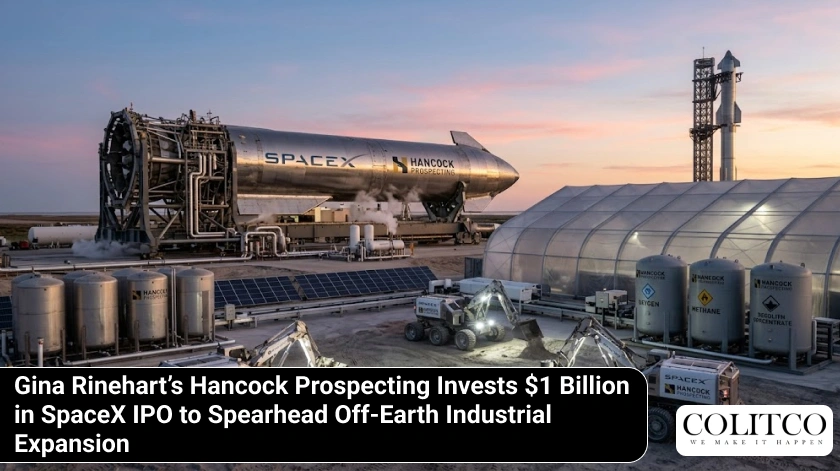
Australian mining magnate Gina Rinehart secured a major equity stake worth more than 1 billion US dollars in SpaceX during the aerospace company’s historic initial public offering. Her privately owned mining company, Hancock Prospecting, confirmed the massive financial commitment following the record-breaking public market debut. This transaction represents Hancock’s largest capital allocation outside its traditional iron ore operations in Western Australia.
The investment immediately delivered positive results as SpaceX shares surged 19 per cent on their first full day of trading. Public market investors drove the valuation of the company past 2.1 trillion US dollars. Rinehart praised the commercial success and the strategic positioning of the aerospace giant in her official statement.
The company’s advanced rocketry system represents the core infrastructure required to achieve these long-term industrial goals.
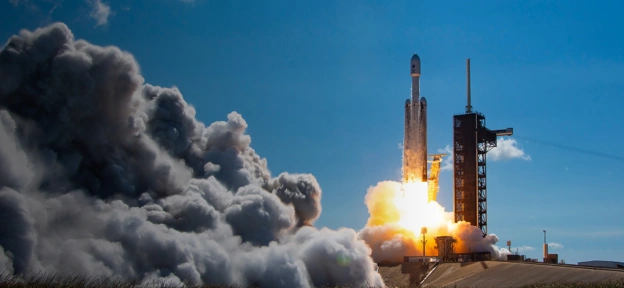
Figure 1: SpaceX rocket launch [Source: SpaceX]
The visual shows a powerful rocket soaring into orbit, illustrating the heavy payload capacity that private companies now deploy to access extra-terrestrial resource bases.
The billionaire released specific details highlighting her confidence in the long-term future of space-based industrialisation. She stated, “This is a significant investment for Hancock, and we are pleased to have received an allocation in what has been an extremely popular and oversubscribed IPO.” This strategic acquisition positions the Australian mining powerhouse at the forefront of the emerging extra-terrestrial resource sector.
The stock market debut pushed the aerospace firm into the upper echelons of corporate valuations globally. Only five other American corporations hold a larger market capitalisation than SpaceX at this moment. Rinehart seized this public offering as a prime opportunity to diversify her massive iron ore wealth into high-growth technology.
The investment marks a sharp pivot for the historical Australian mining house. Hancock Prospecting had previously focused almost exclusively on digging iron ore out of the red dirt of Western Australia. This billion-dollar action demonstrates a profound structural evolution in the investment mindset of the nation’s wealthiest person.
Significance of the Investment
This massive investment signals the beginning of a new era where traditional industrial giants move their focus beyond Earthly borders. Readers will witness how the extraction of critical minerals expands from remote terrestrial locations into the lunar environment and nearby asteroids. The link between terrestrial mineral supply chains and space exploration will dictate the future availability of advanced consumer technologies.
Space industrialisation requires immense volumes of specialised materials to build permanent infrastructure in orbit. The development of space-faring logistics will eventually lower the manufacturing costs of electronics and green energy systems on Earth. Everyday citizens will experience the direct macroeconomic impacts of off-Earth resource gathering through shifts in global commodity prices.
The alliance between Australia’s wealthiest individual and the world’s leading aerospace firm highlights the accelerating commercialisation of the cosmos. Governments no longer hold an absolute monopoly over space operations as private capital takes charge of interstellar development. This economic shift guarantees that commercial market forces, rather than purely political motives, will drive future exploration.
People will soon witness the real-world manifestation of science fiction concepts as corporate entities develop extraterrestrial manufacturing plants. This shift promises to secure the raw materials that Earth needs to maintain its technological progression. Safe and reliable supplies of rare earths will stabilise the prices of electric vehicles, smartphones, and defence technologies for global consumers.
Key Stakeholders
The leadership of Hancock Prospecting drives the entire expansion strategy from traditional terrestrial mining into new operational domains.

Figure 2: Gina Rinehart, Executive Chairwoman of Hancock Prospecting [Source: Gina Rinehart]
Gina Rinehart, the executive chairwoman of Hancock Prospecting, orchestrated the multi-million-dollar transaction. Rinehart controls a fortune of approximately 36.9 billion US dollars, which she built primarily on massive iron ore exports. Her enterprise has recently expanded into strategic defence assets and rare earths deposits across North America and Australia.
Elon Musk, the chief executive officer of SpaceX, represents the opposite side of this technological alliance. Musk recently achieved the status of the world’s first paper trillionaire due to the explosive stock performance of his rocket company. Rinehart has met with Musk multiple times to discuss industrial strategies, resource logistics, and bureaucratic reduction.
Hancock Prospecting Chief Executive Officer Garry Korte also plays a vital operational role in managing this new relationship. Korte oversees a vast investment portfolio that includes major holdings in Lynas Rare Earths and MP Materials. These strategic entities provide the necessary chemical components for high-tech items, military hardware, and rocket engines.
The broader mining sector watches this massive alliance with intense observation and growing interest. Competing mining houses must now re-evaluate their long-term infrastructure and asset strategies. Rinehart’s bold strategy forces the entire resources industry to reconsider the definition of an extractable asset class.
Here are the key corporate entities and figures participating in this technological transition:
- Hancock Prospecting injected over 1 billion US dollars into the SpaceX public offering.
- Executive chairwoman Gina Rinehart directed the diversification away from core iron ore assets.
- Chief Executive Officer Garry Korte manages the direct procurement of critical minerals.
- Elon Musk provides the integrated hardware and software launch platforms via SpaceX.
Investment Location
The financial transaction occurred through the New York financial markets where SpaceX listed its shares for public trading. Hancock Prospecting managed the acquisition from its corporate headquarters located in Perth, Western Australia. The physical impacts of this partnership will bridge the isolated mining pits of the Pilbara region with rocket production facilities in Texas.
The ultimate execution of this investment strategy will take place hundreds of thousands of kilometres above the surface of the Earth. Space exploration teams focus their immediate attention on the south pole of the Moon and near-Earth metallic asteroids. These remote celestial locations contain rich deposits of ice, iron, nickel, and platinum-group elements.
The manufacturing pipeline spans multiple continents before reaching the launchpads of Florida and Texas. Essential mineral processing takes place across processing plants in Australia, Malaysia, and the United States. This international supply chain eventually routes all refined elements directly into the highly integrated assembly facilities of SpaceX.
Also Read: ByteDance in Talks to Buy AI Chips From Iluvatar CoreX and Baidu as Nvidia Loses Ground in China
Timeline of Events
Hancock Prospecting formally announced the massive financial transaction on Monday, June 15, 2026. The announcement followed the record-breaking public listing of SpaceX shares on the previous Friday. This timeline matches Hancock’s aggressive first-quarter investment campaign in global defence and technology companies.
The timing of the bet coincides with major updates from NASA regarding its ongoing lunar exploration initiatives. The international space agency recently unveiled its astronaut crew for the upcoming Artemis programme. This synchronised activity underscores the rapid acceleration of the commercial space race during the mid-2020s.
Strategic Implementation
SpaceX secured 75 billion US dollars in fresh capital through its record-shattering public offering process. Institutional investors heavily oversubscribed the share allocation, but Rinehart successfully obtained her billion-dollar slice. She noted, “We see SpaceX as a rare business: led by a truly exceptional person, technically exceptional and operating in sectors that are crucial, and with long-term potential.”
Hancock Prospecting intends to use its extensive mining expertise to supply the critical minerals that SpaceX requires for advanced manufacturing. Space-faring rockets, Starlink satellites, and orbital datacentres consume massive quantities of titanium, lithium, and rare earth elements. Garry Korte stated, “In the future, we also see the possibility of mutually beneficial arrangements between SpaceX and Hancock Prospecting’s significant critical minerals investments, as demand grows for the materials and infrastructure needed to support advanced technology.”
The collaborative efforts will initially target the creation of supply chains that feed SpaceX manufacturing hubs on Earth. Long-term plans involve the development of autonomous mining machinery capable of operating in low-gravity environments. Korte summarised the corporate enthusiasm by adding, “We look forward to the potential of working with the SpaceX team on its exciting journey.”
The international space community plans to establish operational pilot processing facilities for lunar resources by the year 2032. These facilities will initially extract water and harvest lunar soil to produce rocket propellant and life-support oxygen. Successful extraction of these vital commodities will fundamentally alter the economics of long-duration space flight.
Private space mining entities face severe engineering hurdles, high launch costs, and ambiguous international legal frameworks. Financial analysts estimate that precious metal prices must rise exponentially to make asteroid harvesting profitable today. Despite these staggering economic challenges, Rinehart’s billion-dollar gamble places her company in a dominant position to control the supply lines of the next century.
Sources
- https://www.mining.com/rineharts-1b-spacex-bet-targets-mining-beyond-earth/
- https://cryptobriefing.com/gina-rinehart-billion-spacex-ai-investment/
- https://www.northernminer.com/news/rineharts-1b-spacex-bet-targets-mining-beyond-earth/
Disclaimer:
The information provided in this article is for informational purposes only and does not constitute financial, investment, or legal advice. Investing in equity markets and space-industry ventures involves significant risk, including the potential loss of principal. Readers should conduct their own research or consult with a qualified financial advisor before making any investment decisions. The content relies on external sources and market analysis, which may be subject to change.

Luke Carlino is a seasoned Copywriter, Content Strategist, and Social Media Manager specialising in Mining, Finance, and Business journalism. With more than a decade of industry experience, he brings rigorous editorial standards and commercial acuity to every project.