The numbers from NAB’s monthly survey are not good. January started at +3. By March, it had cratered to -29. That is the second-biggest single-month fall in the survey’s entire 25-year history.
Only two events have ever hit harder:
- The GFC in October 2008
- COVID lockdowns in March 2020
A 10-point bounce in May brought it back to -14. Still negative. Still in the red across every single industry. No sector is posting a positive confidence reading right now.
What the NAB Business Confidence Survey Actually Shows
Three things hit Australian businesses in March at the same time:
- The Iran-Israel conflict broke out
- A global oil shock followed, pushing fuel prices sharply higher
- The RBA hiked rates twice – in February and March – taking the cash rate back to 4.35 per cent
NAB Head of Australian Economics Gareth Spence said falls of that size had “previously only been seen in the GFC and the onset of COVID.”
By April, purchase cost growth had surged to 4.5 per cent in quarterly equivalent terms. Businesses were eating those costs. Not passing them on. Profitability became the weakest sub-component in the entire survey.
May gave back ten points. From -29 to -14.
But NAB Chief Economist Sally Auld put it plainly: “confidence has lifted off a very low base.”
- Forward orders in May: -2 index points (below long-run average)
- Capacity utilisation: slipped below 82 per cent for first time since early 2025
- Retail and wholesale: still the most pessimistic sectors
A -14 reading after a -29 shock is not a recovery. The panic stopped. The belief hasn’t come back.
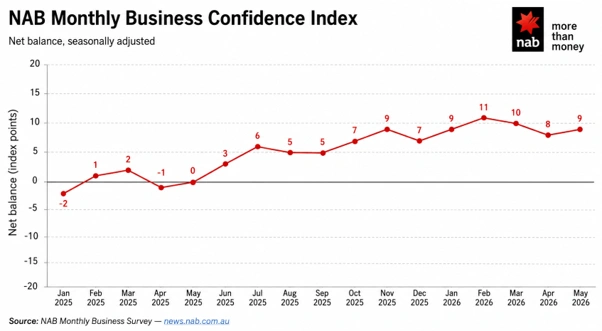
NAB Business Confidence Index readings from January 2025 to May 2026, showing the March 2026 collapse and the partial bounce through May. [NAB]
The CGT Factor: Tax Policy Landing at the Worst Time
NAB CEO Andrew Irvine has not been quiet about the other problem running underneath all of this.
The 2026-27 Budget introduced CGT changes kicking in from 1 July 2027:
- The 50 per cent CGT discount (in place since 1999) gets scrapped
- Replaced with inflation-adjusted indexation and a 30 per cent minimum tax on net capital gains
- Discretionary trusts – widely used by Aussie small and family businesses – face an additional 30 per cent minimum tax on trust income from 1 July 2028
Irvine’s concern is that changes to trust structures and capital gains treatment chip away at the confidence entrepreneurs need to back themselves and invest.
It’s not a hypothetical. Family businesses. Sole traders. Small operators running through a discretionary trust for decades. An abrupt shift adds real uncertainty at a moment when they’re already dealing with higher rates and squeezed margins.
Here’s the timing problem. Australian firms entered 2026 with solid momentum. Conditions averaged above their long-run levels through most of 2025. The oil shock hit businesses that were actually in decent shape.
Now drop a contested tax restructuring on top of that, with transition rules still being negotiated in Parliament, and forward planning gets very difficult very fast.
Why Wages Are the Pressure Nobody’s Talking About Enough
Even before March blew up, NAB’s Q1 2026 quarterly survey called it out. Wage costs were flagged as “the biggest issue affecting business confidence.” The share of firms saying labour was a significant constraint went up in that quarter.
The labour market hasn’t loosened. Unemployment sat at 4.1 per cent through early 2026. That’s still below the level economists consider non-inflationary. The market is too tight.
Labour cost growth through April and May:
- Labour costs: 1.5 to 1.7 per cent in quarterly equivalent terms
- Purchase costs: 4.5 per cent peak in April, easing to 2.6 per cent by May
- Product price growth: slowing to 0.9 per cent – margins tightening
Businesses are caught between costs going up and prices they can’t raise without losing customers.
That creates a problem for the RBA too.
The same tight labour market that’s keeping a recession at bay is blocking the cost relief businesses need to rebuild margins.
Raise rates to cool things down, risk tipping the economy over. Hold rates, keep inflation sticky. Neither answer is clean.
Confidence vs Conditions: The Gap That Matters Most
This distinction doesn’t get enough attention. There’s a real difference between confidence and conditions in the NAB survey.
Business conditions = what’s happening right now. Trading, hiring, profitability.
Business confidence = what firms expect to happen next.
In March, conditions only fell 1 point to +6. Even as confidence collapsed 29 points to -29. In May, conditions held at +3.
The economy didn’t fall off a cliff. Firms still had momentum. They just stopped planning ahead.
When confidence and conditions split like that, specific things happen:
- Capital expenditure gets deferred
- Hiring slows down before it stops
- Forward orders fall – they dropped 6 points in March to -1, erasing all gains from January and February
The lag between a confidence shock and an activity slowdown is typically two to three quarters. That means the full effect of March’s -29 reading might not show up in actual economic activity until late 2026 or early 2027.
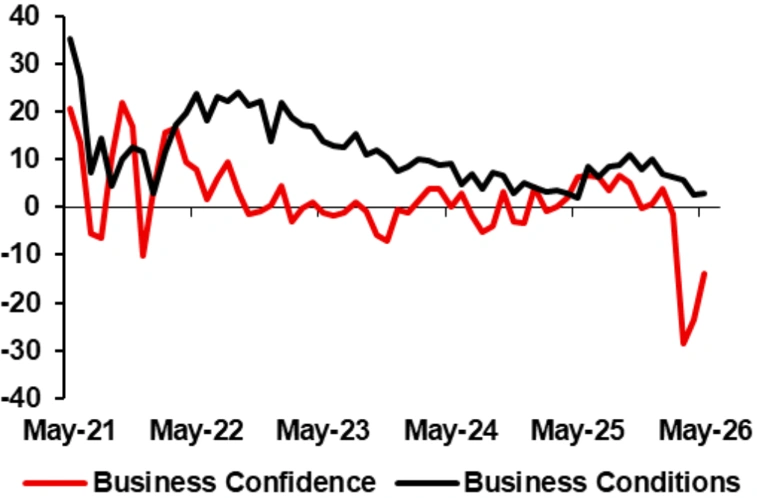
Business Conditions vs Business Confidence divergence chart. [NAB]
Which Sectors Are Feeling It Most
Not every industry is hurting the same way.
Weakest:
- Retail – most negative confidence in the survey
- Transport – direct hit from fuel price surge
- Construction – squeezed by material costs and a pipeline slowing due to higher rates
- Wholesale – weak demand flowing through from cautious consumers
Holding up:
- Mining – benefits from higher energy commodity prices despite the oil shock
- Finance, property, and business services – corporate activity, property transactions, and institutional lending kept conditions positive
Consumer sentiment tracked by Westpac fell 12.5 per cent in April to 80.1 – its lowest in more than two years.
Household spending has slowed but hasn’t crashed. That’s the one saving grace for retail right now.
What a -14 Reading Means for Hiring and Investment
When confidence stays negative for months, it shows up in decisions before it shows up in data.
Hiring: Employment conditions edged up slightly in May but remain below the long-run average. NAB economists have flagged the risk that businesses absorbing costs instead of passing them on will eventually start cutting headcount to protect margins.
Capital expenditure: Capex plans rose in May to +6 index points. On its own, that looks positive. But pair it with forward orders at -2 and you get a different picture. Firms are maintaining existing equipment. They’re not expanding.
Investment decisions: The CGT changes narrow the window for asset sales under the old rules. Before July 2027, some business owners will sell to lock in the current CGT treatment. Others will defer entirely. Neither path pushes new money into productive investment.
For more on the rate environment businesses are navigating, see how the RBA’s rate hike cycle is reshaping household finances and what CBA said about the interest rate trajectory for 2026.
What Happens Next Depends on Two Things
NAB’s own May survey summary described the economy as “muddling through rather than deteriorating sharply.” That’s a generous framing. But it’s accurate.
Two variables will determine whether confidence keeps recovering from -14:
- The Middle East situation. If the Iran-Israel ceasefire holds and fuel supply stabilises, purchase cost pressures ease. That gives the RBA room to stop hiking. Australia imports roughly 80 per cent of its refined fuel. That vulnerability is now fully priced into business sentiment.
- What the RBA does next. Market pricing through mid-2026 suggests the cash rate may be near its peak. But the RBA’s next move is not locked in. If inflation stays sticky, another hike is on the table.
Conditions remain positive. Confidence does not. That gap is the story for the rest of 2026.
Frequently Asked Questions
Q: What is the NAB Business Confidence Index?
A: A monthly survey of around 350 to 900 Aussie businesses. Above zero = net optimism. Below zero = net pessimism.
Q: What caused the March 2026 confidence crash?
A: Three things at once: the Iran-Israel conflict, a global oil price shock, and two consecutive RBA rate hikes that pushed the cash rate to 4.35 per cent.
Q: Has confidence recovered since March 2026?
A: Partially. It went from -29 in March to -23 in April and -14 in May. Still negative across all industries.
Q: What do the 2026 CGT changes mean for small business?
A: From July 2027, the 50 per cent CGT discount is replaced by indexation plus a 30 per cent minimum tax. Trusts face additional tax changes from July 2028.
Q: Which industries are doing worst right now?
A: Retail, transport, construction, and wholesale. Mining is the one sector still showing positive confidence.
Q: What’s the difference between confidence and conditions in the NAB survey?
A: Conditions measure what’s happening now. Confidence measures expectations. Right now, conditions are slightly positive, but confidence is not.
Disclaimer:
This article is for informational purposes only and does not constitute financial advice. Colitco does not hold a financial services licence. Past performance is not indicative of future results. Readers should consult a licensed financial adviser before making any investment decisions.
Source:

Elizabeth Jones is a finance and mining content specialist with over 10 years of experience creating clear, SEO-driven content across fintech, investing, banking, insurance, cryptocurrency, and resource markets. She transforms complex financial data and industry trends into engaging, reader-focused articles that improve understanding and audience engagement.