
HSBC Holdings plc posted a first-quarter pre-tax profit of USD 9.4 billion on 5 May 2026, falling short of the USD 9.59 billion analyst consensus and sliding marginally below the USD 9.5 billion it reported in the same period last year.
The shortfall had two clear culprits: a fraud-related charge inside its UK institutional banking unit and a wave of provisions tied to the Middle East conflict that began on 28 February 2026.
Revenue told a better story. Total revenue climbed 6% year-on-year to USD 18.6 billion, with wealth fees and net interest income doing the heavy lifting across all four of the Group’s divisions.
HSBC Q1 2026: Credit Losses Take Centre Stage
Expected credit losses came in at USD 1.3 billion for the quarter, up USD 400 million from the same period a year ago. Two charges drove the spike:
- USD 400 million linked to a fraud-related secondary securitisation exposure with a financial sponsor in the UK, booked through the Corporate and Institutional Banking division. Reports from Bloomberg and rival bank Barclays’ disclosures suggest the exposure is tied to collapsed UK bridging lender Market Financial Solutions, which entered administration after fraud allegations surfaced.
- USD 300 million in allowances added to reflect heightened economic uncertainty following the outbreak of conflict in the Middle East.
The fraud charge in particular caught markets off guard. HSBC disclosed it holds around USD 3 billion in exposure to securitisation financing structures of this type, which are backed by pools of receivables including mortgages, consumer loans, and auto loans.
Group CEO Georges Elhedery acknowledged the pressure while keeping his tone measured.
“In periods of greater uncertainty, customers turn to us more as their trusted partner to navigate complexity with the financial strength, stability and expertise they know they can rely on,” he said. “We remain confident in achieving the targets we set out in February 2026.”
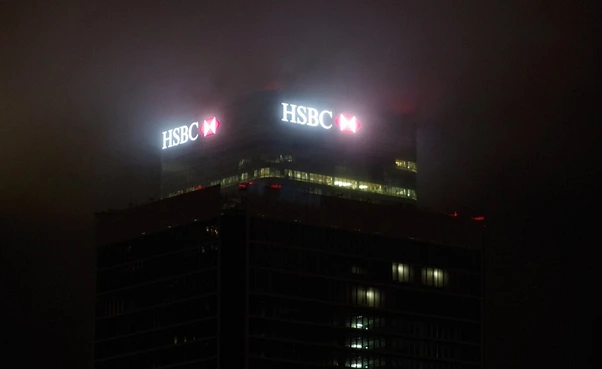 HSBC Holdings plc headquarters in London’s Canary Wharf [Wikipedia]
Middle East Conflict Reshapes the Outlook
HSBC sits at the crossroads of global trade. Its operations span Hong Kong, the Gulf, and across Asia, making it one of the most exposed global banks to the economic ripple effects of the conflict.
The bank’s internal stress testing found that a severe Middle East scenario, including a sharp rise in oil prices, higher inflation, and a material GDP slowdown, could shave a mid-to-high single-digit percentage off profit before tax. That, HSBC warned, could push its return on tangible equity below its 17% target if left unaddressed.
The bank revised its full-year expected credit loss guidance upward, to around 45 basis points of average gross loans, compared to the prior estimate of around 40 basis points.
HSBC is not alone. Standard Chartered booked a USD 190 million credit charge for the same reason. Lloyds Banking Group and Deutsche Bank made similar provisions in the quarter.
Net Interest Income and Wealth Business Pick Up Slack
Banking net interest income rose 6% year-on-year to USD 11.3 billion, supported by deposit growth and higher structural hedge reinvestment yields. HSBC lifted its full-year banking NII guidance to around USD 46 billion, up from the prior guidance of at least USD 45 billion.
Wealth management was a genuine standout. Fee income in the International Wealth and Premier Banking division rose 15% year-on-year. Net new money across the Group hit USD 39 billion in the quarter, with USD 34 billion of that booked in Asia.
All four business divisions delivered annualised returns on tangible equity above 17%, excluding notable items.
Similar to the positive revenue dynamics seen in Bank of America’s Q2 2025 result, HSBC’s top-line growth is proving resilient even as credit costs rise.
Cost Savings on Track, Portfolio Getting Leaner
Operating expenses rose 8% to USD 8.7 billion, driven by inflation, higher technology investment, and the phasing of variable pay.
HSBC says it is on track to deliver USD 1.5 billion in annualised cost savings by the end of June 2026, six months ahead of its original target.
The restructuring continues. HSBC completed the privatisation of Hang Seng Bank in January 2026 and the sale of its UK life insurance business in the quarter.
On 4 May, it announced a binding agreement to sell its retail banking operations in Indonesia, with completion expected in the first half of 2027. Strategic reviews of retail businesses in Australia and Egypt are still underway.
Much like the capital discipline noted in NAB’s Q1 2026 capital update, HSBC’s move to shed non-core retail units reflects a broader global banking trend toward tighter focus and leaner balance sheets.
Dividend Approved, Capital Ratio Slips
The board approved a first interim dividend for 2026 of USD 0.10 per ordinary share, payable on 26 June 2026, to shareholders on record as at 15 May.
The Common Equity Tier 1 capital ratio fell to 14.0% at 31 March 2026, down from 14.9% at year-end 2025. The Hang Seng Bank privatisation and dividend payments drove the decline, partly offset by the quarter’s regulatory profit.
The Group retained its return on tangible equity target of 17% or better through 2026, 2027, and 2028, excluding notable items.
HSBC Q1 2026 Key Financial Metrics
| Metric | Q1 2026 | Q1 2025 | Change |
| Pre-tax profit | USD 9.4bn | USD 9.5bn | -1% |
| Revenue | USD 18.6bn | USD 17.6bn | +6% |
| Revenue excl. notable items | USD 19.1bn | USD 18.4bn | +4% |
| Expected credit losses | USD 1.3bn | USD 0.9bn | +49% |
| Banking NII | USD 11.3bn | USD 10.6bn | +6% |
| RoTE excl. notable items | 18.7% | 18.4% | +0.3ppts |
| CET1 ratio | 14.0% | 14.7% | -0.7ppts |
Source: HSBC Holdings plc 1Q26 Earnings Release
Also Read: The Lottery Corp Locks in Victorian Lottery Licence Extension to 2068
FAQs
Q: What was HSBC’s profit in Q1 2026?
A: HSBC reported a pre-tax profit of USD 9.4 billion for the first quarter of 2026, slightly below the USD 9.5 billion posted in Q1 2025 and short of the analyst consensus of USD 9.59 billion.
Q: Why did HSBC’s credit losses increase in Q1 2026?
A: Expected credit losses rose 49% year-on-year to USD 1.3 billion. The two main factors were a USD 400 million fraud-related charge linked to a UK securitisation exposure and USD 300 million in provisions reflecting the economic uncertainty from the Middle East conflict.
Q: What is HSBC’s dividend for Q1 2026?
A: The HSBC board approved a first interim dividend of USD 0.10 per ordinary share for 2026, payable on 26 June 2026.
Q: Has HSBC updated its 2026 earnings guidance?
A: Yes. HSBC raised its full-year banking net interest income guidance to around USD 46 billion and revised its expected credit loss guidance upward to approximately 45 basis points of average gross loans.
Q: What happened to HSBC’s CET1 capital ratio?
A: The Common Equity Tier 1 ratio declined to 14.0% at 31 March 2026 from 14.9% at 31 December 2025, primarily reflecting the Hang Seng Bank privatisation and dividend payments.
Disclaimer: This article is general in nature and does not constitute financial advice. Please consult a qualified financial adviser before making any investment decisions.
Source: https://www.hsbc.com/investors/results-and-announcements