Askari Metals Limited (ASX: AS2) (“Askari” or “the Company”) has delivered significant updates that reinforce its position as an emerging player in the global critical minerals space. The Company continues to unlock significant value at its 100%-owned Uis Polymetallic Project in Namibia, where recent trenching campaigns have confirmed extensive, high-grade polymetallic mineralisation across multiple pegmatite targets.
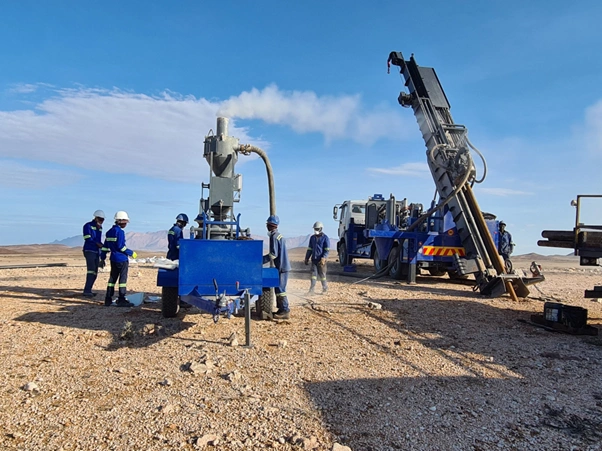
Figure 1: Drill rig in operation in the Uis Polymetallic Project [Source: Askari Metals]
The Company is exploring important future-focused minerals like lithium, tin, tantalum, rubidium, and caesium. It is now moving closer to its next big step: defining a resource and starting drilling, while working in one of Africa’s well-established mining regions.
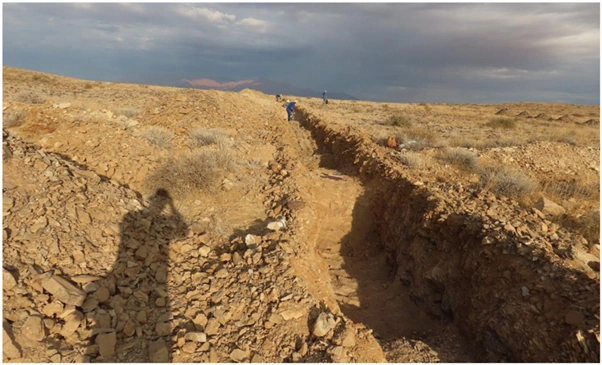
Figure 2: This is an example of the trenching finished at the OP target in the Uis Polymetallic Project in Namibia. Trenches are excavated using machinery (Figure 1) until bedrock is reached, then cleaned and mapped by geologists to record the exposed geology. [Askari Metals]
Strategic Location in a Proven Mining District
The Uis Project sits adjacent to the operating Uis Tin Mine, owned by Andrada Mining Limited, which hosts a substantial JORC (2012) Mineral Resource Estimate of 77.51 Mt. This proximity places the Company in a highly strategic position within a proven mineral-rich corridor.
According to Askari Metals’ Executive Director, Mr Gino D’Anna:
“Strategically positioned, the Uis Project lies contiguous with and directly along strike of the operating Uis Tin Mine, which is owned by Andrada Mining Limited (LOM: ATM). Despite sharing the same geology as the nearby Uis Tin Mine, the potential of the Uis Project to host significant tin and tantalum mineralisation was never a focus in previous exploration or analysis.”
Moreover, the project benefits from excellent infrastructure. It lies less than 230 kilometres from the Walvis Bay Deepwater Port, connected via sealed roads. This logistical advantage significantly enhances the project’s long-term development potential and reduces future capital hurdles.
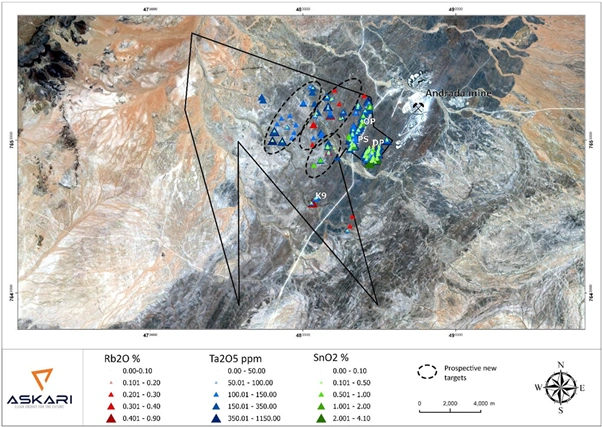
Figure 3: Map highlighting the interpreted prospective corridor within EPL 7345, along with pegmatite targets (DP, OP, PS, and K9) identified and trenched during the Phase 1 Trenching program. [Source: Askari Metals]
Strong Trenching Results Confirm High-Grade Mineralisation
The Company’s Phase 1 trenching programs across the OP and DP pegmatite targets have delivered strong and consistent results, reinforcing the scale and quality of mineralisation at the Uis Project. These outcomes not only validate historical exploration but also significantly strengthen confidence in the continuity of the mineralised system ahead of planned drilling.
High-Grade Polymetallic Results Confirm Scale at OP Target
At the OP Pegmatite Target, systematic trenching completed on approximately 40-metre spacing has defined a large, continuous polymetallic system extending over 2.2 kilometres. Within this broader corridor, the main pegmatite zone spans around 1.2 kilometres, with widths typically ranging between 15 metres and 30 metres before branching into multiple dykes.
Importantly, previous fieldwork at the OP target, where pegmatites reach up to 30 metres in width and extend for more than 2 kilometres along strike, had already identified high-grade mineralisation.
Key results from the latest OP trenching include:
- 8,340 ppm Tin (Sn)
- 57% Lithium Oxide (Li₂O)
- 299 ppm Tantalum (Ta)
- 2,380 ppm Rubidium (Rb)
- 354 ppm Caesium (Cs)
These results demonstrate the polymetallic nature of the system, with meaningful concentrations across multiple critical minerals.
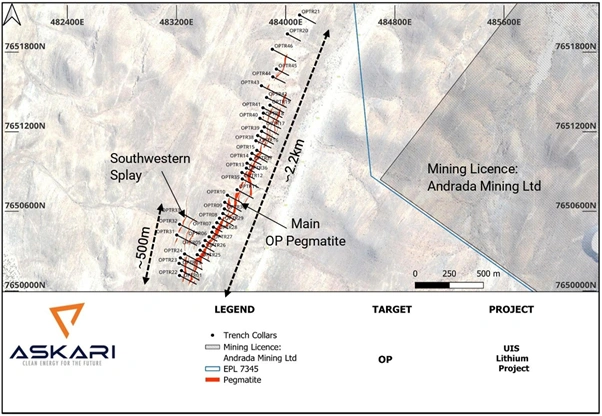
Figure 4: Map illustrating the OP trenches, pegmatites, and the spatial distribution of their surface outcrops. [Source: Askari Metals]
In response to the assay results from the Phase 1 trenching program at the OP Target, Executive Director Mr Gino D’Anna commented:
“Phase I trenching was completed at the OP Pegmatite Target at 40m spacing along its strike length, confirming continuous mineralisation of lithium, tin, tantalum and rubidium. […] We are encouraged by the findings and are actively planning for a follow-on drill program to build on the success of both the recently completed trenching and previously completed reconnaissance drilling.”
Strong Trenching Results Highlight Scale and Grade at DP Pegmatite Target
Meanwhile, the DP Pegmatite Target has also delivered highly encouraging results, further reinforcing the broader polymetallic potential of the Uis Project. Systematic trenching has been completed across ten pegmatites on approximately 40-metre spacing, generating a robust and high-quality dataset to support both drill targeting and future resource definition.
The main DP pegmatite extends for approximately 700 metres along strike, with an average surface thickness of around 6 metres. While narrower than the OP system, the DP target still demonstrates meaningful scale, particularly given the presence of multiple pegmatites across the region.
Key results from DP trenching include:
- 3,360 ppm Tin (Sn)
- 25% Lithium Oxide (Li₂O)
- 364 ppm Tantalum (Ta)
- 3,370 ppm Rubidium (Rb)
- 587 ppm Caesium (Cs)
These results confirm the presence of a strongly mineralised polymetallic system, with elevated grades across several critical minerals. Notably, the lithium grades at DP are particularly compelling, complementing the broader multi-commodity profile of the project.
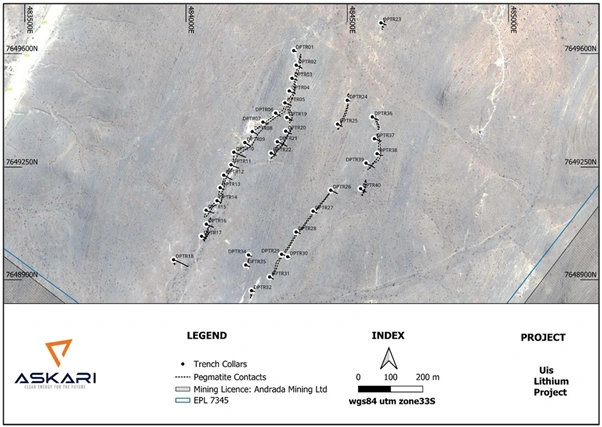
Figure 5: Map illustrating the Phase 1 DP trenching completed across EPL 7345. [Source: Askari Metals]
Previous fieldwork at the DP target had already identified high-grade mineralisation, with recorded values of up to 0.89% SnO₂, 635ppm Ta₂O₅, and 0.29% Rb₂O. On the other hand, nearby pegmatites returned even higher grades, reaching up to 4.05% SnO₂, 1,121ppm Ta₂O₅, and 0.44% Rb₂O.
Regarding the positive DP trenching outcomes, Mr Gino D’Anna has stated:
“These results materially strengthen our confidence in the scale and quality of the mineralised system at Uis and provide a clear technical foundation for drill targeting. With RC drilling scheduled to commence in Q2 2026, we are now moving rapidly toward the next major value inflection point for the project.”
Systematic Exploration Driving Resource Definition
The Company has adopted a systematic approach to exploration, completing trenching on approximately 40-metre spacing across both OP and DP targets. This method has generated a high-quality dataset that will underpin future drilling campaigns and resource estimation.
Historical Drilling Supports High-Grade Potential
The Company’s confidence in the Uis Project is further supported by historic reverse circulation (RC) drilling, which has already demonstrated high-grade intercepts.
Notable historical results include:
- 4 metres @ 0.16% SnO₂ (including 1 metre @ 0.26%)
- 4 metres @ 314 ppm Ta₂O₅ (including 1 metre @ 695 ppm)
- 2 metres @ 0.30% Rb (including 1 metre @ 0.38%)
These results align strongly with current trenching outcomes, reinforcing the project’s high-grade potential and supporting the case for expanded drilling programs.
Clear Pathway to Upcoming Drilling Catalyst
The Company is now preparing for its next major phase, reverse circulation drilling, scheduled for 2026. This program aims to define subsurface continuity, validate surface results, and ultimately contribute toward a maiden resource.
The OP and DP targets will form the core focus areas, given their demonstrated scale and grade. With robust groundwork already completed, the upcoming drilling campaign represents a significant value catalyst.
Exposure to Critical Minerals Driving Global Demand
The Uis Project offers diversified exposure to several critical minerals essential for modern technologies and the global energy transition.
- Lithium – a cornerstone of battery storage and electric vehicles
- Tin – widely used in electronics and soldering applications
- Tantalum – critical for capacitors and high-performance electronics
- Rubidium and Caesium – niche but increasingly important in advanced technologies
This multi-commodity profile reduces reliance on a single market while positioning the Company to benefit from multiple demand drivers.
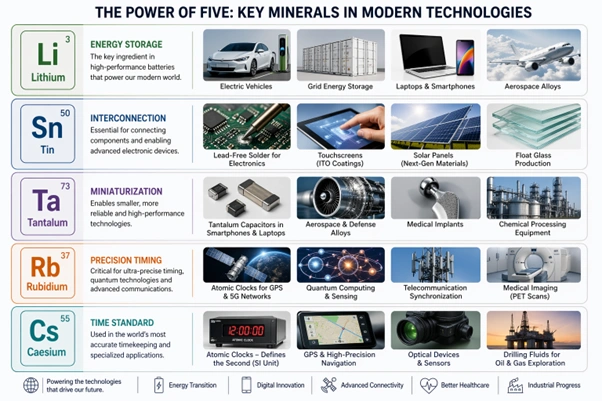
Figure 6: A visual infographic showing the uses of lithium, tin, tantalum, rubidium, and caesium in modern technologies.
Strong Positioning Within a Tier-One Jurisdiction
Namibia continues to attract global attention as a mining-friendly jurisdiction with stable governance, established infrastructure, and a growing focus on critical minerals.
By operating within this environment, and adjacent to an active mining operation, the Company significantly de-risks its exploration strategy while maintaining exposure to high-impact discoveries.
Share Price Activity (ASX)
- Last Price: $0.009
- 1-Year Performance: +28.16%
- vs ASX 200 (1yr): +17.14%
- Market Capitalisation: $6,933,544
Askari Metals’ stock has outperformed the broader ASX 200 over the past year, reflecting growing investor interest and confidence in its exploration progress and strategic positioning.
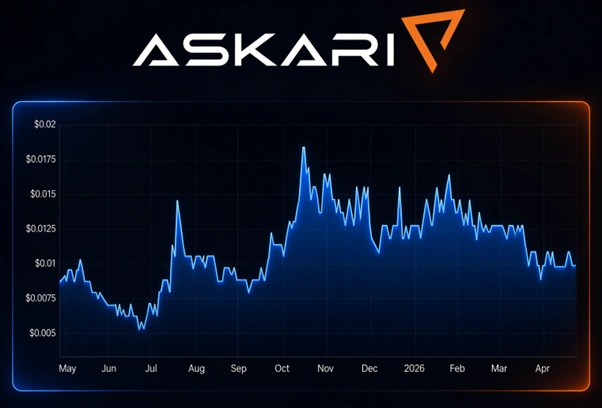
Figure 7: Askari Metals Limited (ASX: AS2) share price performance in the last 12 months
Investors’ Outlook
Askari Metals Limited is steadily transitioning from early-stage exploration toward resource definition, supported by strong technical results and a clear development roadmap.
The confirmation of high-grade polymetallic mineralisation across multiple targets at the Uis Project significantly enhances the Company’s growth profile. Drilling is set to start in 2026, and more assay results are expected soon, giving the Company several near-term catalysts.
Its exposure to a diversified suite of critical minerals, combined with a strategic location in a proven mining district, positions the Company well to capitalise on long-term global demand trends.
For investors seeking leveraged exposure to the critical minerals sector at an early stage, the Company presents a compelling opportunity backed by tangible exploration success and a clear path forward
Disclaimer: This article is for informational purposes only and does not constitute financial product advice, investment advice, or a recommendation to buy or sell any securities. Readers should conduct their own due diligence and consult a licensed financial adviser before making any investment decisions. The information presented is based on publicly available data and company announcements, which may be subject to change.