Askari Metals Limited (ASX: AS2) released its latest exploration update on 10 June 2026, reporting the results of the first systematic trenching campaign ever completed at the K9 Pegmatite Target on Exclusive Prospecting Licence (EPL) 7345 in Namibia’s Erongo Region.
The results confirm that K9 is a large, continuous polymetallic system. The mineralisation covers approximately 950 metres of strike length. That means the ore runs along the surface for nearly a kilometre in a single direction, remaining open in either direction under cover.
The K9 target had never previously been sampled or drill-tested. The Phase 1 trenching program is therefore the first real look at what lies beneath this part of the Project. And the initial picture is a compelling one.
What Happened: Phase 1 Trenching at the K9 Pegmatite Target
A pegmatite is a type of coarse-grained igneous rock that often hosts economic concentrations of metals. At Uis, the pegmatites carry Tin, Lithium, Tantalum, Rubidium and Caesium, five separate commodities within a single rock system.
Phase 1 of the trenching program was designed to test four high-priority pegmatite targets on EPL 7345: OP, PS, DP and K9. Altogether, the Company completed:
- 135 trenches totalling 7,269 metres
- 2,098 channel samples generated across all four targets
- 38 trenches and 781.7 metres completed specifically at K9
- 199 channel samples taken at K9, ranging from 0.3m to 1.9m in length
Trenches were dug on a systematic 40-metre spacing. A channel, a narrow cut in the rock, was then sampled across the width of each pegmatite to collect material for laboratory testing. Samples were sent to Activation Laboratories Ltd (Actlabs) in Canada for multi-element analysis.
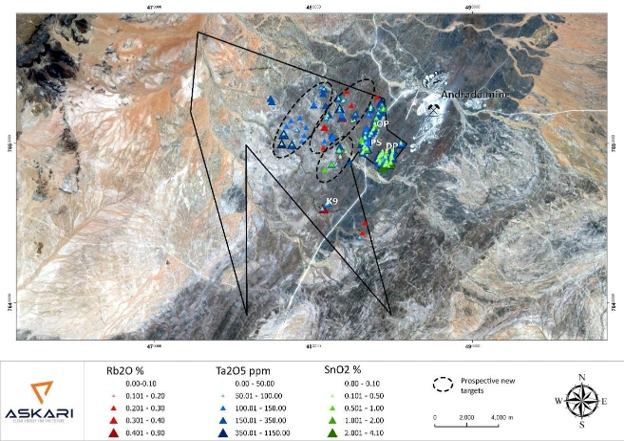
Figure 1: Map showing the interpreted corridor of interest on EPL 7345, along with pegmatite targets DP, OP, PS and K9 trenched in the Phase 1 programme. [Source: Askari Metals Limited, ASX Release, 10 June 2026]
What the K9 Trenching Found: Standout Assay Results
The assay results from K9 confirmed polymetallic mineralisation across all five target commodities. The table below summarises the headline numbers from the announcement.
| K9 Phase 1 Trenching — Headline Results | |
|---|---|
| Tin (Sn) | 4,050 ppm |
| Lithium Oxide (Li₂O) | 0.29% |
| Tantalum (Ta) | 215 ppm |
| Rubidium (Rb) | 2,380 ppm |
| Caesium (Cs) | 479 ppm |
| Strike Length Confirmed | 950m |
Table 1: Headline results from Phase 1 trenching at the K9 Pegmatite Target, Uis Project, Namibia. [Source: Askari Metals Limited, ASX Release, 10 June 2026]
Tin Results
Tin is K9’s most consistent commodity. Results exceeded the 0.05% Sn cut-off grade, the same cut-off used at the adjacent Uis Tin Mine, across most of the 950-metre strike length.
Standout tin intercepts include:
- 0.8m @ 4,050 ppm Sn from 11m in trench K9TR31
- 1m @ 3,030 ppm Sn from 3m in trench K9TR27
- 1m @ 2,280 ppm Sn from 22m in trench K9TR15
- 2.60m @ 1,298 ppm Sn from 19.60m in trench K9TR25
- 3m @ 1,406 ppm Sn from 7.50m in trench K9TR32
These grades compare well with the neighbouring Uis Tin Mine, operated by Andrada Mining, which reports an average grade of 0.15% Sn at its V1/V2 deposit.
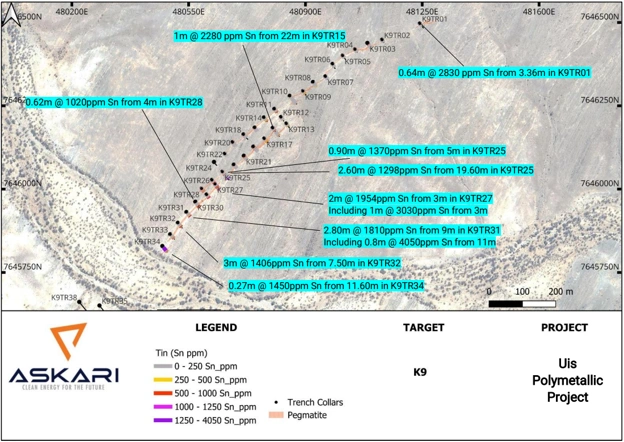
Figure 2: Tin (Sn ppm) mineralisation intercepts from Phase 1 K9 trenches, highlighting high-grade tin exceeding 0.1% Sn. [Source: Askari Metals Limited, ASX Release, 10 June 2026]
Lithium Results
Lithium assays from K9 returned results in the 0.25% to 0.29% Li₂O range. These come from surface-level, weathered rock. Lithium grades at surface can be suppressed by weathering.
The K9 pegmatites show clear evidence of spodumene, a lithium-bearing mineral, weathering to albite and mica near the surface. This process typically lowers measurable lithium grades in the top layer of rock. The Company believes fresh rock below the surface could yield higher lithium values once drilled.
Best lithium intercepts from trenching:
- 0.82m @ 0.29% Li₂O from 6.68m in K9TR21
- 1.10m @ 0.29% Li₂O from 2.80m in K9TR29
- 0.50m @ 0.26% Li₂O from 4.50m in K9TR25
Tantalum Results
Tantalum returned the most consistent results of all five metals. Intercepts exceeded 80 ppm Ta, the comparable cut-off at the adjacent Uis Tin Mine, across the full 950-metre strike length.
Peak tantalum was 215 ppm Ta, from trench K9TR15. For reference, the Uis Tin Mine reports average resource grades of 90 ppm Ta (Measured), 86 ppm Ta (Indicated) and 73 ppm Ta (Inferred). K9’s surface results are therefore broadly in line with those resource grades.
Rubidium Results
Rubidium is a rare metal used in biomedical research, electronics, defence, and pyrotechnics. According to the US Geological Survey, there was no published global production of rubidium in 2024, though some is believed to have been produced in China. Rubidium is classified as a critical mineral by the United States, Japan and New Zealand.
K9 trenching defined rubidium zones averaging around 0.1% Rb₂O with peak results up to 0.23% Rb₂O. These grades are comparable to those at the Mt Edon Critical Mineral Project in Western Australia, where Everest Metals Corporation (ASX: EMC) hosts an inferred resource of 3.6 million tonnes at 0.22% Rb₂O.
Best rubidium intercepts:
- 3.26m @ 0.18% Rb₂O from 20.73m in K9TR15 (including 2m @ 0.23% Rb₂O from 22m)
- 2.80m @ 0.17% Rb₂O from 5m in K9TR27
- 2m @ 0.15% Rb₂O from 10m in K9TR30
Caesium Results
Caesium is used in drilling fluids, electronics, optics, and medical applications. It is also integral to emerging technologies including quantum computing and perovskite solar cells.
K9 returned caesium concentrations from 100 ppm to 479 ppm Cs. The Company acknowledges these values are below the globally accepted cut-off of 1% Cs₂O.
However, it attributes this to surface weathering. The Cape Cross-Uis pegmatites, which include K9, weather near the surface in a way that leaches caesium-rich minerals like pollucite, reducing the measured surface grade. Fresh rock drilling in H2 2026 is expected to return higher caesium values.
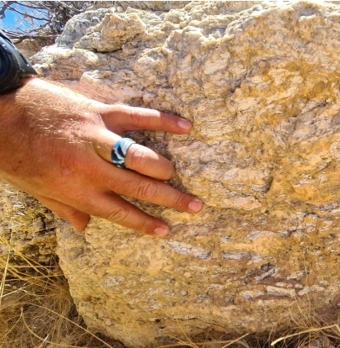
Figure 3: Pegmatite outcrop at the K9 Target exhibiting weathered spodumene mineralisation. Visual estimates are not a proxy for laboratory results. [Source: Askari Metals Limited, ASX Release, 10 June 2026]
Why It Matters: K9’s Position in the Uis District
The K9 target sits directly along strike from the B1 and C1 pegmatite targets on the adjacent mining lease ML129. Those targets were previously held by Andrada Mining Ltd (now the Uis Small Miners Association).
Prior drilling at B1 and C1 by Andrada in 2023 returned high-grade lithium results. Drill hole B1_01 intersected 14.52 metres at 1.38% Li₂O, 285 ppm tantalum and 0.131% tin from 15.48 metres. Higher-grade zones within that included 5 metres at 2.32% Li₂O from 18 metres.
K9’s surface results now place it within the same fertile pegmatite trend that produced those results. This alignment provides a geological reference point, or analogue, that supports the case for a meaningful system at K9 once drilled.
The Company has also defined a high-priority ‘corridor of interest’ on EPL 7345 approximately 15 kilometres long and 5 kilometres wide. K9 sits within that corridor, and chemical data confirms it is prospective for lithium-tin-tantalum mineralisation.
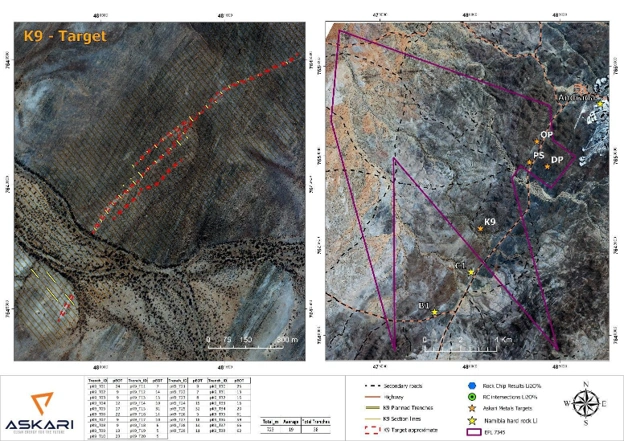
Figure 4: Map of the K9 pegmatite target including the location of trench lines completed in Phase 1. [Source: Askari Metals Limited, ASX Release, 10 June 2026]
What the Company Said: Executive Director’s Comment
“K9 is shaping up as a standout polymetallic discovery at Uis. Phase I trenching has confirmed broad, continuous mineralisation over a 950m strike, with standout results including up to 4,050 ppm tin, 0.29% Li₂O, 215 ppm tantalum, 2,380 ppm rubidium and 479 ppm caesium. These results materially de-risk drilling and strengthen our conviction that K9 sits within a fertile, high-quality mineralised corridor with the scale and commodity mix to capture strong investor attention. With drilling planned for H2 2026 and more results still to come, we see strong potential for continued newsflow as we unlock the broader upside at Uis. In a strong tin and critical minerals market, we believe Uis is increasingly well positioned to deliver meaningful value as exploration momentum builds.”
— Gino D’Anna, Executive Director, Askari Metals Limited
What Comes Next: RC Drilling Planned for H2 2026
With Phase 1 trenching complete, the Company is now advancing plans for reverse circulation (RC) drilling at K9. RC drilling is a method that uses a rotating drill bit to extract rock chips from depth, providing a much clearer picture of the mineralisation than surface sampling alone.
The drilling program has been designed using wireframe models built from the trench data. K9 is interpreted as an inclined pegmatite body, meaning it dips into the earth at an angle, and drill holes have been planned to test the system both along strike and at depth.
Beyond K9, the Company’s broader work program for EPL 7345 includes:
- Second phase of infill soil sampling on EPL 7626
- First phase trenching programs on EPL 7626 and EPL 8535
- Second phase trenching on EPL 7345
- Detailed mapping and rock chip sampling of new targets on EPL 7345
- RC drilling at the DP, OP, PS and K9 targets
The Company also confirmed that surface exposure likely represents only part of the K9 opportunity. Pegmatite thickness and strike can vary both along strike and at depth. Planned drilling is therefore the critical next step in establishing K9’s true scale.
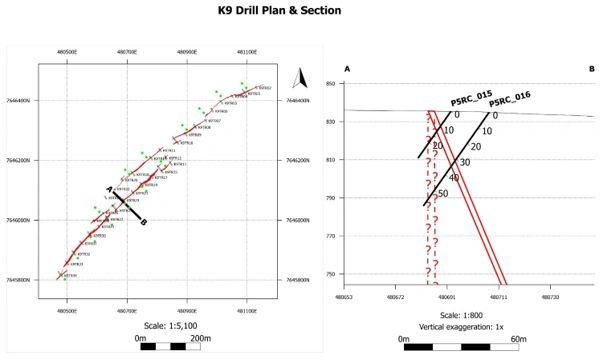
Figure 5: K9 Drill Plan and Section View, showing planned RC holes and modelled pegmatite wireframes using trench intercepts. [Source: Askari Metals Limited, ASX Release, 10 June 2026]
Industry Context: Why These Commodities Matter Right Now
Tin
Tin is one of the few metals with growing demand across both legacy and new-economy applications. It is used in soldering, electronics packaging, lithium-ion battery anodes and as a lead-substitute in food-safe coatings. Supply is concentrated, with China, Indonesia and Myanmar accounting for the majority of global output.
The Democratic Republic of Congo dominates artisanal tin production, raising persistent supply chain concerns. Projects in stable, regulated jurisdictions like Namibia are well placed to attract attention from downstream buyers seeking traceable supply.
Tantalum
The tantalum market is growing steadily. According to Mordor Intelligence, the global market is forecast to expand from 3 kilotons in 2025 to 4.02 kilotons by 2031, representing a compound annual growth rate of approximately 4.99%.
Tantalum’s primary use is in capacitors, components found in virtually every smartphone, laptop and automotive electronic system. It is also used in aerospace superalloys and surgical implants. The Democratic Republic of Congo supplies over 70% of global tantalum ore, according to the European Commission. Diversification of supply is a stated strategic priority across both the US and EU.
Rubidium and Caesium
Rubidium and caesium are among the least widely produced metals in the world. The US Geological Survey reported no published global production of rubidium in 2024. Both metals are listed as critical by the United States.
Demand for rubidium and caesium is expected to grow alongside advances in quantum computing, precision timing, and next-generation solar technology. Projects hosting these metals in association with other commercially viable commodities, like K9, have an obvious appeal for investors tracking the critical minerals theme.
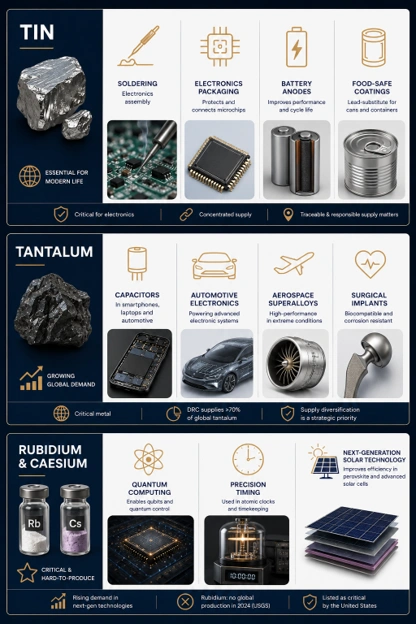
Figure 6: Use cases of Tin, Tantalum, Rubidium, and Caesium.
About the Uis Project
The Uis Project sits within the Cape Cross-Uis Pegmatite Belt in the Erongo Region of west-central Namibia. The Company holds three Exclusive Prospecting Licences covering approximately 380 square kilometres.
The Project lies less than 5 kilometres from the township of Uis and less than 2.5 kilometres from the operating Uis Tin-Tantalum-Lithium Mine, held by Andrada Mining plc (LSE: ATM). The neighbouring mine hosts a JORC (2012) Mineral Resource Estimate of 77.51 million tonnes at 0.79% Li₂O, 0.15% Sn and 82 ppm Ta — a benchmark that underlines the fertility of the broader mineralised corridor.
The Uis Project is accessible by sealed road and lies approximately 165 kilometres from Swakopmund, the regional capital. The Walvis Bay Deepwater Port, which provides export infrastructure for bulk minerals, is reachable via sealed road from site.
Investor’s Outlook
As at 10 June 2026, Askari Metals Limited (ASX: AS2) shares are trading at approximately A$ 0.007 per share, based on the most recent available market data.
| ASX: AS2 — Share Price Snapshot (10 June 2026) | |||
|---|---|---|---|
| Metric | Value | Metric | Value |
| Last Price | A$0.007 | Market Cap | ~A$6.25 million |
| 52-Week High | A$0.019 | 52-Week Low | A$0.005 |
| Shares on Issue | ~780 million | Exchange | ASX |
Key Upcoming Catalysts
- RC drilling at K9 – planned for H2 2026; first subsurface test of the pegmatite system
- Phase 2 trenching on EPL 7345 – additional surface sampling to extend the corridor
- First phase trenching on EPL 7626 and EPL 8535 – new ground yet to be systematically tested
- Further assay results – additional trenching data still to be reported from the Phase 1 program
- Potential resource definition drilling – if RC results support it, maiden resource estimation could follow
Final Note
K9 was never previously sampled or drill-tested before this program. The Phase 1 trenching dataset, 38 trenches, 199 channel samples, 950 metres of confirmed mineralised strike, now forms the foundation for planned RC drilling in the second half of 2026.
What happens when drilling tests the system at depth will be the next significant data point for investors watching Askari Metals’ Uis Project.
FINANCIAL DISCLAIMER
This article has been prepared by Colitco in collaboration with Askari Metals Limited (ASX: AS2) as part of a commercial content and investor communications arrangement. Colitco may receive compensation for the production and distribution of this content. This article is intended for informational purposes only and does not constitute financial product advice, investment advice, or a recommendation to buy or sell any securities. The content reflects information available at the time of publication and may not be updated. All figures, data and statements have been sourced from Askari Metals’ official ASX announcements and publicly available sources. Readers should conduct their own independent research and seek professional financial advice before making any investment decisions. Past performance is not a reliable indicator of future results. Exploration results are not a guarantee of future resource definition or commercial production.

Luke Carlino is a seasoned Copywriter, Content Strategist, and Social Media Manager specialising in Mining, Finance, and Business journalism. With more than a decade of industry experience, he brings rigorous editorial standards and commercial acuity to every project.