
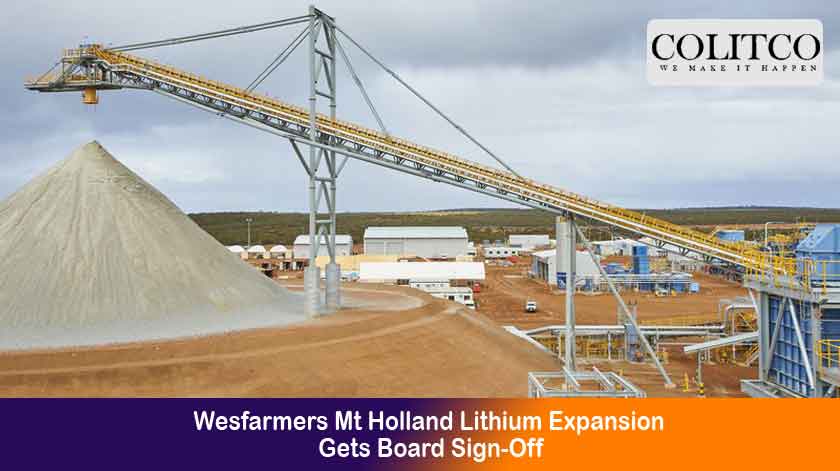
Expansion of the lithium production at Wesfarmers’ Mt Holland has been given approval on 22 July 2026, but the real figures are quite different than those stated in headlines.
Wesfarmers (ASX: WES), alongside its Chilean counterpart SQM, will boost its annual nameplate capacity of production of spodumene concentrate from the mine by approximately 380,000 tonnes per annum to 760,000 tonnes per annum on a 100 per cent basis.
The company forecasts that the capital expenditure required for such an operation will be in the range of A$645 million to A$715 million.
Double this sum and you get a well-known A$1.4 billion cost. Wesfarmers itself never printed that number. Its release only discloses its own half.
The work covers the mine, a second concentrator and a new ore sorting plant. Covalent Lithium, the 50-50 joint venture, finished the definitive feasibility study behind it.
Construction of the second concentrator starts in the second half of calendar 2027. First concentrate from the expansion is not expected until the first half of 2030.
The Money Is Going Into The Pit, Not The Refinery
Here is the part most coverage skated past.
The Kwinana lithium hydroxide refinery by Covalent Lithium processes up to 50,000 tonnes of lithium a year. It is unable to digest another 380,000 tonnes of spodumene concentrate.
So the extra rock gets sold as concentrate, mostly to refiners in Asia. Wesfarmers says the expansion gives it “optionality” to feed a future Kwinana expansion, which is a polite way of saying no such expansion has been approved.
Read plainly, that is a company backing its orebody rather than its chemical plant. Five years ago the whole pitch for Mt Holland was value-added processing on Australian soil.
Kwinana produced its first hydroxide in July 2025. The ramp-up was then stretched out while engineers fixed intermittent odour problems, with that work due to wrap by the middle of this year.
Nobody at Wesfarmers is saying the downstream dream is dead. Nobody is spending fresh money on it either.
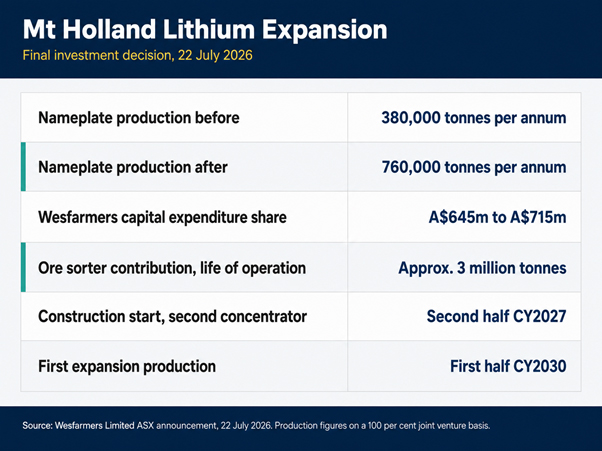
Key figures from the Mt Holland expansion final investment decision announced on 22 July 2026.
The Ore Sorter Is The Sleeper In This Deal
Buried three paragraphs into the release is the detail worth circling.
The new ore sorting facility will recover stockpiled material that Covalent currently cannot process. That adds roughly three million tonnes of spodumene concentrate across the life of the operation.
Those are tonnes already mined. Already hauled. Already sitting on the surface with the drilling and blasting cost sunk years ago.
At any sensible price assumption, that stockpile is the cheapest lithium in the entire plan. It also explains the confidence around lower unit costs better than the second concentrator does.
Wesfarmers Lithium Project FID Timing Says Everything
Consider what the calendar is telling shareholders.
Spodumene has run hard. Lithium prices reached about US$2,890 per tonne in May 2026, following the doubling of lithium carbonate prices in the March quarter, and Fastmarkets increased its 2026 lithium carbonate price forecast to US$23.80 per kilogram from US$17.40.
Wesfarmers is not selling into that. The Wesfarmers lithium project FID delivers first tonnes in 2030, four years out.
That is the difference between a trader and a balance sheet. Bunnings and Kmart pay for this, so the group can commit capital across a cycle instead of chasing a spot price.
Compare the peer group. Mineral Resources’ Bald Hill and Rio Tinto’s Mt Cattlin have sat idle, Core Lithium’s Finniss remains in restart-ready limbo, and PLS only started weighing up a Ngungaju restart in January.
Everyone else spent two years shrinking. Wesfarmers spent them building a refinery and is now doubling the mine.
What A$715 Million Buys A Company Earning A$6 Million
The scale mismatch is stark.
In the six months to 31 December 2025, Wesfarmers’ lithium business contributed A$6 million in earnings to the group, including its share of Covalent’s corporate and overhead costs. Its share of spodumene production was 98,000 tonnes.
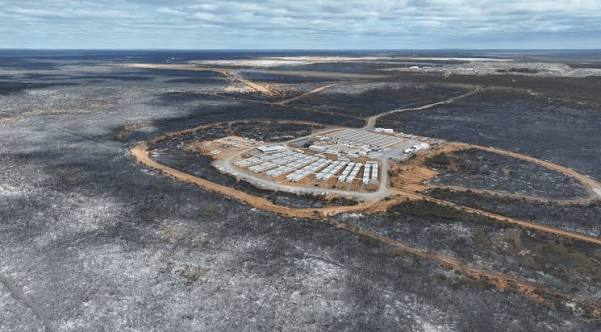
The Mt Holland operation sits about 400 kilometres east of Perth. [Covalent Lithium]
Six million dollars. Against a cheque of up to A$715 million.
That gap is the honest read on where Mt Holland sits today. It is a start-up inside a A$100 billion retailer, funded from existing cash and debt facilities rather than fresh equity.
Managing Director Rob Scott framed it around the cost curve, saying the expansion “improves its position on the cost curve” and would enhance resilience through commodity price cycles.
Resilience is the word doing the work there. Not growth.
For readers tracking the sector, our coverage of why lithium prices are rising in 2026 sets out the deficit maths behind the current rally, while Wood Mackenzie’s revised demand forecast explains why 2028 keeps appearing as the pinch point.
The danger is on the other side of that equation. 380,000 tonnes per year added in one WA operation means it is actual supply, and if all those idle Australian plants turn on at the same time, 2030 might look like 2024.
Investors evaluating their risk here can gauge institutional sentiment through Pilbara Minerals’ performance during the bear market and the positioning of the ASX critical mineral stocks versus the major companies.
Wesfarmers will be reporting its full year results in August 2026. That briefing, not this announcement, is where the return assumptions get tested.
Also Read: Origin Energy Data Breach: What the Filing Won’t Say
FAQs
Q: Who owns Mt Holland?
A: Wesfarmers and SQM, 50-50, through Covalent Lithium.
Q: What is Wesfarmers paying?
A: Between A$645 million and A$715 million, its share only.
Q: When does the extra output start?
A: First half of calendar 2030.
Q: Is the Kwinana refinery being expanded?
A: No. The extra concentrate will be sold to third-party refiners.
Q: Where is Mt Holland?
A: Near Southern Cross, about 400 kilometres east of Perth.
Disclaimer: This content is for general information and education only. It does not constitute financial, investment or trading advice, and does not take account of any individual’s objectives, financial situation or needs. Investing in listed securities carries risk, including loss of capital. Readers should conduct their own research and seek advice from a licensed financial adviser before making any investment decision. Colitco holds no position in the securities mentioned.
Source: https://wesfarmers.gcs-web.com/static-files/e2b55ac2-0479-4726-a1d9-0d982b269a8b/?auth_token=f77014b8-a01a-4d5c-a2cb-28689c3d3c5d

Luke Carlino is a seasoned Copywriter, Content Strategist, and Social Media Manager specialising in Mining, Finance, and Business journalism. With more than a decade of industry experience, he brings rigorous editorial standards and commercial acuity to every project.