The case for putting money into Australian shares has never depended on the market being calm.
It has depended on the market being relentless.
Since it started, the S&P/ASX 200 has returned about 8.27% a year if you include dividends. Without them, the return is closer to 3.92%.
That is not a number produced by picking the right sector at the right time. That is what patient, consistent exposure to the ASX has delivered.
For most Australians, that fact alone is enough to build a strategy around.
The ASX’s Real Edge: Franking Credits No Other Market Offers
There is something about the Australian market that does not get nearly enough attention when outsiders talk about equity markets.
Franking credits.
When ASX-listed companies pay dividends, those dividends often come already taxed at the corporate rate. Eligible Australian investors can claim that tax back. ETFs providing exposure to ASX-listed companies pass those credits through directly to investors.
This creates a meaningful after-tax advantage, particularly for investors in lower and middle tax brackets.
It is not available on Wall Street. Not in London. Not on any other major exchange in the world.
The BetaShares Australia 200 ETF (A200) offers strong quarterly distributions with franking credits typically ranging between 70% and 85% of the dividend payment.
On a meaningful portfolio, that adds up to real money. Money that most other global investment markets simply cannot match.
$330 Billion in ETFs Says Something
Not many statistics tell the story of a market’s health as clearly as the amount of money flowing into it.
Australia’s ETF market ended 2025 at a record A$330.6 billion in funds under management. It attracted A$53 billion in net inflows during the year alone, nearly double the previous record set in 2024.
With 545 funds now available across the ASX and Cboe, and nearly 3 million Australians owning at least one, the depth of the local ETF market has reached a point where no investor lacks for options.
That $53 billion net inflow is the signal worth reading.
It did not come from institutions alone. It came from self-managed super funds, retirees, millennials with $200 a fortnight, and everyone in between.
By the end of 2025, the total funds managed in Australian ETFs reached a record 330.6 billion dollars.
When a market attracts this much consistent interest, it generally stays easy to trade and well-regulated. The ASX qualifies on all three counts.
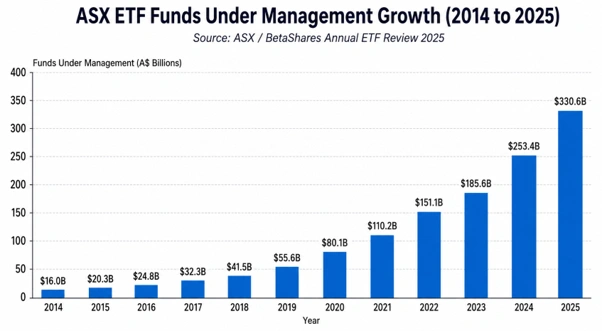
Australian ETF funds under management grew 20-fold over the past decade, reaching a record A$330.6 billion by end of 2025.
Volatility Is the Entrance Fee, Not the Reason to Stay Out
April 2025 produced a sharp correction. Markets fell hard and fast.
Market movements can sometimes cause nervous investors to pull their money out quickly.
The investors who panicked on the way down missed almost all of it.
Research from Morningstar Senior Analyst Shamir Popat found that Australian shares outperformed cash 85% of the time over seven-year rolling periods across a 30-year study window.
The periods when cash won tended to be brief. The periods when equities won tended to compound.
This is not a coincidence.
The ASX carries exposure to sectors that do not go away. Banking, Healthcare, Mining, and Infrastructure. These are the structural backbone of the Australian economy, repriced daily on an exchange with 125 years of history behind it.
The ASX Investment Opportunity Beyond Blue Chips
Most coverage of how to invest in the Australian Securities Exchange focuses entirely on the top 20 companies. That is understandable.
BHP, Commonwealth Bank, CSL, and Macquarie carry enormous weight.
But the exchange also hosts over 1,800 listed companies and 447 ETFs across every sector. From junior gold explorers in Western Australia to biotech firms running clinical trials in the United States.
That breadth matters.
Australia’s stable regulatory environment and strong technology and mining sectors provide a platform for a wide range of growth stories. Companies across health technology, mining, finance, and commercial services all contribute to the ASX’s performance profile.
For investors who want the stability of large-cap dividends and the optionality of early-stage exposure, the ASX delivers both inside the same brokerage account.
Not many exchanges in the world can say the same.
The resources sector is a major focus for 2026. Because of the global shift toward clean energy, there is high demand for materials like copper, lithium, nickel, and rare earths.
Australian mining companies own a large share of the world’s supply of these minerals.
ASX ETF Breakdown (VAS, A200, IOZ)
| ETF | Fund Name | FUM (June 2025) | MER | 1-Year Return | 5-Year Return | Franking Credits |
|---|---|---|---|---|---|---|
| VAS | Vanguard Australian Shares Index ETF | A$20B+ | 0.07% | ~11.4% | 12.09% p.a. | High |
| A200 | BetaShares Australia 200 ETF | A$7.6B | 0.04% | 13.29% | 12.31% p.a. | 70–85% |
| IOZ | iShares Core S&P/ASX 200 ETF | N/A | 0.05% | ~13% | ~12% p.a. | High |
An Australian Stock Market Investment Strategy That Works
Two principles keep showing up across serious Australian investing.
Time in the market. The 8.27% per annum figure assumes dividends reinvested. That reinvestment, compounded across decades, is where the real wealth creation happens. Pulling money out during corrections cuts off the compound effect at exactly the wrong moment.
Diversify across sectors. The ASX goes through periods where banks dominate and resources underperform, and vice versa. A portfolio that bets entirely on one pocket of the market is not a strategy. It is a sector call.
FAQs
Q: What is the average yearly return of the ASX?
A: Including dividends reinvested, it’s around 8.27% per year since inception.
Q: What are the strongest investment options on the ASX for 2026?
A: Low-cost index ETFs and mining and resources stocks as they are related to the clean energy transition, which are widely favoured.
Q: How do franking credits work for Australian investors?
A: They represent corporate tax already paid on dividends. Eligible Australian investors can claim thesback to reduce their personal tax bill.
Q: How does ASX compare to other markets in the world?
A: This strategy works well for people living in Australia, as they can take advantage of franking credits and the country’s strong resources sector. The market is also well-regulated, which helps.
Q: What is the meaning of dollar-cost averaging on the ASX?
A: Investing a fixed amount regularly regardless of price. This reduces the impact of short-term market swings over time.
Disclaimer: This article is for informational purposes only and does not constitute financial advice. The content reflects publicly available information and does not take into account any individual’s personal financial circumstances, objectives, or needs. Past performance is not a reliable indicator of future results. All investments carry risk, including the potential loss of capital. Readers should seek independent advice from a licensed Australian financial services professional before making any investment decisions. Colitco LLP may have commercial arrangements with companies mentioned or covered on this platform.
Source: https://www.asx.com.au/investors/investment-tools-and-resources

Luke Carlino is a seasoned Copywriter, Content Strategist, and Social Media Manager specialising in Mining, Finance, and Business journalism. With more than a decade of industry experience, he brings rigorous editorial standards and commercial acuity to every project.