
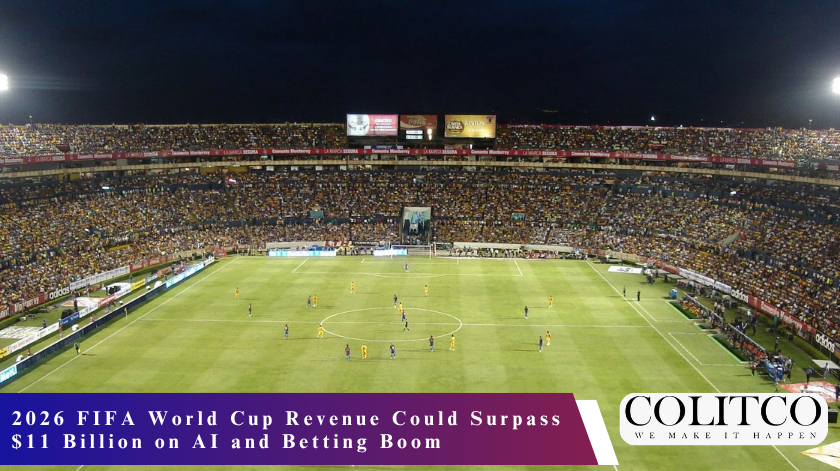
The 2026 FIFA World Cup could be the highest-revenue-generating football event in history. With profits estimated to exceed $11bn thanks to AI, record betting activity, and an increased number of tickets.
FIFA Sets a New Revenue Record With the 2026 World Cup
Tournament Expansion Is Driving the Numbers Higher
FIFA’s predicted revenues from 2023 to 2026 are 11 billion dollars, whilst the predicted revenues from 2019 to 2022 are 7.6 billion dollars.
This increase itself is proof of the increased size of the competition. The expansion is arguably the main cause of the increased earnings.
The 2026 World Cup will consist of 48 teams instead of 32, and it will consist of 104 matches instead of 64.
The addition of more matches increases both the broadcasting and advertising time available, as well as the ticket sales that are made.
Each additional game allows the 2026 FIFA World Cup revenue to generate additional income from all streams.
FIFA president Gianni Infantino also stated his stance on the direction of the tournament’s business. Infantino explained FIFA’s earnings potential was far greater but “We had an opportunity to put everything behind a paywall and achieve a $30 billion revenue” implying they could earn significantly more than predicted but maintained the option of wide access alongside the target for a record income.
Where the $11 Billion Comes From
FIFA has four main revenue streams in its official $11 billion budget. Television and broadcasting rights account for $4,264 million, or 39% of the total. Hospitality and ticketing bring in $3,097 million, or 28%. Marketing and sponsorship adds $2,693 million, making up 24% of the budget.
| Revenue Stream | Projected Amount | Share of Total |
| TV and Broadcasting Rights | $4.26 billion | 39% |
| Hospitality and Ticketing | $3.10 billion | 28% |
| Marketing and Sponsorship | $2.69 billion | 24% |
| Other Sources | Around $950 million | 9% |
Broadcasting remains the biggest single source. Sponsorship revenues should exceed $2.8 billion. Both figures are records for FIFA. Ticket and hospitality income is growing the fastest. Matchday revenues at the Qatar World Cup were approximately $950 million. That figure could rise to as much as $3 billion in 2026, a 216% increase.
AI Is Reshaping How the 2026 FIFA World Cup Revenue Gets Generated
From a TV Event to a Live Data Product
The 2026 FIFA World Cup revenue story is not only about ticket booths and broadcast deals. Artificial intelligence is changing how the tournament creates and captures value at every level. Bank of America says teams will have access to AI models analyzing hundreds of millions of FIFA data points. These systems can also track more than 2,000 performance measures in real time.
 Artificial intelligence is changing how the 2026 FIFA World Cup creates and captures value [Source: Techfinitive]
That kind of data reach has commercial weight. Broadcasters, sponsors, and betting platforms all pay more for richer and faster data. AI tools make that data available to all of them at once. This is one reason analysts now describe the 2026 tournament as a live operating system rather than a simple broadcast event.
The Data Volume Behind the Revenue
The scale of data being generated explains why technology companies are so involved. Bank of America estimates that matches, player tracking, venues, broadcasts, and tournament operations could create about 90 petabytes of direct data.
Stadium digital models and AI-run control centers are expected to help manage crowd flow, security, logistics, and operations. These systems cover three countries and 104 matches. They reduce costs for organizers and create new data products for commercial partners. The wider digital system could generate close to two exabytes of data. That includes streaming, social media, betting activity, AI models, simulations, and other systems. That volume equals about 45,000 years of 4K video.
Betting Markets Add Billions to the 2026 FIFA World Cup Revenue Equation
US Betting Volume Set for a Record Surge
Betting activity is one of the fastest-growing parts of the 2026 FIFA World Cup revenue picture. Most of it flows outside FIFA’s direct income. The US market sits at the center of that growth. Bank of America cites Bookies.com estimates that US World Cup betting and prediction market trading could rise to $5.9 billion in 2026. That compares to $1.8 billion during Qatar 2022. Prediction markets alone could account for $2.7 billion of that total.
Independent projections are more careful but still point to a record. US sportsbooks might receive $2.82 billion in bets during the tournament. In the bullish case that figure might jump as high as $4.3-$4.4 billion, predict Eilers and Krejcik Gaming analysts.
How Betting Compares to the Qatar 2022 Baseline
This evolution between Qatar and the 2026 events demonstrates the maturity of the American betting market. Even with a baseline projection of $2.82 billion, the event would represent an enormous leap from the estimated $900 million – $1 billion bet on the 2022 World Cup.
Key factors behind that growth include:
- Legal sports betting now available across most US states
- The 48-team format creating more matches and more betting lines each day
- Prediction markets entering the space for the first time at scale
- Home-nation interest with the US, Canada, and Mexico all competing
The expanded betting market benefits platforms and payment processors tied to sports wagering. It also adds commercial pressure on FIFA to develop its own data licensing deals with betting operators.
Economic Impact of 2026 FIFA World Cup Revenue Comes With Caution
Big GDP Numbers, But Economists Are Careful
The broader economic picture around the 2026 FIFA World Cup revenue is large. Bank of America cites estimates that the 2026 World Cup could add about $41 billion to global GDP, including $17 billion in the US. The tournament could also support nearly 824,000 jobs globally.
However, economists have long urged caution around numbers like these. Mega-events often show GDP gains on paper that do not fully come through. Visitors may be replaced by tourists who avoid crowded host cities. Local residents tend to shift spending rather than add to it. Host cities also carry public costs that do not show up in FIFA’s revenue totals.
Ticket Prices Raise Questions About Fan Access
Record 2026 FIFA World Cup revenue at the top does not automatically mean better outcomes for fans on the ground. The entry price on FIFA’s resale site for the World Cup final is $9,805. That puts the showpiece match well beyond the reach of most supporters.
Rising prices have drawn criticism from fan groups and football commentators. FIFA has defended the pricing by pointing to free broadcast access and lower-tier ticket categories. Still, the debate around who benefits from record 2026 FIFA World Cup revenue continues as the tournament runs.
2026 FIFA World Cup Revenue: Key Numbers at a Glance
| Metric | Figure |
| FIFA 2023 to 2026 Cycle Budget | $11 billion |
| Qatar 2022 Cycle Revenue | $7.6 billion |
| Projected Direct World Cup Revenue | $8.9 billion |
| Broadcasting Rights | $4.26 billion |
| Hospitality and Ticketing | $3.10 billion |
| US Betting Volume Base Case | $2.82 billion |
| US Betting and Prediction Markets High Case | $5.9 billion |
| Direct Tournament Data | 90 petabytes |
| Total Data Including Digital Ecosystem | Around 2 exabytes |
| Projected Global GDP Boost | $41 billion |
Also Read: Nickel Industries Presses Ahead on Green Nickel Certification and EV Battery Supply Chain
FAQs
Q: How much revenue will the 2026 FIFA World Cup generate?
FIFA’s budget is expected to be worth $11bn in 2023-2026, although predictions of $13bn+ were also put forward.
Q: How much could US betting on the 2026 World Cup reach?
The handling could get as high as $5.9bn in prediction markets or as high as $2.82bn as the base case, according to BofA and Bookies.com.
Q: How is AI being used to drive 2026 FIFA World Cup revenue?
Using player/match data alongside stadium operational analysis and leveraging betting and broadcasters, the AI is being used to maximize commercial revenue from the matches.
Q: Why are ticket prices so high at the 2026 World Cup?
The resale FIFA prices of matches, including $9,805 for a final, are in line with demand, but the commercial structure of the World Cup seems to be favoring profit above wide fan access.
Disclaimer
This article is for informational purposes only. The revenue, betting, and economic projections related to the 2026 FIFA World Cup are based on publicly available reports and estimates and may change as the tournament approaches. Readers should conduct their own research before making any financial or betting decisions. The figures discussed are forecasts and are not guaranteed.
Sources
https://finance.yahoo.com/markets/stocks/articles/ai-reshaping-fifa-world-cup-121200690.html

Luke Carlino is a seasoned Copywriter, Content Strategist, and Social Media Manager specialising in Mining, Finance, and Business journalism. With more than a decade of industry experience, he brings rigorous editorial standards and commercial acuity to every project.