

The Xero board appointment arrives at an awkward moment. The stock sits near A$60, under a third of its June 2025 peak.
On Friday, the stock sat close to A$60. That is roughly 63% below a year ago and a long way from the A$197 peak of June 2025.
No profit warning caused the slide. Fear did, mostly the fear that AI tools will chew into paid software. Higher bond yields added to it.
A new director cannot fix that. But a pick like this shows what a board is nervous about. Here is the read.
A chip veteran takes the seat of a software product leader
Mark Durcan joined Micron in 1984 and ran it as CEO from 2012 to 2017.
Today he sits on the supervisory board of ASML, the Dutch maker of the machines that print advanced chips. He chairs the technology committee there. Away from chips, he chairs Cencora, a large US pharmaceutical wholesaler. Chipmaker AMD has had him as a director too.
He replaces Anjali Joshi, who retired after the 27 August annual meeting following three years on the board. Joshi came up through engineering and product roles over three decades, including a stint at Google.
That is not a like-for-like swap. Joshi knew how software gets built and sold. Durcan knows how a giant, cash-hungry public company gets run.
Chair David Thodey hinted at a shake-up in July. He said the board was committed to further evolving the Board’s capabilities. That line came two months before Durcan arrived.
The seat was budgeted too. At the same August meeting, shareholders lifted the cap on total non-executive director fees from NZ$3.3 million to NZ$4.3 million. The notice said the extra room would cover an additional director.
The same notice said the board would hold six non-executive directors after the meeting. On that count, Durcan looks like number seven.
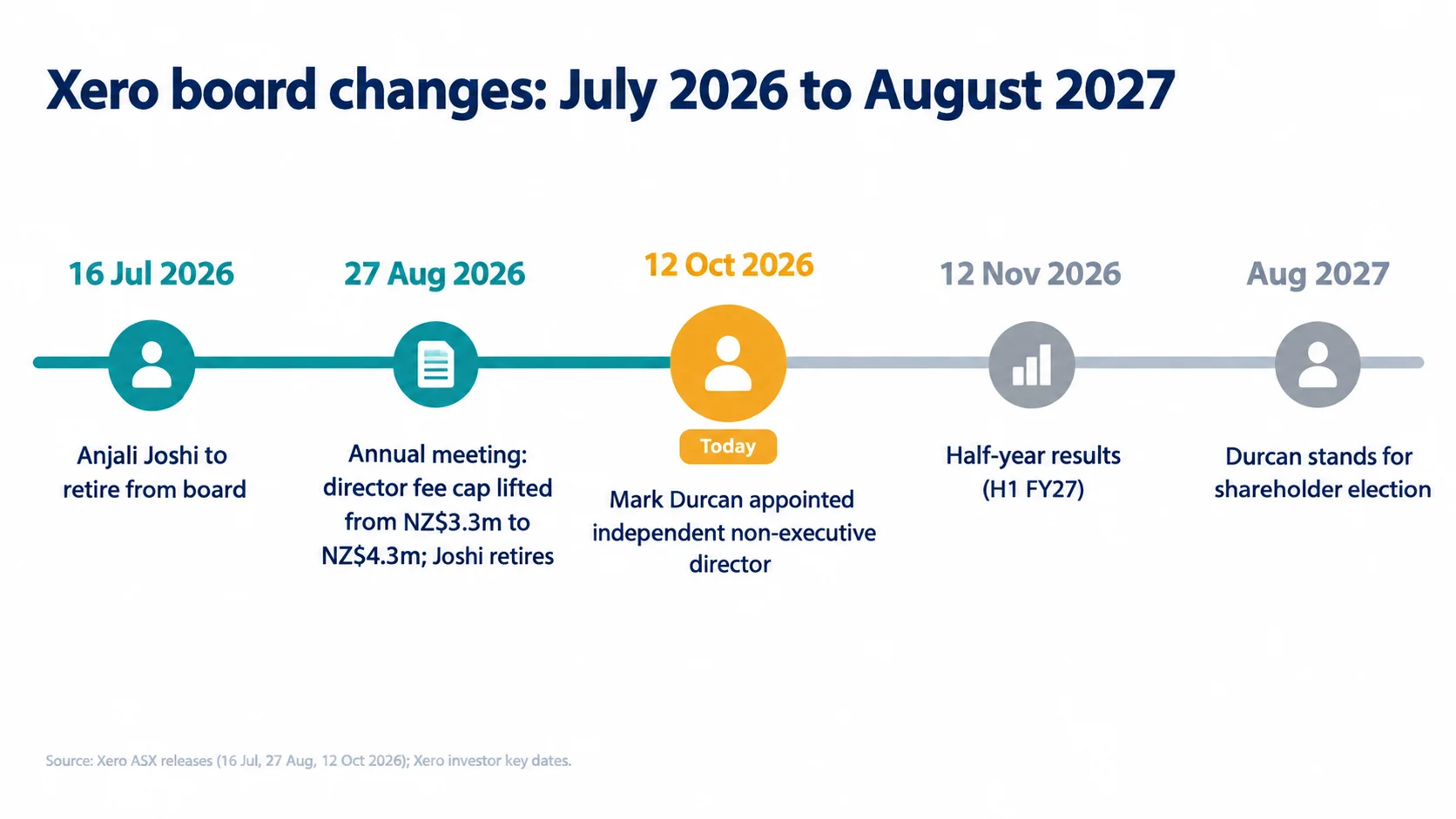
Xero’s board changes from Anjali Joshi’s retirement notice to Mark Durcan’s first shareholder vote.
The Xero AI strategy runs on computing power someone has to pay for
In May, Xero told investors it was “well positioned to be a long-term AI winner” in its FY26 results release.
The numbers behind the pitch are real. Its JAX assistant has reconciled more than 40 million bank transactions at a reported 97% accuracy. About 500,000 customers use the newer generative AI features. Messages sent to JAX per user rose around 115%.
Behind each of those messages sits a model that charges Xero for the work. Xero rents much of its AI brainpower rather than building it. It has deals with OpenAI and Anthropic.
That cuts both ways. Some of those same suppliers also sell agents that can do routine bookkeeping on their own. Xero is partly renting from companies that could become rivals.
Gross margin slid from 89.0% to 83.9% in FY26. Melio’s lower-margin payments business explains plenty of that drop. AI running costs lean the same way as usage grows.
Xero says it will bundle AI into existing plans, sell add-ons, and bring in usage-based pricing.
Usage pricing only works if the sums are right. Memory chips are a major cost inside AI servers, and their prices swing hard. Durcan watched those swings from inside a company that sells them.
That is where a former memory boss can earn his fee. He is well placed to press management on compute costs, supplier dependence, and what happens when usage races ahead of price.
The risk is plain too. A semiconductor résumé reads well in an AI-era release. It does not ship an accounting feature. Product know-how now rests with the rest of the board and management.
Mark Durcan holds no Xero shares, and results land in a month
His initial director’s interest notice, lodged with the ASX, shows no Xero securities and no related contracts. That is normal on day one. The interesting question is whether he starts buying.
At about A$60, an on-market buy would say more than any media release. Directors often trade after results, so watch the filings after 12 November.
That date is half-year result day. FY27 guidance gives the market a scorecard:
- Operating revenue: NZ$3.62 billion to NZ$3.73 billion
- Adjusted EBITDA: NZ$860 million to NZ$920 million
- Extra US brand spend: up to NZ$55 million
Xero also expects more of that profit to land in the second half. That back-end weighting is the first thing investors will test.
Software valuations have been bruised by higher rates as well, a theme in Colitco’s Australia interest rate forecast for 2026. Other ASX names face the same demand for proof, as the piece on what Zip and Block must prove next shows.
Leadership changes can move shares on their own, as the Lovisa senior executive change showed. Readers comparing software names can also check WiseTech Global’s FY26 growth story.
Durcan stands for election at the August 2027 annual meeting. Before then he sits through two result seasons.
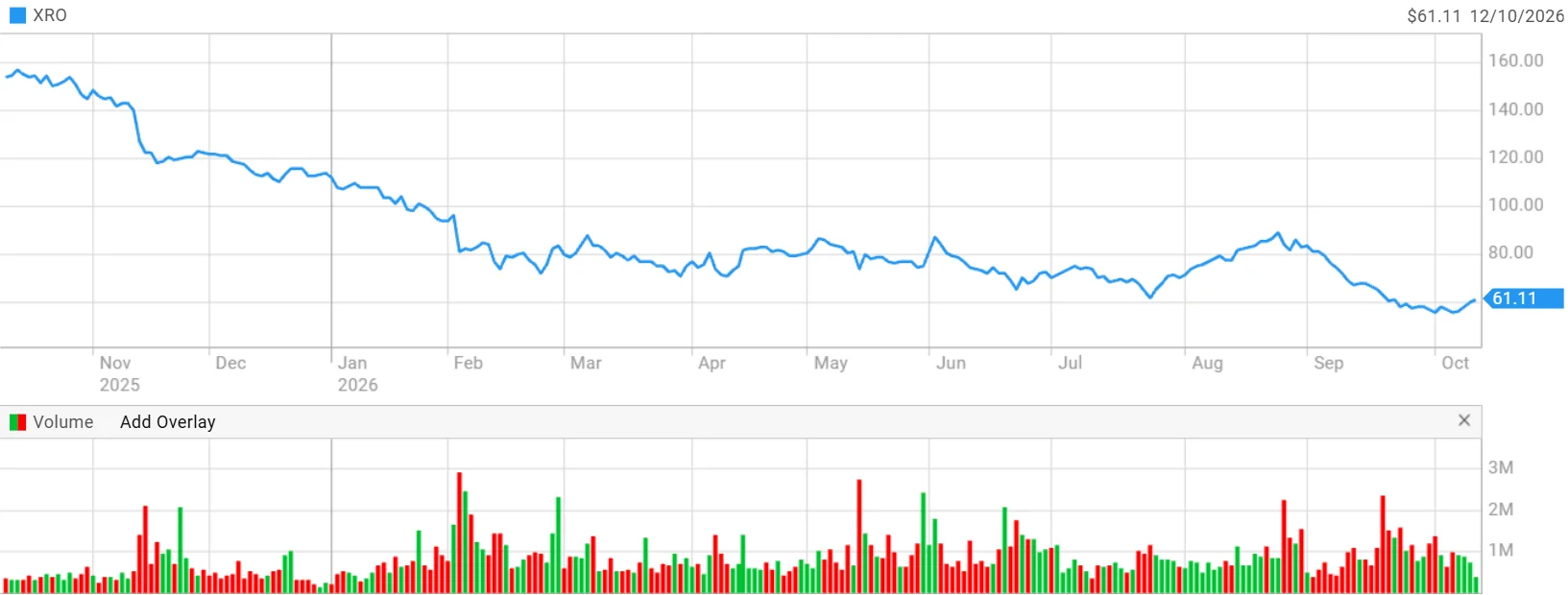
XRO share price performance [ASX]
So does one appointment make Xero a buy? No. Does it show a board looking at the AI cost line and not only the AI headline? Probably. That counts for more than the Micron name on the page.
Also Read: EOS’s A$700 Million Counter-Drone Contract Has Strings
FAQs
Q: Who is Mark Durcan?
A: A former Micron CEO who now sits on ASML’s supervisory board and chairs Cencora.
Q: When did he join Xero’s board?
A: 12 October 2026, effective immediately.
Q: Who did he replace?
A: Anjali Joshi, who retired after the 27 August 2026 annual meeting.
Q: When do shareholders vote on him?
A: Shareholders decide in August 2027, at the next annual meeting.
Q: Does he change Xero’s AI strategy?
A: Nothing in the release says so. He adds board skills, not products.
Q: Does he own Xero shares?
A: His interest notice shows none at appointment.
Disclaimer: This article is general information only and is not financial product advice. It does not consider your objectives, financial situation or needs. Speak to a licensed financial adviser before making any investment decision. Colitco or its associates may hold shares in companies mentioned.

Elizabeth Jones is a finance and mining content specialist with over 10 years of experience creating clear, SEO-driven content across fintech, investing, banking, insurance, cryptocurrency, and resource markets. She transforms complex financial data and industry trends into engaging, reader-focused articles that improve understanding and audience engagement.