
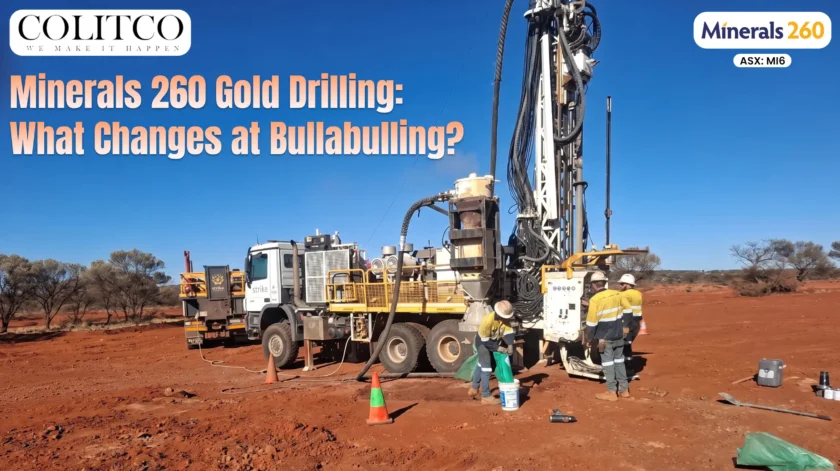
The work spans Phoenix, Bacchus, Kraken and Dicksons at the company’s wholly owned Bullabulling operation, 25 kilometres southwest of Coolgardie.
The resource figure has not increased in this announcement. What has changed is the information available to test the model, plan future mining and choose where to drill next.
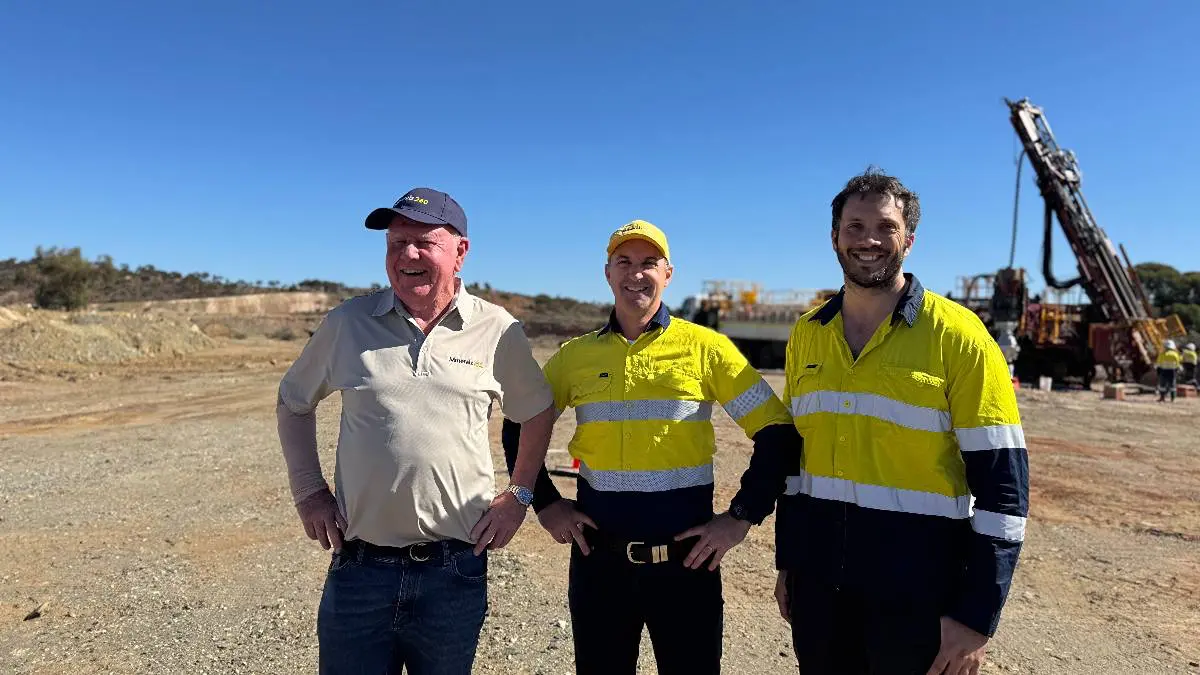
Figure 1: Minerals 260’s Tim Goyder, Luke McFadyen and Matt Blake at Bullabulling when drilling began in May 2025. Archive image. Credit: Josh Chiat / Stockhead.
Phoenix Drilling Tests the Ground Planned for Early Production
The initial grade-control programme covered Phoenix North and South on a 10-metre by 10-metre grid.
This is closer-spaced drilling intended to define mineralisation at a scale useful for mining. At Phoenix, it tested an area expected to be mined during the first three months of production.
Minerals 260 compared the results with the drilling behind its existing Mineral Resource Estimate. That work included 39 pairs of RC holes drilled close to one another, alongside broader comparisons across the area.
The company’s preliminary assessment found that overall grades were consistent with the earlier drilling. Mineralised intervals also matched the modelled mineralisation well.
Shallow Phoenix Intercepts Add Detail to the Model
Several of the better Phoenix grade-control results began close to surface.
| Drill hole | Gold intercept | Higher-grade interval included |
| BBGC0070 | 7m at 10.9 g/t from 7m | 2m at 35.4 g/t |
| BBGC0267 | 6m at 17.1 g/t from 19m | 2m at 45.0 g/t |
| BBGC0285 | 6m at 10.0 g/t from 22m | 2m at 24.0 g/t |
| BBGC0026 | 21m at 3.4 g/t from 27m | 1m at 52.6 g/t |
| BBGC0123 | 11m at 9.0 g/t from 49m | 2m at 44.8 g/t |
These are downhole intervals. The company estimates true widths for these intersections at 85–95% of the reported lengths.
The results show higher-grade sections within Phoenix, whose reported resource averages 0.95 g/t gold. They should not be substituted for that deposit-wide average.
Their value lies in helping define the distribution of gold within the proposed mining area. The company says this work improves its geological model and reduces operational uncertainty.
Deeper Holes Identify Potential Beyond the Resource Boundary
The Bullabulling gold project update also includes intersections below the pit shell used to constrain the existing resource estimate.
At Phoenix, hole BBRD0009 returned eight metres at 1.0 g/t gold from 354 metres, directly beneath that shell. Hole BBRD0693 returned five metres at 2.8 g/t from 412 metres, approximately 100 metres below it.
At Bacchus, extensional drilling returned 10 metres at 2.4 g/t from 309 metres in BBRD0701.
These results provide targets for further work outside the current estimate. Additional drilling and resource modelling are needed before any extra ounces can be reported.
Colitco’s earlier coverage of Bullabulling’s expanded project footprint examines the additional ground available for exploration.
The Existing Resource Remains the Starting Point
The announcement retains the July 2026 estimate of 190 million tonnes at 1.0 g/t gold for 6.2 million ounces.
Phoenix and Bacchus account for most of the reported gold.
| Deposit | Resource tonnage | Gold grade | Contained gold |
| Phoenix | 74Mt | 0.95 g/t | 2.3Moz |
| Bacchus | 72Mt | 1.0 g/t | 2.4Moz |
| Dicksons | 22Mt | 0.93 g/t | 660,000oz |
| Kraken | 16Mt | 1.1 g/t | 540,000oz |
| Gibraltar | 8.5Mt | 1.1 g/t | 290,000oz |
Figures are rounded as reported. The estimate has an effective date of 8 July 2026 and includes the project’s maiden Ore Reserves; those reserves should not be added again.
Part of the current infill programme aims to support the conversion of Inferred Resources to Indicated. That would improve confidence in the estimate, even if the total number of ounces did not change substantially.
Colitco’s report on St George Mining’s higher-confidence Araxá resource looks at resource classification in another development project.
A Second Grade-Control Programme Will Feed the Feasibility Study
Minerals 260 says another grade-control programme will begin shortly.
Its results will support the Definitive Feasibility Study, future grade-control planning and Resource-to-Reserve evaluation. Managing Director Luke McFadyen said the current work was improving the company’s understanding of mineralisation at a mining scale.
Exploration will continue beyond those immediate planning areas.
A ground gravity survey has identified geological trends north and south of the current resource. The company has used the survey to generate further drill targets, including around a change in structural orientation at Kraken.
Those targets still need testing. A geophysical anomaly helps decide where to drill; it does not establish a gold deposit.
What Should MI6 Shareholders Watch Next?
For readers following the ASX MI6 share price, the announcement provides new technical evidence for assessing Bullabulling.
The next checks are whether further drilling confirms the higher-grade trends, whether infill results support resource reclassification, and how the new information affects the feasibility study.
Colitco’s assessment is that Phoenix offers the clearest immediate change. Closely spaced drilling has broadly supported the model in the area planned for early production. Bacchus and the deeper intersections offer additional possibilities, with more work needed to establish their scale.
The announcement does not provide a revised project valuation or demonstrate a particular share-price response.
Also Read: Why Franco-Nevada Just Put Another A$200m on Minerals 260
FAQs
Q1. What changed in the latest Minerals 260 drilling update?
Ans. Grade-control results strengthened confidence in the Phoenix model, while infill and extensional drilling identified further higher-grade zones and potential resource extensions.
Q2. Has Bullabulling’s resource increased?
Ans. No. The announcement keeps the July 2026 estimate of 6.2 million ounces.
Q3. Does the Bacchus result mean the entire deposit is grading 290 g/t?
Ans. No. That assay is for a 1.1m drill interval. The Bacchus resource averages 1.0 g/t gold.
Q4. What’s the next move?
Ans. A second grade-control program is planned, along with further work on higher-grade trends, resource confidence and the Definitive Feasibility Study.
Legal Disclaimer
This article is solely for informational purposes and should not be considered financial advice. Drill results selected are not representative of average grade of a deposit as a whole. The work planned, the potential for exploration still need to be further assessed. Investors should review company filings before deciding to invest. Investments involve risk of loss.

Luke Carlino is a seasoned Copywriter, Content Strategist, and Social Media Manager specialising in Mining, Finance, and Business journalism. With more than a decade of industry experience, he brings rigorous editorial standards and commercial acuity to every project.