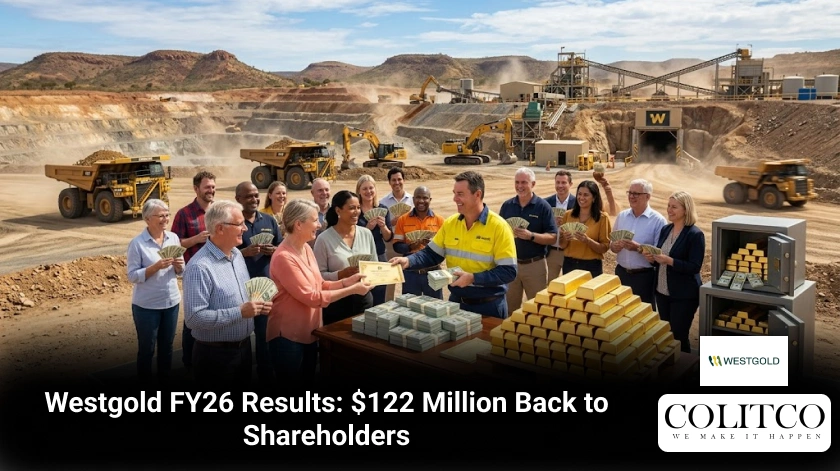
Westgold (ASX: WGX) reported FY26 results that include a record $122 million in shareholder capital returns, anchored by a 10 cent fully franked dividend declared on 28 August 2026.
The minimum the Company committed to paying was 2 cents per share. Ten cents is 400% above that floor. The treasury sits at $939 million.
Free cash flow came in at $602 million for FY26. The $95 million dividend is 16% of that. Six times covered. The gap between commitment and delivery here is wider than most ASX100 gold names manage.
CEO Wayne Bramwell said Westgold enters FY27 with “strong financial and production momentum.” After a year that saw underlying EBITDA cross $1 billion for the first time, the description is accurate.
Westgold FY26 Earnings Jumped at Every Single Line
Production hit 387,000 ounces for FY26. That beat guidance and ran 19% above FY25’s 326,000 ounces.
The EBITDA margin is where the number gets interesting. It climbed from 37% in FY25 to 45% this year. Underlying EBITDA: $1.1 billion.
Shareholders received $480 million in underlying net profit. FY25 statutory net income was $112 million. That is not a misprint. One year.
All-in sustaining cost for FY26 was $2,841 per ounce. Against Australian dollar gold prices trading well above $4,500 for much of the year, each ounce is generating substantial cash.
Operating cash flow reached $964 million, up 158% on the prior year. At 30 June 2026, the treasury held $939 million across cash, bullion, and liquid investments. No debt on the books.
Another $600 million sits in undrawn facilities, bringing total available liquidity to $1.5 billion.
The margin expansion is the detail most will skip over in favour of the dividend headline. Production grew 19%, but EBITDA margin grew eight percentage points. Every extra ounce produced flowed to the bottom line far more efficiently than the previous year.
| Metric | FY26 | Change YoY |
|---|---|---|
| Gold Production | 387,000oz | +19% |
| Underlying EBITDA | $1.1B | +349% |
| Underlying NPAT | $480M | +454% |
| Operating Cash Flow | $964M | +158% |
| Free Cash Flow | $602M | +170% |
| EBITDA Margin | 45% | From 37% |
| AISC | $2,841/oz | — |
| Treasury Balance | $939M | — |
| Ore Reserves | 4.1Moz | +41% |
Source: Westgold Resources ASX announcements, 28 August 2026 and 20 August 2026
$27 Per Ounce of Reserve Addition Is the Sleeper Detail
Westgold spent $42 million on exploration and resource definition in FY26.
Gross Ore Reserves added: 1.5 million ounces.
Cost per ounce added: $27.
Industry benchmarks across WA gold commonly run between $80 and $150 per ounce of reserve development. Westgold’s number sits below where most operators in the sector are working.
Total Ore Reserves now stand at 4.1 million ounces, up 41% on the 3.5 million ounces reported in FY25. Third consecutive year of growth after depletion. Grade improved 15% to 2.22 grams per tonne gold. At installed capacity of 5.7 million tonnes per annum, that is approximately 10 years of reserve life.
26 rigs were active across the Murchison and Southern Goldfields for the year. This is not idle drilling. These rigs are finding gold at a cost that very few producers match.
The Beta Hunt and Fletcher complex keeps delivering beyond initial estimates. The merger with Karora Resources, completed in 2024, brought Beta Hunt into the portfolio. Since acquisition, the Beta Hunt Ore Reserve has grown 201%. The maiden Fletcher Ore Reserve, declared in August 2026 at 1.1 million ounces from 13.5 million tonnes at 2.6 grams per tonne gold, was reached within two years of the mine purchase. Fletcher’s Mineral Resource grew 30% to 3.0 million ounces.
These results are supported by over 85 kilometers of drilling completed at Fletcher since August 2024.
The Group’s total mineral resources now stand at 14.4 million ounces, an 8% increase after accounting for asset sales.
The Karora acquisition continues to show positive developments with each update.
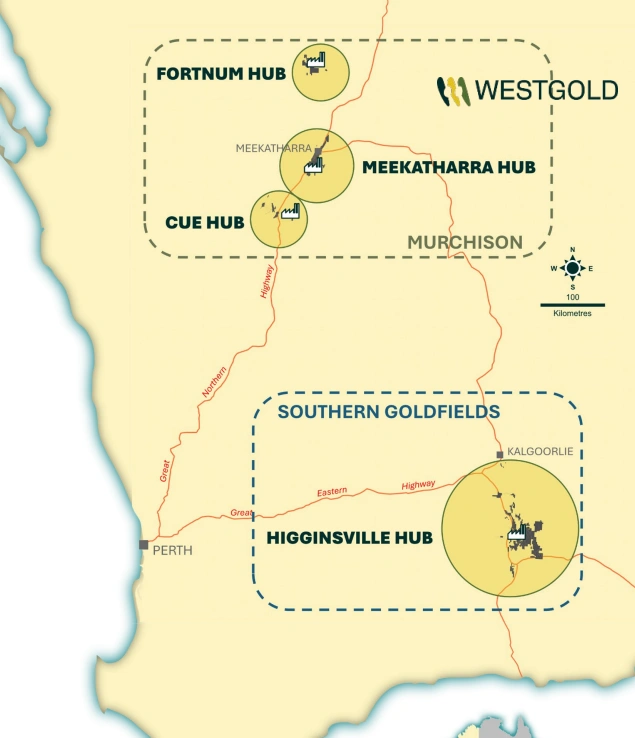
Westgold’s four Western Australia processing hubs, spanning the Murchison and Southern Goldfields [Source: Westgold Resources]
Three Mill Expansions Chart a Path to 470,000 Ounces in FY28
Westgold’s organic growth story runs through its processing infrastructure. All of it is self-funded.
At Cue, a study confirmed a capacity expansion from 1.4 to 1.7 million tonnes per annum, a 21% lift. Indicative capital: $22 million. Payback period: 10 months. Commissioning: FY27.
At Meekatharra, throughput moves from 1.8 to 2.9 million tonnes per annum. A 61% capacity lift, with a production uplift of roughly 47,000 ounces per year. Indicative capital: $100 million.
Nine-month payback. FY28 commissioning target.
Higginsville adds a third expansion, with a definitive feasibility study advancing a 4-million-tonne-per-annum case up from 1.6 million today.
If all three proceed, Westgold’s combined milling capacity moves from approximately 5.7 million tonnes today to roughly 9.5 million tonnes per annum. A potential 66% increase, self-funded from cash generation.
The FY28 gold production target is 470,000 ounces. At FY26’s 387,000-ounce result, that is a 21% step-up. No equity raise is factored into the plan.
The maths work. At FY26’s AISC of $2,841 per ounce, adding 83,000 ounces of production to FY26’s base at similar economics would generate in the range of $140 million in additional annual cash on current gold prices. This is why Bramwell’s comment about “fully funded” growth carries weight: the cash is already in the treasury.
The New Capital Return Policy Raises the Minimum Commitment
Westgold formalised an updated Shareholder Capital Return Policy for FY27 alongside the FY26 results announcement on 28 August.
The minimum annual shareholder capital return increases to 3 cents per share, comprising at least 2 cents as an ordinary dividend with the balance returned via buybacks or additional distributions.
The total payouts are limited to 30% of the yearly free cash flow. This is also dependent on keeping at least $200 million in net cash. The Board has approved a $50 million share buyback program for the 2027 fiscal year.
This buyback will happen on the open market, starting September 11, 2026, and ending September 10, 2027. It will not exceed 5% of the company’s total shares. Canaccord Genuity in Australia will handle the buyback.
For the dividend relating to fiscal year 2026, shareholders will not be eligible to receive it if they buy shares after September 15, 2026. The list of shareholders who will get the dividend will be finalized on September 16, 2026, and the payment will be made on October 8, 2026. In fiscal year 2024, a total of $10 million was given back to shareholders.
FY25 returned $28 million. FY26 returned $122 million. The three-year total since the dividend policy began in FY24: $161 million.
The Company is listed on both the ASX and the Toronto Stock Exchange (TSX:WGX) and holds 944.1 million shares on issue. Market capitalisation stood at approximately $6.3 billion as at 28 August 2026, per the Company’s investor presentation.
For investors tracking the Australian gold sector, FY26 reporting season has produced some standout numbers. Westgold sits high on that list.
WA gold producers have benefited from a high Australian dollar gold price environment through 2025 and 2026, and Westgold’s unhedged position meant every dollar of that price environment dropped through to margins. The EBITDA margin expansion from 37% to 45% is the clearest evidence of that.
More Westgold and ASX mining news can be found in our coverage of the Australian mining sector. The Westgold FY26 dividend announcement is available for full reference.
Also Read: Ampol 1H26 Results: War Did What Prices Couldn’t
FAQs
Q: What dividend did Westgold declare for FY26?
A: 10 cents per share, fully franked.
Q: When is the Westgold FY26 dividend payment date?
A: 8 October 2026.
Q: How much gold did Westgold produce in FY26?
A: 387,000 ounces. Beat guidance and up 19% on FY25.
Q: What is Westgold’s Westgold FY26 results underlying EBITDA?
A: $1.1 billion, on a 45% margin.
Q: What is Westgold’s FY27 minimum capital return?
A: 3 cents per share, including at least 2 cents as an ordinary dividend, capped at 30% of annual free cash flow.
Q: Is Westgold carrying any debt?
A: No. The Company is debt free with $1.5 billion in total available liquidity.
Disclaimer:
This article is intended for informational purposes only and does not constitute financial product advice or a recommendation to buy or sell any securities. The content reflects information available at the time of publication. All figures and data have been sourced from Westgold Resources’ official ASX announcements dated 28 August 2026 and 20 August 2026. Readers should conduct their own independent research and seek professional financial advice before making any investment decisions. Past performance is not a reliable indicator of future results.

Elizabeth Jones is a finance and mining content specialist with over 10 years of experience creating clear, SEO-driven content across fintech, investing, banking, insurance, cryptocurrency, and resource markets. She transforms complex financial data and industry trends into engaging, reader-focused articles that improve understanding and audience engagement.