The Middle East conflict that fractured global oil markets in February 2026 was, for most energy businesses, a crisis to absorb.
For Ampol (ASX: ALD), it was a test the supply chain had been built to handle.
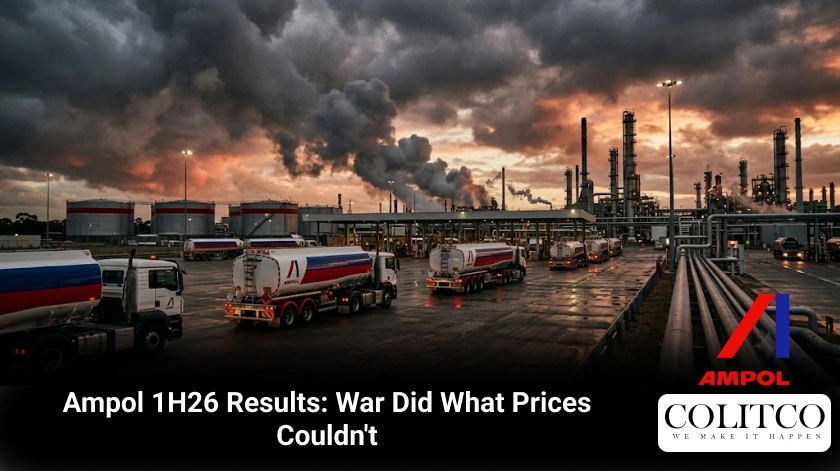
The Ampol 1H26 results tell that story plainly. RCOP EBITDA for Group came to US$1,637 million in the period between January and June 2026. This is 152% more than the result shown for the same period a year before. RCOP net profit after tax came in at $857.2 million, up 376% on the prior year’s $180.2 million.
In the first half of 2026, the company showed statutory profit at the amount of $1,363 million, which includes $527.6 million of profit from inventories. Statutory loss in the first half of 2025 was US$25.3 million.
These numbers require context, not just a calculator.
How Lytton Became the Centrepiece of Ampol’s 1H26 Earnings
The Lytton refinery in Brisbane has spent much of the past decade generating policy debates rather than profits. The federal Fuel Security Services Payment was, for years, the primary commercial reason the plant stayed open.
That calculus reversed completely in 1H26.
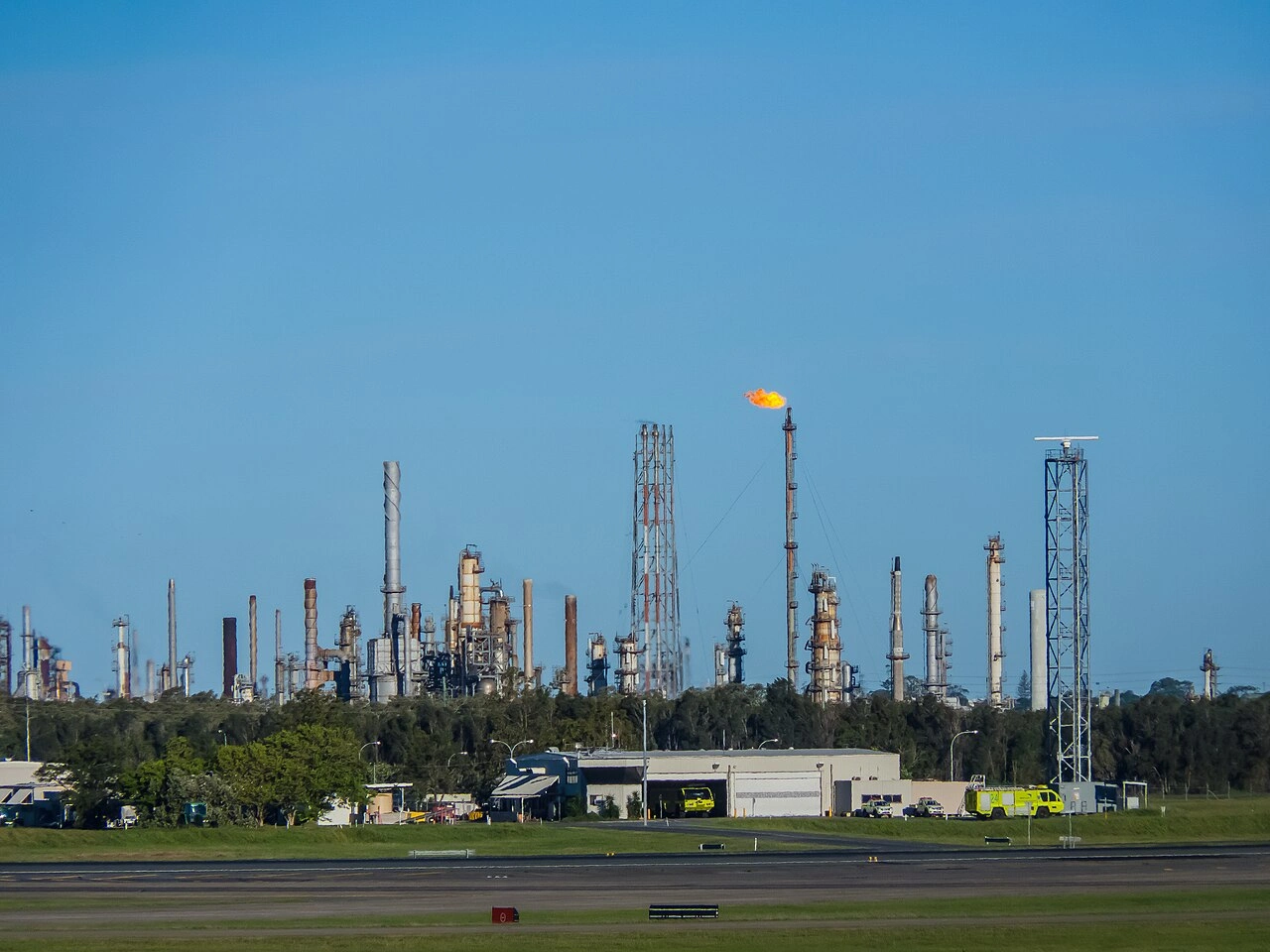
Lytton refinery production rose 8.7% in 1H26, with the facility operating at 84% utilisation as regional supply tightened. [Wikipedia]
The start of military activities of the United States and Israel against Iran resulted in the effective closure of the Strait of Hormuz from late February 2026, resulting in fast tightening of the global refining supply.
Singapore complex refining margins rose to US$30 per barrel – the highest level since 2022 – due to reduced run rates or shutdowns of feedstock-constrained refineries in Asia. Asian refiners considered slashing crude throughput by 20 to 30%.
Lytton kept running. Production for the half reached 2,945 million litres, up 8.7% on the prior period, and the facility ran at 84% utilisation. The Lytton Refiner Margin averaged US$28.26 per barrel across the six months. In the first half of 2025, that margin was US$7.44 per barrel.
The Singapore WAM component of the LRM build-up, the regional crack spread proxy, landed at US$31.07 per barrel for the half against a trailing five-year average comfortably below US$15.
Lytton RCOP EBIT went from $1.1 million in 1H25 to $533.4 million in 1H26. A refinery that nearly became a policy problem became the single largest earnings contributor in the group.
The Integrated Supply Chain That Made It Actually Count
Lytton was significant. The trading and shipping arm did something equally remarkable.
Fuels and Infrastructure International RCOP EBIT reached $307.5 million for the half. In 1H25, the same segment earned $2.8 million. That near-100-fold move reflects Ampol’s independently operated crude and product sourcing capability across Asia-Pacific.
The investor presentation is explicit about the mechanics: supply positions were established prior to the commencement of the original conflict.
When product prices spiked following the Strait closure, Ampol had already secured volumes at pre-disruption prices. The margin between cost and sale price was enormous.
Prior to the war, roughly 25% of global maritime oil trade in crude and petroleum products passed through the Strait of Hormuz. When that route tightened, buyers without pre-arranged supply scrambled.
The deferral of Russian diesel exports and product inventories sitting at or near historic lows added two further pressure points to an already acute physical market.
Fuels and Infrastructure Australia (excluding Lytton and Energy Solutions) added $309.3 million in RCOP EBIT, up 123%. Australian wholesale volumes excluding net-sell contracts grew 2.9% for the half.
In March alone, regional market volumes jumped 30% as buyers pulled forward purchases in anticipation of further disruption. Ampol kept supply moving while competitors with less reliable logistics could not.
Total F&I segment RCOP EBIT: $1.134 billion. Prior period: $118.3 million. The 859% increase explains most of the headline number.
The company also secured roughly 340 million litres of additional refined fuel through Export Finance Australia, in an arrangement with the federal government to bolster national inventories.
That program added $148 million in short-term borrowings to the balance sheet. It also kept fuel flowing to regional Australians when supply chains elsewhere failed, an outcome that earned Ampol considerable goodwill with government stakeholders.
For the fuller picture of how Australia’s fuel supply held together during those weeks, Colitco’s reporting on the domestic fuel shortage response is worth revisiting.
Convenience Retail Grew, New Zealand Didn’t, and EG Changes the Second Half
Convenience Retail delivered RCOP EBIT of $204.5 million, up 12% on 1H25.
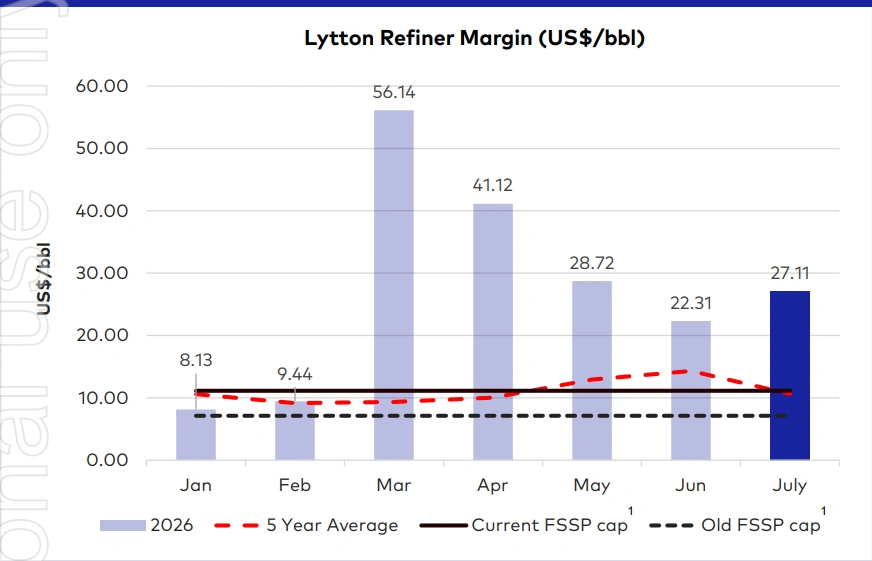
Lytton Refiner Margin (US$/bbl) across 1H26, showing the spike driven by the Strait of Hormuz closure in March 2026. [Ampol Limited]
Shop gross margin reached 40.1%, up 0.2 percentage points year-on-year, and more than 10 percentage points above where it sat in 2020. Average basket value hit $12.94. Ex-tobacco and ex-U-GO conversions, network shop sales grew 3.5%.
The tobacco drag, which has weighed on retail metrics for years, is now at a point where Ampol describes its impact on profitability as immaterial.
U-GO, the unstaffed discount fuel offer, is operating at 47 sites. Volume through those sites grew 64% year-on-year. Management describes the payback period as less than one year per site and the economics as exceeding original expectations.
New Zealand was the clear weak spot. Z Energy RCOP EBIT came in at $103.8 million, down 16% from $122.9 million in 1H25. The dynamics were predictable in hindsight.
Local competitors with different supply arrangements held prices lower for longer as landed costs jumped. Ampol’s NZ operation was slower to pass through those rising costs, compressing margins during the period of sharpest disruption.
An adverse AUD/NZD conversion took off another $6.5 million. The absence of earnings from divested businesses like Flick Energy and Channel Infrastructure, which contributed $7.6 million in NZD EBITDA during 1H25, also made the comparison tougher.
Management describes the NZ performance as temporary. The partial resumption of Hormuz traffic following the U.S.-Iran Memorandum of Understanding signed on 17 June 2026 should ease the margin pressure over the second half.
On EG Australia: Ampol completed the acquisition of 511 sites at midnight on 30 June 2026. The last day of the half. Not one of those sites contributed a dollar to first-half earnings. From 1 July, that changes. Combined with existing operations, Ampol now runs approximately 1,080 company-operated sites.
The synergy target is $65 to $80 million per year within two years. The board elected to cash-settle the scrip component of the deal for $315 million, adding to borrowings but keeping full earnings accretion for existing shareholders rather than diluting them.
This is not an incidental footnote. The EG Australia acquisition represents the scale dimension of a retail segmentation strategy Ampol has been executing consistently since the brand returned in the early 2020s.
Net borrowings at 30 June 2026 reached $3.523 billion, including both the EG acquisition cost and the Export Finance Australia facility. Leverage sits at 1.8 times adjusted net debt to RCOP EBITDA on a last-twelve-months basis, well within the stated 2.0 to 2.5 times target range.
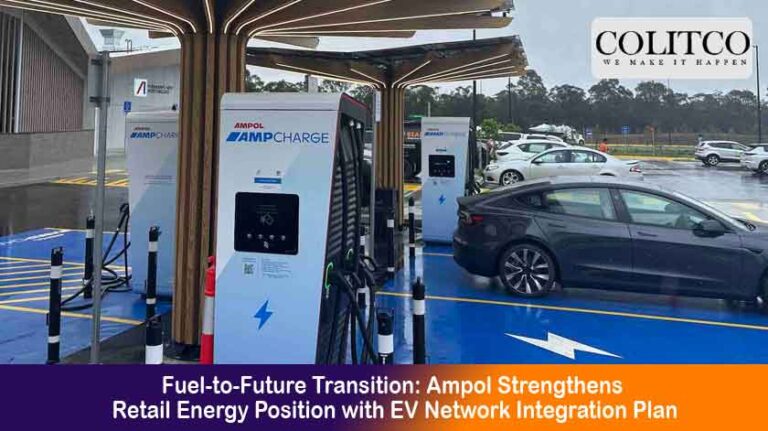
Energy Solutions, the EV charging arm, continued improving its loss trajectory. EBITDA loss narrowed from $21.5 million in 1H25 to $12.7 million in 1H26. The AmpCharge network reached 356 bays in Australia, up 98% year-on-year. Charging sessions hit 229,000 for the half, up 116%.
One detail worth flagging: EV new car sales in Australia exceeded 20% of total new vehicle sales in each of May, June, and July 2026, partly accelerated by the fuel price shock. The conflict that inflated Lytton’s margins may have also shortened the timeline for EV adoption. Ampol’s charging business stands to benefit from both sides of that equation.
The Dividend Signals What the Board Believes
One hundred and eighty-five cents per share. Fully franked.
More than quadruple the prior year’s interim dividend. Ampol will return $441 million in ordinary dividends to shareholders in 2H26, releasing $189 million in franking credits.
Boards don’t do that when uncertain about earnings durability.
The caveats are real. Lytton’s Fluidised Catalytic Cracking Unit entered a Turnaround and Inspection maintenance period on 30 July. Restart is expected in October. For roughly a quarter, production is constrained.
Retail fuel margins in both Australia and New Zealand have tightened since June as rising landed costs haven’t fully passed through to board prices yet.
Current trading is still running ahead of the prior corresponding period, underpinned by Lytton’s strong July result before the maintenance outage began. The Lytton Refiner Margin for July came in at US$27.11 per barrel, with 524 million litres of production.
The global diesel crack spread forward curve remains elevated well into 2027 as European inventory rebuilds ahead of northern winter and Russian export deferrals persist, as confirmed by the IEA’s April 2026 Oil Market Report.
The Ultra Low Sulfur Fuels project at Lytton is on track to come online before year end. Regional scarcity of the new gasoline specification gives Lytton another margin support avenue as compliance deadlines approach across Asia.
The FSSP Phase 2 review outcome, still pending, will set long-run refinery support terms at a moment when the facility’s strategic importance has rarely been more visible.
The key analytical question here isn’t whether 1H26 was exceptional. It clearly was. The question is which parts of that outperformance are structural rather than cyclical.
The integrated supply chain, trading capability, and retail earnings trajectory all point toward durability. Lytton margins at US$28 per barrel almost certainly won’t be permanent. But the EG Australia earnings uplift, the U-GO rollout economics, and the growing charging network are not things that reverse when Middle East tension eases.
Ampol exits this half with a structurally stronger earnings base than it carried into it. That matters beyond just one exceptional six months.
Also Read: Charter Hall FY26 results: growth without the fee windfall
FAQs
Q: What was Ampol’s profit in 1H26?
A: RCOP NPAT came in at $857.2 million; statutory net profit reached $1.363 billion for the six months to 30 June 2026.
Q: What drove Ampol’s 1H26 earnings surge?
A: The Middle East conflict shut the Strait of Hormuz, tightening global refined product supply and pushing the Lytton Refiner Margin to US7.44 in 1H25.
Q: How much is Ampol’s interim dividend for 1H26?
A: The board declared 185 cents per share, fully franked, payable 30 September 2026. That is more than four times the prior year’s interim.
Q: Why did New Zealand underperform?
A: Z Energy was slower to pass through rising fuel input costs to retail prices, compressing margins temporarily during the period of sharpest disruption.
Q: When does EG Australia start contributing earnings?
A: All 511 acquired sites close from 1 July 2026. Management targets $65 to $80 million in annual synergies within two years of completion.
Q: Is Lytton refinery currently operating?
A: Lytton entered a planned Turnaround and Inspection shutdown on 30 July 2026. Restart is expected in October 2026. The Ultra Low Sulfur Fuels project remains on track for year-end start-up.
Q: What is Ampol’s leverage position after EG Australia?
A: Net borrowings were $3.523 billion at 30 June 2026. Adjusted net debt to RCOP EBITDA was 1.8 times, within the stated target range of 2.0 to 2.5 times.
Disclaimer:
The information in this article is general in nature and does not constitute financial product advice. Colitco LLP and its associates may hold interests in companies covered. Past performance is not a reliable indicator of future results. Readers should seek independent financial advice before making any investment decisions. This content is intended for informational purposes only.

Luke Carlino is a seasoned Copywriter, Content Strategist, and Social Media Manager specialising in Mining, Finance, and Business journalism. With more than a decade of industry experience, he brings rigorous editorial standards and commercial acuity to every project.