
The Nickel Copper Opportunity at Magna Mining’s Levack Mine is developing along two paths. Underground exploration is expanding the R2 Footwall Zone, while surface drilling is identifying mineralisation that could contribute early material if the company approves a restart.
Located in Canada’s Sudbury Basin, Levack gives Magna an opportunity to assess additional mineralisation around an established mining operation. The latest results add geological evidence to that assessment without settling the development decision.
For shareholders, the significance goes beyond individual assay grades. The relationship between drilling, underground access and mine planning will determine whether the growing exploration footprint translates into a workable production schedule.
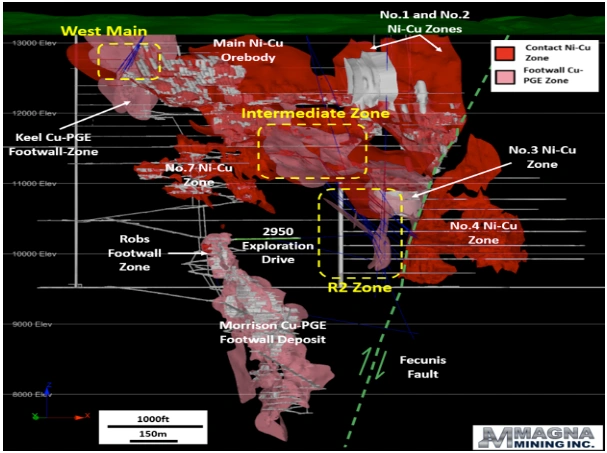 Figure 1: Magna’s longitudinal view shows the relationship between the R2 Footwall Zone, Intermediate Orebody and West Main Orebody at Levack. Image credit: Magna Mining.
How Are Two Exploration Fronts Strengthening the Nickel Copper Opportunity?
Magna’s update separates the copper-rich R2 Footwall results from nickel-bearing intersections at West Main. These are distinct targets with different potential contributions to a future operation.
At R2, hole FNX2038A-W1 returned a 2.1-metre interval containing 9.5% copper, 2.6% nickel and 17.5 grams per tonne of combined platinum, palladium and gold. Silver graded 24.9 grams per tonne.
West Main delivered a separate 4.6-metre intersection grading 4.0% nickel, 1.7% copper and 3.5 grams per tonne of combined platinum, palladium and gold.
The company’s September exploration announcement identifies these as separate drilling results. Keeping that distinction clear helps readers understand how each area fits into the broader Levack assessment.
| Target | Reported interval | Nickel | Copper | Platinum + palladium + gold |
| R2 Footwall Zone | 2.1 metres | 2.6% | 9.5% | 17.5 g/t |
| West Main Orebody | 4.6 metres | 4.0% | 1.7% | 3.5 g/t |
| West Main, hole MLV-26-68 | 32.9 metres | 1.7% | 0.4% | 0.4 g/t |
Intervals are downhole lengths. Magna states that estimated true widths vary between 30% and 80% of downhole length.
What Has Changed at the Footwall Discovery
The Levack Footwall Discovery has gained additional direction and definition from the latest drilling.
- An expanded footprint: Drilling extended the R2 veins approximately 30 metres towards the No.3 Orebody.
- Multiple mineralised intersections: Hole FNX2038A-W1 encountered five distinct veins across a 91.5-metre downhole span.
- Further exploration space: R2 remains open up dip towards the No.3 Footwall Zone and at depth to the south.
- A nearby geological reference: The No.3 Orebody lies approximately 75 metres up dip, providing a focus for further investigation.
The five veins should not be interpreted as one continuous 91.5-metre mineralised interval. Their distribution provides evidence about the system’s geometry, but additional drilling must establish how individual veins connect.
That distinction matters when translating exploration results into potential mining shapes.
Could West Main Add a New Production Opportunity?
While R2 offers scope to extend copper and precious-metal mineralisation, West Main introduces a shallower nickel opportunity.
Hole MLV-26-68 intersected 32.9 metres grading 1.7% nickel, 0.4% copper and 0.4 grams per tonne of combined platinum, palladium and gold. The reported West Main results occur within 150 metres of surface.
Magna considers this material potentially relevant to the early stages of production following a positive restart decision. That remains a planning possibility rather than an approved mining schedule.
The practical question is whether the shallow mineralisation can be defined sufficiently to support extraction. Grade continuity, mining width, access and recovery will influence its usefulness.
For the Nickel Copper Opportunity, shallow mineralisation and deeper footwall veins therefore offer different avenues for evaluation. Their eventual value depends on how effectively they can be incorporated into the same operating plan.
Underground Access Gives Exploration a Practical Base
Physical development is progressing alongside the drilling programme.
The supplied reporting records approximately 181 metres of underground development during July and August, including advancement of the 2950 Level drift between the Morrison Footwall deposit and R2.
This work provides additional drilling platforms. Access closer to a target can help teams investigate its shape and test gaps in the geological interpretation.
Magna’s Levack project overview also describes established underground connections and dewatering infrastructure. These features provide context for the restart assessment, although existing infrastructure still requires evaluation against future operating needs.
The Magna Mining Expansion story consequently involves both discovery and preparation. Exploration identifies possible mineral inventory; development creates access for further testing and, potentially, later mining.
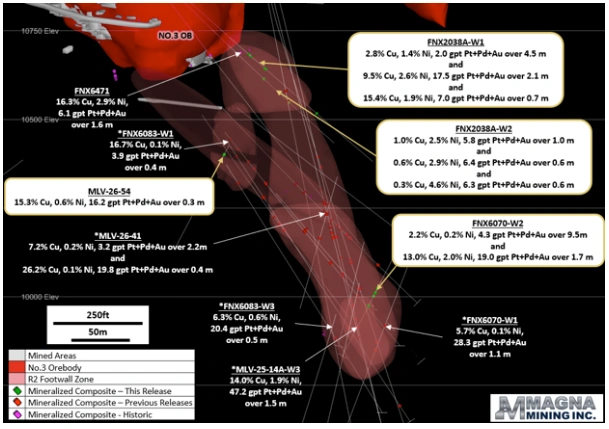 Figure 2: A longitudinal view of the R2 Footwall Zone places recent assay results within Magna’s geological interpretation. Image credit: Magna Mining.
Where the Restart Assessment Still Needs Evidence
Strong assays improve the exploration case, but several practical questions remain relevant to development.
- Continuity: Further holes need to establish how consistently mineralisation extends between intersections.
- Recoverable value: The presence of several metals does not establish how much can be recovered and sold economically.
- Mining conditions: Vein geometry and surrounding rock influence extraction methods, dilution and operating costs.
- Development requirements: Underground access must be assessed alongside the work necessary to support sustained production.
These issues explain why a headline grade cannot substitute for a mine plan. A narrow, metal-rich vein and a broader nickel-bearing interval may require different approaches.
The restart assessment must bring those differences together into realistic assumptions about costs, sequencing and output.
What Could the Upcoming Economic Studies Reveal?
Magna expects results from the Levack Preliminary Economic Assessment and Crean Hill Prefeasibility Study in the first half of October 2026.
The company is evaluating the implications of Canada’s Productivity Mega Deduction, announced on 15 September, before releasing the studies.
This introduces a financial consideration alongside the technical work. Any benefit must be reflected in project-specific assumptions before readers can judge its significance.
The supplied report does not quantify the effect on Levack’s valuation or establish that the measure will trigger a restart.
Investors should therefore examine the published economics when available, including the assumptions that drive them. Study results will provide a more useful basis for assessing development potential than assigning value to tax changes in isolation.
Milestones That Could Clarify the Opportunity
The next updates should help connect exploration progress with development choices.
- Additional R2 drilling: Results could clarify vein continuity and the relationship with nearby mineralisation.
- West Main follow-up: Further testing could establish the extent of shallow material potentially available early in a restart.
- Study publication: Levack and Crean Hill results should provide more detail on their respective development cases.
- A formal restart decision: This would clarify whether Magna intends to move Levack beyond assessment and preparation.
These milestones carry different meanings. An assay improves geological understanding; an economic study evaluates a development concept; a restart decision commits the company to a course of action.
What to Expect Next?
Magna’s latest results strengthen the evidence supporting further work at Levack. R2 has expanded, West Main has delivered shallow intersections, and underground development is creating additional exploration access.
The investment question now centres on integration: whether these separate advances can support an economically credible restart.
For readers following Magna Mining Expansion, the approaching studies should help distinguish geological promise from a development case that can withstand scrutiny.
Also Read: BHP vs Rio Tinto: The Copper Power Shift Redefining Mining Investment Leadership
Disclaimer
This article is prepared for Colitco for general information and does not constitute investment advice. It draws on the Mining.com.au report and Magna Mining disclosures. Exploration results do not establish economic viability. Study timing, potential production and development decisions remain subject to technical, financial and operational uncertainties. Readers should review original company disclosures before making investment decisions.

Luke Carlino is a seasoned Copywriter, Content Strategist, and Social Media Manager specialising in Mining, Finance, and Business journalism. With more than a decade of industry experience, he brings rigorous editorial standards and commercial acuity to every project.