
Lightning Minerals Limited (ASX: L1M) (“Lightning” or the “Company”) is advancing two important exploration opportunities in Queensland, with new results from its Mt Turner Gold Project and Warby Tungsten Project strengthening the Company’s broader exploration portfolio.
At Mt Turner, Lightning Minerals has identified two compelling gold target areas within the five-kilometre Western Zone, including a one-kilometre gold anomaly associated with a much larger interpreted hydrothermal footprint.
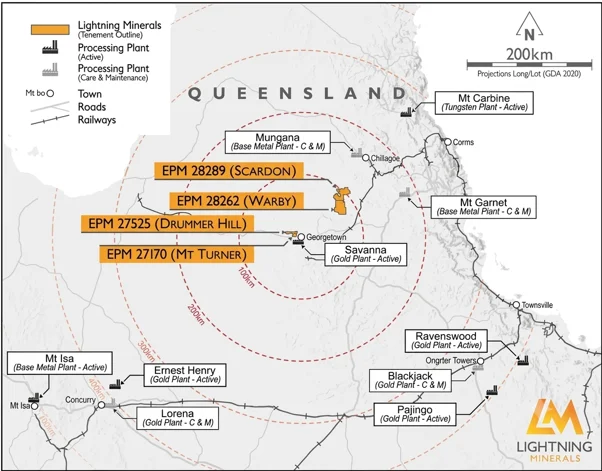
Figure: Mt Turner Project Site Layout and Location [Lightning Minerals]
At Warby, the Company has confirmed a substantially larger tungsten mineralised system, with rock-chip results returning grades of up to 5.5% tungsten (W) and soil and drainage sampling expanding the known mineralised footprint in several directions.
The latest results add to the Company’s exploration pipeline as it progresses systematic follow-up programs across both projects.
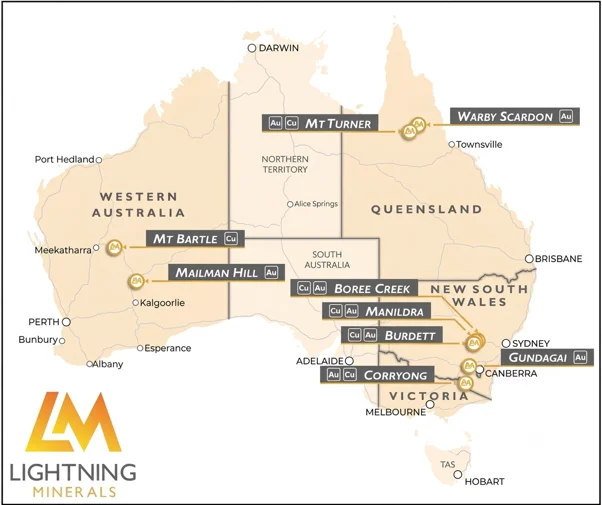
Figure: Lightning Minerals: Gold and Copper Project Locations in Australia. [Lightning Minerals]
Mt Turner Emerges as a Multi-Target Gold Corridor
Lightning Minerals’ latest work at the Mt Turner Gold Project has transformed the Western Zone from a conceptual structural target into a defined multi-target gold exploration corridor.
The Company completed 551 soil samples during July 2026, using gold and pathfinder-element distributions together with structural and thermal vectoring techniques to identify areas warranting further investigation.
The Western Zone extends for approximately five kilometres along the western margin of the Mt Turner porphyry system. Geological mapping has identified faulted Proterozoic metasediments and granite intruded by rhyolite dykes.
The latest exploration has defined two distinct gold target areas:
- A northern target featuring a continuous one-kilometre gold anomaly.
- A southern target comprising four sub-parallel gold trends extending over approximately 200–300 metres.
Lightning Minerals Managing Director Troy Brice said:
“These results represent an important step forward in our systematic evaluation of the broader Mt Turner Gold and Copper Project, defining two significant gold target areas within the five-kilometre Western Zone corridor.”
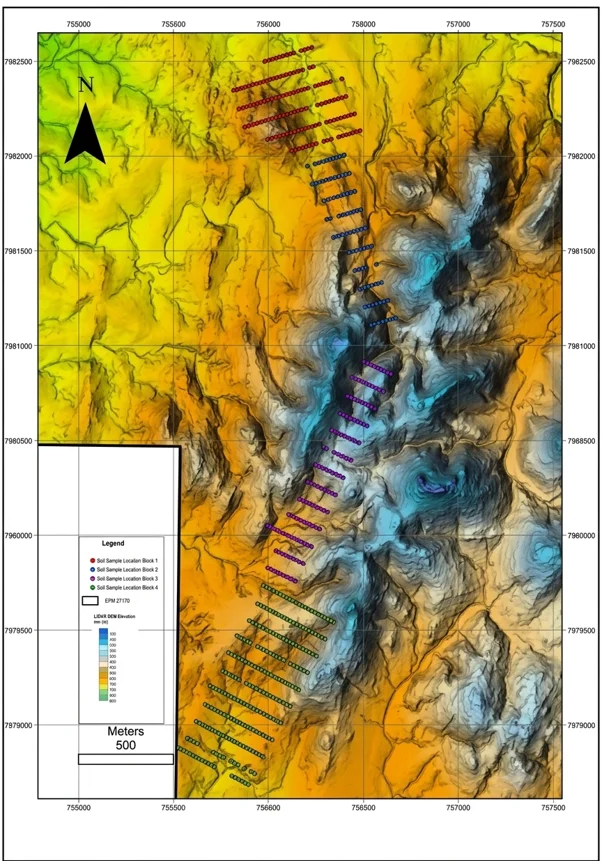
Figure: The Western Zone structural framework and soil sampling layouts are superimposed on a LiDAR digital elevation model from the August 2026 Western Zone Analysis Report. [Lightning Minerals]
Northern Target Shows a Large Hydrothermal Footprint
The northern Western Zone target represents one of the more significant outcomes from the latest exploration program.
Lightning Minerals identified a continuous gold anomaly exceeding 20 parts per billion (ppb) Au over approximately one kilometre. The anomaly ranges from about 20 to 80 metres wide and remains open towards the south.
More broadly, the Company identified a multi-element thermal vector anomaly extending approximately 1.4 kilometres along strike and up to 140 metres wide. The anomaly also remains open to the east.
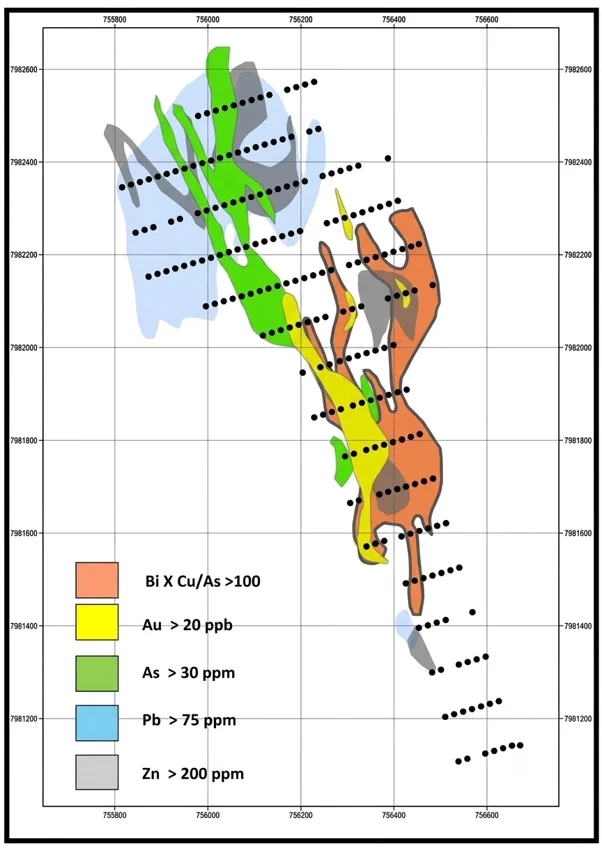
Figure: Northern soil geochemistry (Western Zone), highlighting gold anomalies above 20 ppb in yellow. [Lightning Minerals]
The gold response sits along the western margin of this broader hydrothermal footprint, while arsenic, lead and zinc provide additional evidence of metal zonation.
Rock-chip and float observations further support the interpretation, with the Company identifying gossanous breccia and siliceous gossan containing minerals including bismutite and cuprite.
Lightning Minerals interprets the northern target as potentially consistent with an intrusion-related gold system. However, the Company has emphasised that this interpretation remains preliminary and requires further surface sampling, trenching and eventual drilling.
Mr Brice added:
“The scale and coherence of the northern target is particularly encouraging, with a continuous one-kilometre gold anomaly adjacent to a larger 1.4-kilometre multi-element interpreted hydrothermal footprint, additionally, multiple, parallel, gold anomalies have been defined in the south.”
Southern Target Adds a Second Gold Style
The southern portion of the Western Zone provides a separate exploration opportunity.
Four sub-parallel north-trending gold anomalies have been identified, each extending approximately 200–300 metres along strike and reaching widths of up to 40 metres.
The strongest soil result returned 330 ppb Au.
Rock-chip sampling has also delivered encouraging results. One sample returned:
1.19 g/t Au, 38.80 g/t Ag, 5,540 ppm As, 1.32% Pb and 903 ppm Sb.
The Company believes the association of gold, silver, arsenic and antimony, together with relatively low copper and bismuth, may indicate a lower-temperature epithermal-style mineralisation environment.
This provides an important contrast with the northern target and suggests the broader Western Zone could host multiple mineralisation styles at different structural and thermal levels.
Lightning Minerals plans to conduct systematic rock-chip sampling along the southern anomalies and mineralised rhyolite dykes, with trenching to follow where continuity and tenor warrant additional investigation.
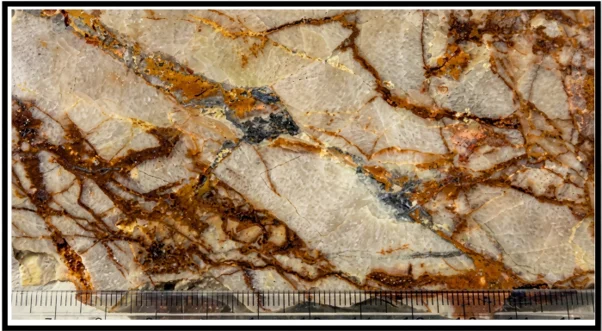
Figure: Silicified/brecciated rhyolite rock chip (Sample 106064, Cert #TV26251464). [Lightning Minerals]
Historical Results Add Further Exploration Context
The latest results are supported by historical exploration.
Lightning Minerals reviewed 99 historical rock-chip samples collected between 2019 and 2022. Twenty-four samples returned anomalous gold, silver or copper values, with individual results reaching:
- Up to 15.35 g/t Au.
- Up to 198 g/t Ag.
- Up to 22% Cu.
The Company has cautioned that these rock-chip samples are selective and spatially dispersed, meaning they should not be interpreted as representative of average grades, continuity or mineralised widths.
The historical data nevertheless provides additional context for the emerging Western Zone exploration model.
Warby Reveals a Much Larger Tungsten System
While Mt Turner is strengthening Lightning Minerals’ gold exploration pipeline, the Warby Tungsten Project is emerging as another important exploration opportunity.
Warby is a 100%-owned project in North Queensland, approximately 25 kilometres north of Mount Surprise.
The Company’s Phase 2 exploration program incorporated 91 soil samples, 17 panned concentrate samples, six additional rock-chip samples and 21 reference samples.
The results have confirmed that the mineralised system extends well beyond the known historical workings.
Most notably, five of six additional rock-chip samples returned more than 1% W, with the strongest result reaching approximately 5.5% W.
Managing Director Troy Brice said:
“The integrated Phase 2 results represent a significant step forward for the Warby Tungsten Project, confirming a mineralised system that is substantially larger than we originally interpreted.”
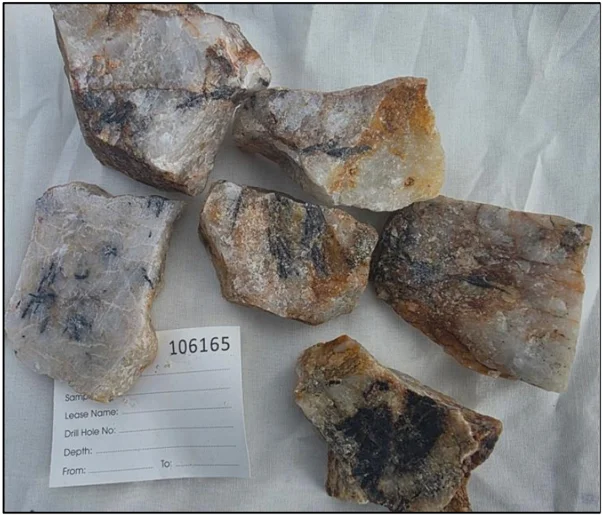
Figure: Specimen No. 106165 features prominent, coarse wolframite blades (up to 3 cm) embedded heavily within a milky white quartz vein. Laboratory analysis shows a tungsten content of 5.5% W. The photograph captures a 15 cm field of view.
Widespread Tungsten-Tin Dispersion Strengthens Warby
Soil sampling has significantly expanded the known footprint at Warby.
Anomalous tungsten values exceeding 50 parts per million (ppm) remain open in several directions, with the Company yet to establish the boundaries of the mineralised system.
Regional drainage sampling has also identified tungsten-tin dispersion across approximately four square kilometres. Peak results reached:
- 44,800 ppm W
- 41,700 ppm Sn
These results occur along a broader 13-kilometre granite contact that remains largely untested.
Another important sample returned 2.22 ppm Au, 0.21% Sn and 1.31% W, demonstrating that Warby has potential beyond tungsten alone.
The Company has identified evidence for wolframite and scheelite, the two principal tungsten minerals. Scheelite observed within wall rock under ultraviolet fluorescence may also provide a useful vector towards areas of potentially higher in-situ tungsten mineralisation.
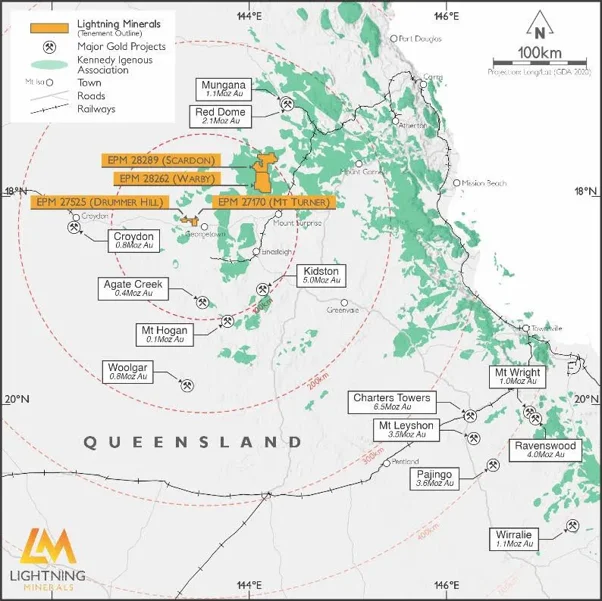
Figure: Warby project location map highlighting Lightning Minerals’ North Queensland tenements relative to major regional gold deposits.
Growing Tungsten Market and Industrial Demand
Tungsten has applications across a wide range of industrial sectors because of its exceptional hardness, density, high melting point and resistance to wear and heat.
The tungsten market was valued at approximately US$5.42 billion in 2025 and is projected to reach US$5.68 billion in 2026, before growing to approximately US$8.77 billion by 2035, representing a projected compound annual growth rate of 4.95%.
Demand comes from several major industrial applications.
Key Tungsten Applications
- Steel and high-speed tools: Tungsten strengthens steel and improves hardness, wear resistance and performance in applications such as drills, milling cutters and industrial tooling.
- Tungsten carbide: Tungsten carbide is widely used in cemented carbide products for cutting tools, mining equipment and wire-drawing dies because of its exceptional hardness and wear resistance.
- Wear-resistant and high-temperature alloys: Tungsten-containing alloys can withstand demanding thermal and mechanical conditions and are used in components including turbine and aerospace applications.
- High-density alloys: Tungsten’s high density supports applications requiring high specific gravity, strength and thermal performance.
- Electronics: Tungsten’s high melting point and electrical characteristics support applications including wires, electrodes and components used in electronic equipment.
- Chemical applications: Tungsten compounds are used in areas including pigments, inks, lubricants and catalysts.
- Medical applications: Tungsten alloys are used in radiation shielding, X-ray equipment and other medical applications requiring high density.
- Aerospace and defence: Tungsten’s density, hardness and high-temperature resistance make it useful in specialised aerospace, engineering and defence applications.
This diverse industrial demand provides broader context for Lightning Minerals’ exploration focus at Warby.
The Company has also highlighted tungsten’s status as a strategically important critical mineral, with governments and industry seeking to diversify supply chains and develop additional sources outside dominant producing regions.
Mr Brice said:
“Tungsten continues to be recognised as a strategically important critical mineral, with increasing global focus on securing supply from stable Western jurisdictions. Warby’s location in North Queensland positions Lightning well in that context.”
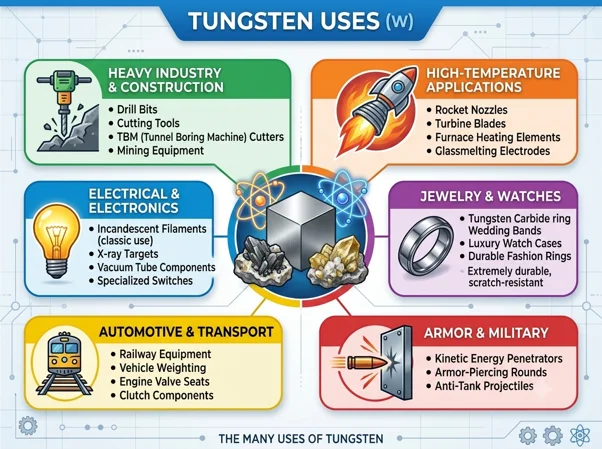
Figure: Different uses of Tungsten
Phase 3 to Define Warby Drill Targets
Lightning Minerals has already commenced Phase 3 exploration at Warby.
The program will extend and infill the existing soil grid to better define anomalies that remain open towards the northeast, southwest, north and west.
The Company intends to use these results to refine targets for a maiden drilling program.
Further regional panned concentrate sampling could also assess the broader Lyndbrook Complex, particularly around the 13-kilometre Angore Granite contact and areas where favourable northwest-trending structures intersect prospective geology.
Lightning Minerals also plans to use LiDAR data to help identify concealed historical workings and improve structural interpretation.
Next Steps Across Lightning Minerals’ Queensland Portfolio
The latest results provide Lightning Minerals with multiple exploration pathways across its Queensland projects.
At Mt Turner, the Company intends to undertake approximately 100 additional soil samples, five trenches across the northern gold anomaly and systematic rock-chip sampling across the southern target.
At Warby, Phase 3 soil sampling will focus on defining the extent and geometry of tungsten anomalies before the Company advances towards maiden drilling.
Mr Brice said:
“With multiple gold targets now emerging across Mt Turner, we are excited by the opportunity ahead and look forward to systematically advancing the Project.”
At Warby, he added:
“Our inaugural soil program has expanded the mineralised footprint well beyond the known historic workings, with anomalies remaining open in multiple directions, meaning we have not yet found the boundaries of this system.”
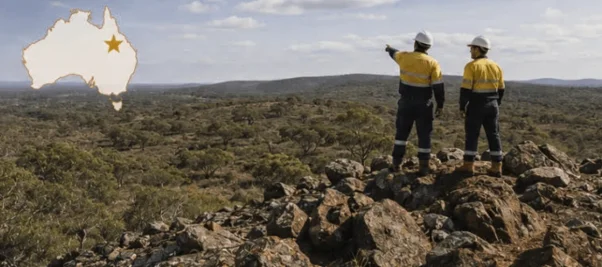
Figure: Lightning Minerals continues to explore a larger-than-expected polymetallic system at the 100%-owned Warby Tungsten Project.
Investors’ Outlook
Lightning Minerals is building a broader exploration pipeline around two distinct Queensland opportunities.
Mt Turner is generating multiple gold targets within a five-kilometre Western Zone, with the northern target displaying a substantial interpreted hydrothermal footprint and the southern target presenting a potentially different epithermal-style mineralisation environment.
Warby, meanwhile, is showing evidence of a large and open tungsten system with high-grade surface samples, broad tungsten-tin dispersion and additional gold, tin and copper indications.
The Company’s next exploration programs will be important in determining whether these anomalies develop into drill-ready targets and, ultimately, whether drilling can demonstrate mineralisation of sufficient continuity and scale to support further evaluation.
Share Price Activity (ASX)
| Metric | Performance |
| Last Price | $0.0155 |
| 1 Week | +29.17% |
| 1 Month | +10.71% |
| Market Cap | $6.08 million |
Lightning Minerals remains at an early exploration stage, and the current results do not establish a mineral resource or demonstrate economic viability. However, the expansion of both gold and tungsten exploration targets provides the Company with multiple avenues to generate further exploration results as it progresses its Queensland portfolio.
Disclaimer
This article has been prepared by Colitco in collaboration with Lightning Minerals as part of a commercial content and investor communications arrangement. Colitco may receive compensation for the production and distribution of this content. This article is intended for informational purposes only and does not constitute financial product advice, investment advice, or a recommendation to buy or sell any securities. The content reflects information available at the time of publication and may not be updated. All figures, data and statements have been sourced from Lightning Minerals’ official ASX announcements and publicly available sources. Readers should conduct their own independent research and seek professional financial advice before making any investment decisions. Past performance is not a reliable indicator of future results. Exploration results are not a guarantee of future resource definition or commercial production.

Luke Carlino is a seasoned Copywriter, Content Strategist, and Social Media Manager specialising in Mining, Finance, and Business journalism. With more than a decade of industry experience, he brings rigorous editorial standards and commercial acuity to every project.