The Charter Hall FY26 results tell a plain story with an odd twist. Operating earnings per security climbed roughly 26% on the year. And the group got there without booking a single dollar of performance fees.
That last point is the one worth chewing on.
Performance fees are the lumpy, feast-or-famine slice of a fund manager’s income. They show up when funds beat their hurdles. They vanish in flat years. Charter Hall guided all year on the assumption of zero. It still delivered growth of more than a quarter, 26.5% ahead of FY25’s 81.4 cents. So the money came from somewhere steadier.
It came from capital. Great slabs of it.
Institutional money did the heavy lifting on Charter Hall Group earnings
Gross equity inflows passed $6.5 billion during the year, which management has called the strongest capital-raising haul in the group’s 35-year history. Half a decade ago that figure would have looked like a typo.
Funds under management followed the money up. By the December half, pro-forma group funds under management sat near $92 billion, with property funds under management above $73 billion. Both kept climbing into the June close.
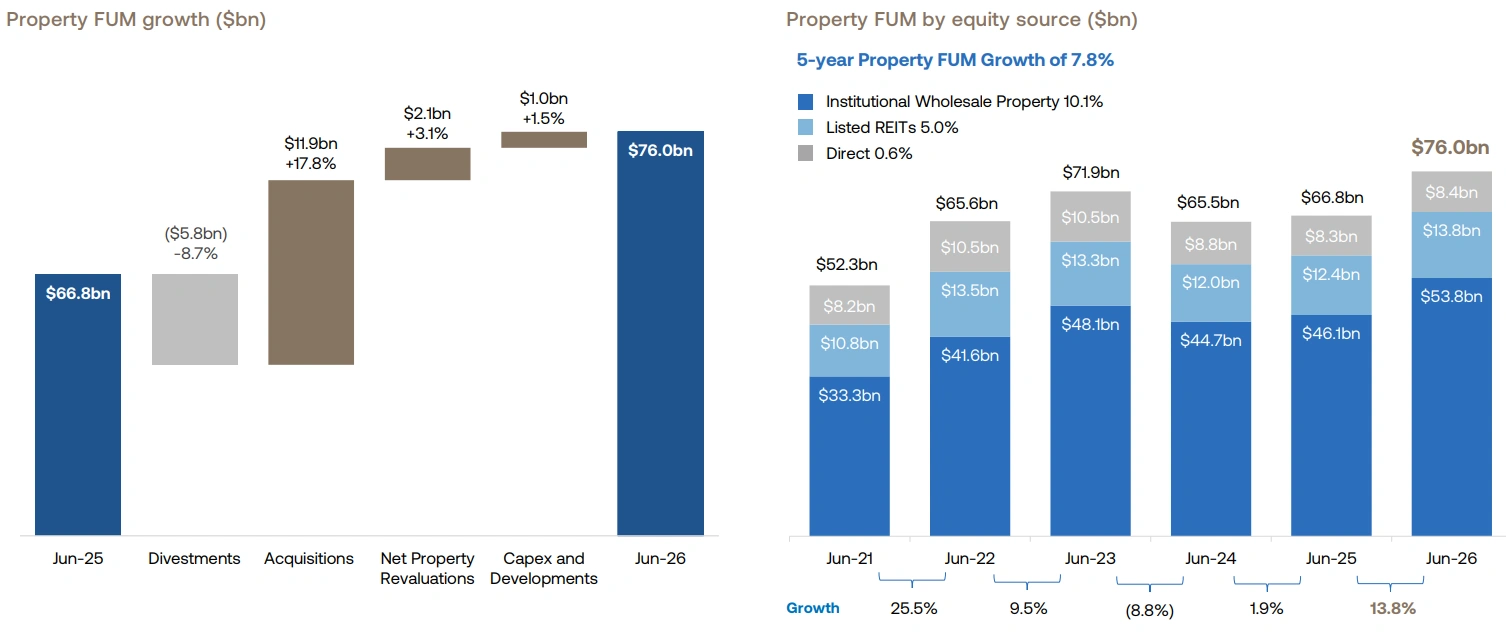
Charter Hall operating earnings per security, FY24 to FY26 [Source: Charter Hall Group]
Twenty-five new institutions signed onto the platform inside 18 months. Each one is a future fee stream, not a one-off.
The mandates show where the appetite sits. A $1.2 billion diversified core mandate. A $1.15 billion Sydney CBD office partnership. A new industrial partnership chasing long-lease logistics. An inflation-protected social infrastructure vehicle.
Office leasing, the sector plenty of people wrote off two years ago, ran 20% ahead of the first half.
The visible tip and the hidden engine
Most people meet Charter Hall through its listed trusts. Those already reported.
- Charter Hall Retail REIT (ASX: CQR): operating earnings up 4.0% to 26.4 cents a unit
- Charter Hall Social Infrastructure REIT (ASX: CQE): up 13.1% to 17.3 cents a unit
Steady, unremarkable numbers. The kind of income those trusts are built to throw off.
But the trusts are the shopfront. The engine sits behind them, in the funds management arm that clips a fee on every dollar it manages and every deal it transacts. That is where the 26% came from.
The half-year figures showed the shape of it. Statutory profit jumped 186% to $272.8 million in the six months to December. Operating earnings of $238.8 million, or 50.5 cents a security, up 21.6%.
The balance sheet stayed lazy in the best way. Gearing at 7.7%. About $1 billion of cash on hand. More than $7.8 billion of deployment capacity across the platform. Return on contributed equity ran 23.1% after tax. For a business that runs on other people’s capital, that is a good ratio to own.
Charter Hall operating EPS rode the turn in rates
Timing helped. David Harrison, the group’s managing director and chief executive, called FY25 an “inflection year.” Rates had peaked. Values had stopped falling. Big investors started moving again.
Harrison has been blunt about the next wave. He expects proposed federal changes to capital gains tax and negative gearing to push money out of residential property and toward commercial assets with long leases and built-in rent growth. If he’s right, the country’s largest diversified property manager is standing in the doorway.
There’s a dividend thread too. This result extends a distribution growth streak that now runs beyond 15 years. Payouts are set to rise about 6% on FY25. Over the streak, distributions have compounded at 7.8% a year.
The catch: the yield is thin. At a share price north of $23, the trailing payout sits around 2%. Income hunters find fatter cheques elsewhere. People buy Charter Hall for the compounding, not the coupon.
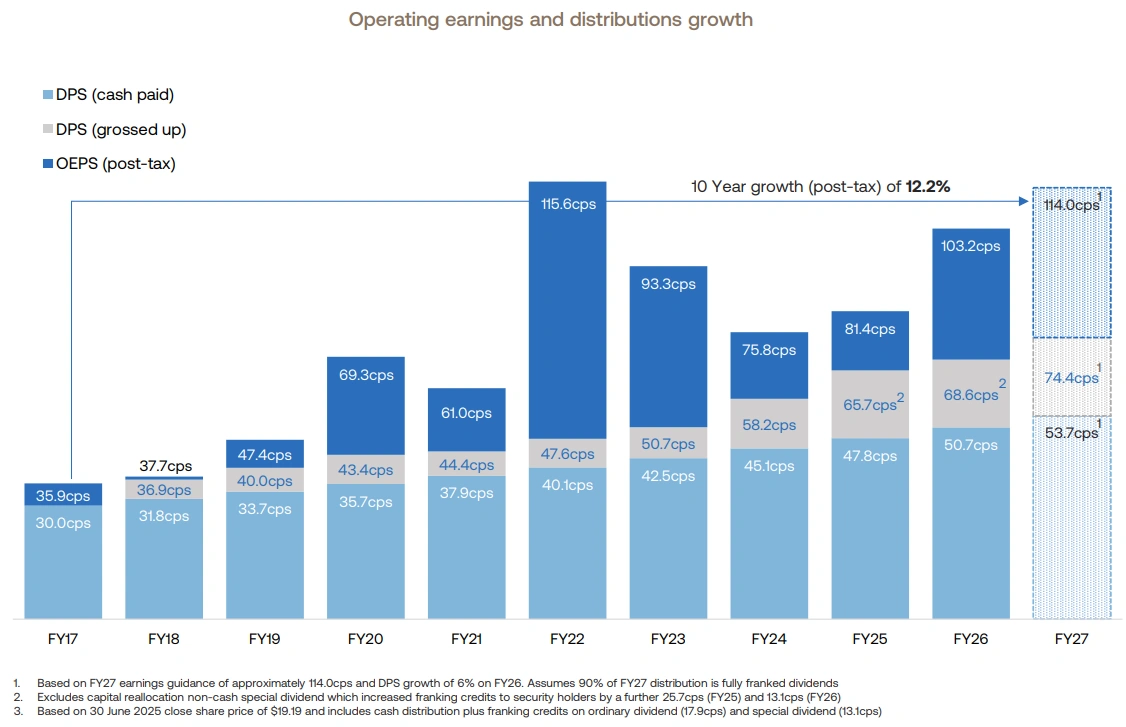
Charter Hall operating earnings per security, FY24 to FY26 [Source: Charter Hall Group]
What the number doesn’t fix
The result was strong. It wasn’t flawless.
Inflows drive earnings in later years, not the year they arrive. So the FY26 results mostly loads the spring for FY27 and beyond. The pipeline commentary matters more than the headline figure. Watch it.
Performance fees stay switched off in guidance. That’s conservative, and it hands the group a free option if funds outperform. It also means the base did all the work this year, with nothing held in reserve to paper over a soft patch.
Then there’s the obvious risk. Charter Hall lives and dies by the rate cycle. A stall in cuts, or a fresh leg up in bond yields, would cool the institutional demand that powered this year. Its construction and residential exposure carry execution risk of their own.
The market wasn’t in a party mood ahead of the print. Shares eased to about $22.86 by mid-August as the broader property sector sold off. Over 12 months the stock is up roughly 9%, a touch ahead of the ASX 200. Broker targets are all over the shop, which tells you nobody quite agrees on what a fund manager riding a capital wave is worth.
For readers, the takeaway is narrow. The 26% headline is real and it’s clean. But the thing to track from here isn’t FY26 at all. It’s whether the money keeps walking through the door, and whether Harrison’s residential-to-commercial rotation actually turns up in the FY27 inflow numbers.
FAQs
Q: What were Charter Hall’s FY26 results?
A: Post-tax operating earnings of about 103 cents a security, up roughly 26% on FY25.
Q: What is Charter Hall’s operating EPS for FY26?
A: Operating earnings per security landed near 103 cents, against 81.4 cents in FY25.
Q: Did Charter Hall book performance fees in FY26?
A: No. Guidance assumed none. Growth came from base fees and capital inflows.
Q: Who runs Charter Hall?
A: David Harrison, managing director and group chief executive.
Q: Why did earnings jump?
A: Record institutional inflows lifted funds under management and the fees tied to it.
Q: Does Charter Hall pay a big dividend?
A: No. Distributions grew about 6%, but the yield sits near 2%.
Disclaimer:
This article is general information, not financial advice. It does not account for your objectives, financial situation or needs. Figures are drawn from Charter Hall’s ASX releases and publicly available sources and may include derived or forecast data. Past performance is not a reliable guide to future results. Seek licensed financial advice before making any investment decision. Colitco may hold interests or have commercial arrangements with companies mentioned.

Luke Carlino is a seasoned Copywriter, Content Strategist, and Social Media Manager specialising in Mining, Finance, and Business journalism. With more than a decade of industry experience, he brings rigorous editorial standards and commercial acuity to every project.