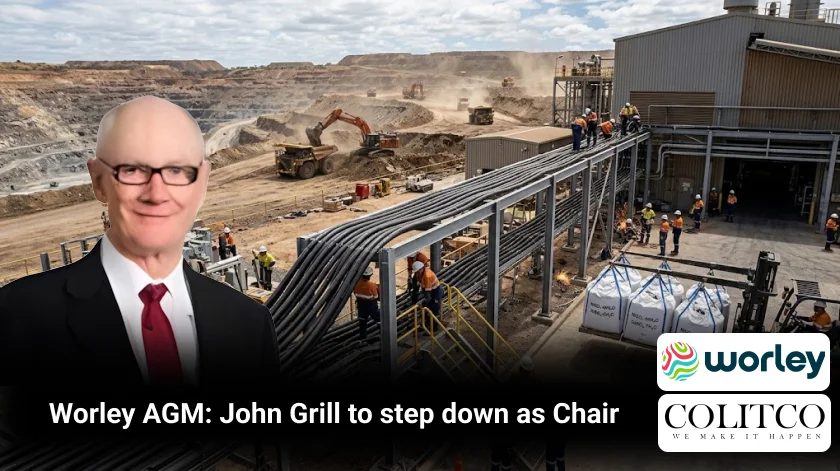
Worley’s 2026 AGM on 19 November carried two big headlines. Founder John Grill said he will step down as Chair at next year’s meeting, “provided my successor is in place”.
Shareholders also gave the remuneration report a strike. That means 25 per cent or more of the votes cast went against it.
A third piece sat in the middle. CEO Chris Ashton reconfirmed the FY27 outlook in the same session.
Three stories landed in one morning, and they are tangled together. Here is how they fit.
A remuneration strike landed on a bonus the board had already cut
Emma Stein, who chairs the People and Remuneration Committee, told the meeting the CEO’s FY26 short-term bonus paid 49.8 per cent of the maximum. Other key executives got 53.1 per cent. Both were the lowest in five years.
Last year the CEO figure was 78 per cent, according to the Australian Shareholders’ Association report on the 2025 meeting. That is a drop of about 28 percentage points. The strike came anyway.
Last year roughly 20 per cent voted against the pay report, which fell short of the line. This year the vote cleared it.
Worley has been here before. In 2019, the ASA recorded 31 per cent against the pay report.
So what went wrong? The bonus cut points to the answer. The short-term bonus was never the main sore spot.
The FY25 deferred equity award vested in full. Its test was gross margin growth from sustainability work, a target the board picked. The FY23 long-term award vested only 29.4 per cent, and the part tied to relative shareholder return paid nothing.
Put those side by side and the picture is simple. A company-chosen target paid out in full while the share price sagged. Ashton himself told the meeting the share price had declined and that he shares the disappointment.
The read from this desk is that a full payout on a hand-picked target is a hard sell to anyone holding the stock.
There was a second irritant. Worley treated $120 million of restructuring costs as abnormal, outside underlying EBITA. Grill said the board had heard the feedback on that treatment.
For FY27, the deferred equity test now targets gross margin growth from Energy and Power, with a graduated vesting scale. Grill said shareholders “expect a substantive response”. Whether a changed hurdle counts as one is the open question.
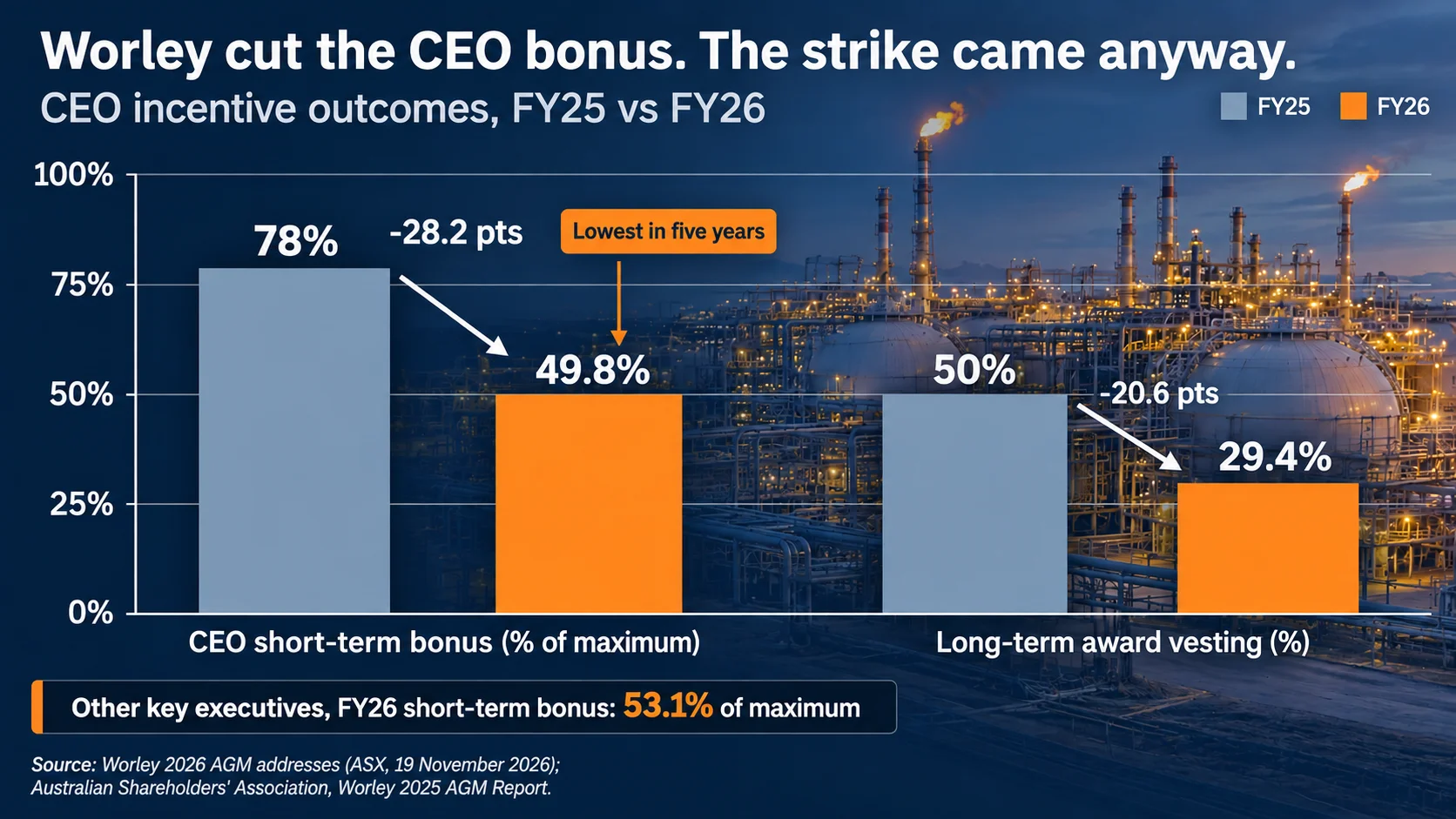
Worley’s CEO bonus and long-term vesting both fell in FY26, yet shareholders still struck the pay report.
John Grill’s exit comes with a condition attached
The wording matters. Grill said he intends to leave at the next AGM, but only if a successor is in place. There is no hard date, then.
He has been Chair since 1 March 2013, according to Worley’s governance statement. Last year the ASA reported that he put his hand up for another three-year term while promising an orderly succession. The handover now has a rough timeframe.
Deputy Chair Andrew Liveris is running the search through a board sub-committee. He has ruled himself out, citing other commitments. Executive search firm CHAIRS Global is on the job, and both internal and external names are in play.
Governance adds another angle. Worley’s own governance statement lists Grill as non-independent, with Liveris as Lead Independent Director. The ASX Corporate Governance Council recommends an independent Chair. A successor from outside the founder’s circle would most likely close that gap.
The FY27 outlook was reconfirmed, with a soft first half built in
Ashton said “we reconfirm our outlook”. That means mid to high single-digit growth in aggregated revenue and underlying EBITA. The condition is no material deterioration in markets and no major escalation of the Middle East conflict.
The base is low. FY26 underlying EBITA was $734 million, down from $823 million, and the Middle East conflict cost $58 million in the second half.
Quick maths on that base lands somewhere near $770 million to $800 million. Even the top of that range sits below FY25.
| Measure | FY26 | FY25 |
|---|---|---|
| Aggregated revenue | $12,023m | $12,050m |
| Underlying EBITA | $734m | $823m |
| Underlying NPATA | $395m | $475m |
| Underlying EPS | 78.2c | 90.2c |
| Full-year dividend | 50c | 50c |
Worley FY26 headline results against FY25
Ashton also said first-half earnings will be lower than last year’s. Profit is weighted to the second half. The half-year result, usually out in February, is where that gets tested.
The market already flinched once. Worley’s shares fell about 10 per cent on result day in August, with brokers having pencilled in faster growth.
One detail from the address shows how odd the disruption can get. Sulfur supply is holding up some fertiliser projects in North Africa under the JESA joint venture. Activity should pick up as sulfur prices fall.
Demand looks healthier than earnings. Bookings were $15.5 billion, up 23 per cent, and backlog was $13.8 billion. Data centres got a mixed note: Ashton said the environment has become harder, but Worley’s bookings and pipeline there are still growing.
The next Chair inherits a pay fight and a Middle East problem
Here is the calendar risk. If 25 per cent or more vote against the pay report again at the 2027 AGM, a spill resolution goes on the ballot. It needs 50 per cent support to pass.
That meeting is also the one where Grill hopes to hand over. A new Chair could walk into a spill vote in their first week.
The board has about twelve months to show the changes work. The bonus cut suggests the size of the payout was not the main complaint. The design of the targets was.
Nothing in the addresses links Grill’s exit to the strike. The timing will get read that way anyway.
Dates worth circling:
- The Chair announcement, including whether the pick is independent
- The half-year result, due around February 2027
- The 2027 remuneration report and notice of meeting
Grill built Worley from a small Australian consultancy into a 40,000-person global business. His exit is slow, conditional and now sits beside a strike. The next Chair’s first job is to settle the pay argument.
Also Read: Capstone Copper Guidance Cut: Pinto Valley Restart Slips
FAQs
Q: Who is John Grill?
A: The founder of Worley and its Chair since 2013.
Q: When will John Grill step down?
A: At next year’s AGM, if a successor is in place.
Q: What is a remuneration strike?
A: 25 per cent or more of votes cast going against the pay report.
Q: Who is leading the Chair search?
A: Deputy Chair Andrew Liveris, with CHAIRS Global. He is not a candidate.
Q: Did Worley reconfirm its FY27 outlook?
A: Yes. It expects mid to high single-digit growth in revenue and underlying EBITA.
Disclaimer:
General information only. This is not financial advice. It does not consider personal objectives, financial situation or needs. Readers should consider seeking independent financial advice before making investment decisions.

Elizabeth Jones is a finance and mining content specialist with over 10 years of experience creating clear, SEO-driven content across fintech, investing, banking, insurance, cryptocurrency, and resource markets. She transforms complex financial data and industry trends into engaging, reader-focused articles that improve understanding and audience engagement.