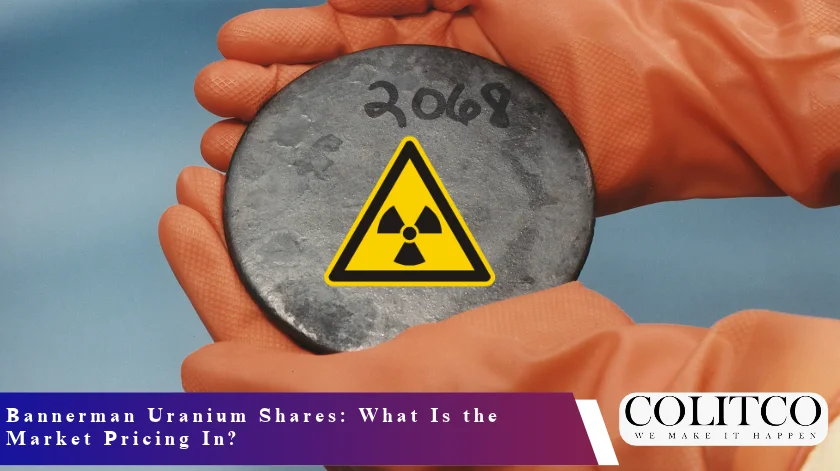
Bannerman Energy has entered a significant new phase in its development, with its flagship Etango uranium project in Namibia moving from early-stage development towards full-scale construction. Following a major strategic investment from China National Nuclear Corporation’s subsidiary, CNNC Overseas Limited (CNOL), and a positive Final Investment Decision (FID), the company has strengthened its pathway towards becoming a uranium producer.
However, the latest developments raise an important question for investors: how much of Bannerman Energy’s future growth is already reflected in its share price?
The Bannerman Energy share price has attracted attention as investors assess the company’s funding position, construction progress, uranium market conditions and expected production timeline. With the ASX-listed company trading under the ticker BMN, its valuation increasingly depends on whether it can successfully deliver the Etango project and translate its development milestones into future revenue.
This article examines the ASX BMN share price, the company’s latest developments, the factors influencing its valuation and what investors should consider when assessing the Bannerman Energy stock forecast.
Bannerman Energy Share Price: Where Does the Stock Stand?
Bannerman Energy Limited trades on the Australian Securities Exchange (ASX) under the ticker BMN. Its primary focus is the development of uranium assets in Namibia, particularly the Etango Uranium Project.
As of 30 October 2026, the ASX BMN share price closed at approximately A$3.37, following a decline of 7.16% during the trading session.
The company’s reported market capitalisation was approximately A805million,witha52-weektradingrangeofA2.77 to A$5.25.
These figures provide an indication of the market’s current valuation of Bannerman’s development prospects.
The recent share price movement also highlights the volatility associated with uranium development companies. Even following positive project announcements, investors may reassess valuations based on execution risks, commodity prices, financing conditions and broader market sentiment.
For Bannerman, the central valuation question is no longer simply whether Etango can be developed. It is increasingly about how efficiently the company can deliver construction, achieve production targets and generate sustainable cash flow.
Etango Uranium Project: The Biggest Driver of Bannerman’s Valuation
The Etango Uranium Project in Namibia is the most important asset influencing Bannerman Energy’s long-term investment outlook.
Located in the Erongo uranium province, Etango is an advanced uranium development project that has progressed through extensive technical assessments, permitting and early construction activities.
In October 2026, the Etango joint venture reached a positive Final Investment Decision, marking a major milestone in the project’s development.
Under the approved Etango-8 development plan, the project is expected to achieve:
- Forecast average annual production of approximately 3.5 million pounds of uranium (U3O8).
- Targeted commissioning and first production during 2028.
- Estimated pre-production capital expenditure of approximately US$353 million, with a +/-10% range.
- A phased construction programme building on the early works already completed.
The project had also achieved substantial construction progress by the end of September 2026, with bulk earthworks approximately 99% complete.
These developments are important because they move Bannerman closer to its transition from a uranium developer to a producing company.
For investors, reaching FID reduces some of the uncertainty associated with project approval and funding. However, it does not eliminate construction, operational or commodity-price risks.
The company’s ability to maintain its construction schedule and manage capital expenditure will remain important valuation factors.
CNOL Investment: Has Bannerman Reduced Its Funding Risk?
One of the most significant developments for Bannerman Energy has been its strategic partnership with CNNC Overseas Limited.
The transaction delivered approximately US$320.4 million in total cash proceeds, comprising:
- US$294.5 million invested into the Etango joint venture.
- US$25.9 million paid to Bannerman as reimbursement for eligible project expenditure.
CNOL now holds a 45% interest in the Etango joint venture, while Bannerman retains 55%.
Since the joint venture owns 95% of the Etango Project, the underlying economic ownership is distributed as follows:
Stakeholder | Effective project interest |
Bannerman Energy | 52.25% |
| CNOL | 42.75% |
| One Economy Foundation | 5% |
This structure has two important implications for Bannerman shareholders.
First, the strategic investment provides substantial financial support for Etango’s development. Second, Bannerman has reduced its direct exposure to the project’s construction funding requirements while retaining majority economic ownership.
According to the company’s September 2026 quarterly activities report, Bannerman held approximately A$175 million in consolidated cash at 30 September 2026, excluding cash held by the Etango joint venture.
The joint venture separately held approximately US$295 million in cash, excluding cash held in Namibian subsidiaries.
The company stated that these combined cash resources provide a fully funded pathway through construction, ramp-up and into commercial production, including Bannerman’s forecast share of residual working capital requirements.
For investors, this significantly changes the funding-risk profile compared with an earlier-stage uranium developer that still needs to secure substantial project capital.
Nevertheless, funding certainty does not guarantee construction will be completed without delays or cost increases.
What Is the Market Pricing Into Bannerman Uranium Shares?
The current Bannerman Energy valuation reflects several interconnected expectations.
Investors are assessing not only the company’s existing project assets but also the potential value of future uranium production.
There are five major factors worth examining.
1. Progress Towards Commercial Uranium Production
The first major factor is the expected transition to commercial production in 2028.
Development-stage mining companies are often valued on their future production potential rather than current operating revenue.
Etango’s projected annual production of approximately 3.5 million pounds of U3O8 provides a measurable basis for assessing the project’s future economics.
However, investors must distinguish between total project production and Bannerman’s economic share.
With Bannerman holding an effective 52.25% interest in Etango, its attributable production exposure is smaller than the project’s headline production figure.
This distinction is important when evaluating the company’s potential future revenue and valuation.
2. Uranium Market Fundamentals
The uranium market remains a central factor in Bannerman’s investment case.
Nuclear energy is receiving renewed attention as governments and utilities consider energy security, electricity demand and low-emission power generation.
At the same time, uranium supply availability and long-term contracting activity influence expectations for future prices.
Bannerman reported a quarter-end long-term uranium price of approximately US$97 per pound in its September 2026 quarterly report.
Higher long-term uranium prices could improve the economic attractiveness of new production projects.
However, uranium prices can fluctuate, and the company’s future realised selling prices will depend on contractual arrangements and prevailing market conditions.
3. Strategic Offtake Agreement With CNOL
Another important factor is Bannerman’s uranium sales arrangement.
Under the joint venture agreement, CNOL will purchase 60% of Etango’s uranium production through binding life-of-mine offtake arrangements.
The pricing structure is linked to a combination of spot and term uranium price indices at the time of delivery, without contractual price floors or ceilings.
Bannerman retains responsibility for independently marketing the remaining 40% of production.
This arrangement provides a significant sales channel while leaving some production exposed to future marketing opportunities.
For investors, the agreement reduces uncertainty around placing a substantial portion of future production. However, it also means that the full project production volume should not be treated as revenue attributable solely to Bannerman.
4. Construction Execution and Capital Management
With FID achieved, construction execution becomes increasingly important.
The market will be watching several developments:
- Progress across major construction packages.
- Procurement of critical equipment.
- Completion of processing infrastructure.
- Permanent water and electricity infrastructure.
- Management of capital expenditure.
- Progress towards commissioning and first production.
Even a well-funded project can face delays due to supply-chain constraints, contractor performance, infrastructure challenges or unexpected costs.
For Bannerman, delivering Etango within its forecast development parameters will be essential to supporting investor confidence.
5. Future Production and Expansion Potential
The longer-term opportunity is another factor that may influence the Bannerman Energy stock forecast.
Etango is being developed around the Etango-8 design, with a planned average annual production rate of approximately 3.5 million pounds of U3O8.
The project also provides Bannerman with exposure to a broader uranium production opportunity in Namibia.
However, investors should distinguish between the currently approved development plan and any future expansion opportunities.
Additional production capacity would require its own technical, commercial and capital assessment. It should not automatically be included in the company’s current valuation.
Bannerman Energy Stock Forecast: What Could Influence BMN in 2027 and Beyond?
The Bannerman Energy stock forecast is closely connected to the successful execution of Etango and the direction of the uranium market.
As the company moves into full-scale construction, investors are likely to focus on operational milestones rather than development announcements alone.
Several factors could influence the stock’s performance over the coming quarters.
Potential positive drivers
- Construction progresses within the expected budget and timeline.
- The company achieves its targeted 2028 first-production schedule.
- Uranium prices and long-term contracting conditions remain supportive.
- The CNOL partnership continues to provide financial and commercial stability.
- Bannerman successfully markets its remaining 40% production allocation.
Potential downside risks
- Construction delays or capital expenditure increases.
- Weakness in uranium prices.
- Changes in global nuclear energy investment.
- Operational challenges during commissioning and ramp-up.
- Market volatility affecting development-stage mining stocks.
Third-party market data available on 30 October 2026 indicated an average 12-month analyst price target of approximately A$5.10, based on six analyst estimates.
This compares with the closing share price of A$3.37 on the same date.
Although this represents a substantial implied difference between the market price and the reported analyst target, it should not be interpreted as a guaranteed return or a reliable prediction of future performance.
Analyst targets are estimates based on individual assumptions about project economics, commodity prices, risk and valuation.
The actual performance of BMN will depend on how the company delivers against its operational and financial objectives.
Is Bannerman Energy Undervalued or Already Pricing in Future Growth?
Determining whether Bannerman Energy is undervalued requires looking beyond its latest share price.
The company has achieved several important milestones that have strengthened its development profile:
- Completion of the CNOL strategic financing transaction.
- Establishment of the Etango joint venture.
- A positive Final Investment Decision.
- Substantial cash resources supporting construction and working capital.
- A defined production target and expected 2028 first-production timeline.
These developments provide a stronger foundation for evaluating Bannerman compared with its earlier development stage.
However, the market may already be assigning value to some of these achievements.
The company’s valuation must also account for its reduced effective ownership of Etango following the joint venture, future operating costs, uranium selling prices and the risks associated with bringing a large-scale mining operation into production.
A key question for investors is whether the company’s future attributable cash flows can justify its current market capitalisation.
That assessment will become clearer as construction advances, capital requirements are confirmed and the project approaches commercial production.
Therefore, rather than viewing BMN solely through its potential upside, investors should assess both the value created by its strategic partnership and the execution risks that remain.
What Should Investors Watch Next?
The next phase of Bannerman Energy’s development will provide important information about whether the company’s current valuation is supported by operational progress.
Some of the key developments to monitor include:
- Construction milestones: Updates on processing infrastructure, earthworks, procurement and major construction contracts.
- Capital expenditure: Any changes to the forecast US$353 million pre-production capital cost.
- Project financing: Updates on the utilisation of joint venture cash and Bannerman’s working capital position.
- Uranium market conditions: Changes in spot and long-term uranium prices.
- Offtake arrangements: Progress in marketing the remaining 40% of production.
- Production timeline: Updates supporting the targeted 2028 commissioning and first-production schedule.
These factors could provide a clearer picture of Bannerman’s ability to convert its development assets into a producing uranium business.
Frequently Asked Questions
What is the Bannerman Energy share price?
Bannerman Energy (ASX: BMN) closed at approximately A$3.37 on 30 October 2026. Share prices fluctuate throughout trading, so investors should check the latest ASX market data.
What is the ASX BMN share price forecast?
Third-party market data reported an average 12-month analyst price target of approximately A$5.10 as of 30 October 2026, based on six analyst estimates. This is an estimate rather than a guaranteed future share price.
Is Bannerman Energy expected to produce uranium in 2028?
Yes. Bannerman’s Etango-8 development plan targets commissioning and first uranium production during 2028, subject to successful construction and operational execution.
What is the Etango Uranium Project’s expected production capacity?
The Etango-8 design forecasts average annual production of approximately 3.5 million pounds of uranium (U3O8).
Who is CNOL, and why is its investment important to Bannerman?
CNNC Overseas Limited is a subsidiary of China National Nuclear Corporation. Its US$320.4 million strategic transaction provides major funding support for Etango and establishes a long-term uranium offtake relationship.
Does Bannerman Energy pay dividends?
Bannerman Energy is primarily focused on developing its uranium project rather than distributing operating earnings. Investors should check the company’s latest financial disclosures for any changes to its dividend policy.
Final Thoughts: What Is the Market Pricing In?
Bannerman Energy has reached an important turning point.
The completion of its strategic partnership with CNOL, the funding position of the Etango joint venture and the positive Final Investment Decision have moved the company closer to becoming a uranium producer.
These developments provide a stronger basis for the Bannerman Energy investment case, but they also raise expectations around construction performance and the targeted 2028 production timeline.
The ASX BMN share price will likely remain sensitive to uranium market conditions, project execution, capital management and the company’s ability to generate sustainable returns from its attributable production.
Ultimately, the market is pricing in more than the potential of a uranium deposit. It is assessing whether Bannerman can successfully deliver a large-scale project and convert its development progress into long-term shareholder value.
For investors following Bannerman uranium shares, the next stage of construction and the approach towards first production could prove more important than the announcements that brought the project to this point.
Disclaimer: This article is for informational and educational purposes only and should not be considered financial or investment advice. Analyst estimates and share-price information are subject to change. Investors should conduct their own research and consider their financial circumstances before making investment decisions.

Luke Carlino is a seasoned Copywriter, Content Strategist, and Social Media Manager specialising in Mining, Finance, and Business journalism. With more than a decade of industry experience, he brings rigorous editorial standards and commercial acuity to every project.