
ASIC financial reporting and audit quality is back under the microscope after Report 842 landed on 29 October 2026. The regulator says preparers and auditors are still “not getting the fundamentals right”.
The sample is small. ASIC reviewed 311 company financial reports and dug into 19 company audit files across 12 firms.
The Big 4 audit firms ASIC findings cluster around revenue and impairment
Four of the 19 files came back clean. The other 15 carried at least one finding.
ASIC logged 17 “audit findings”, the serious category. It means the auditor lacked enough evidence to back the opinion. It doesn’t mean the accounts were wrong.
Six findings were about revenue and receivables. Five were about impairment and asset values. Both areas run on management guesses, so auditors have to push back.
The names make the pattern clearer. PwC had three audit findings, Deloitte two, EY two and KPMG one. BDO had two and Grant Thornton one. Across the Big Four, 10 files produced eight.
Some were specific. A Deloitte auditor did not properly test the risk premium inside a discount rate. A PwC auditor did not challenge one discount rate across multiple sites, or forecasts running past five years.
Here is the part that surprised. The heaviest load per file sat with the smallest firms. Three small-firm files produced four audit findings, and every one of them had a finding of some kind.
One auditor has since handed back a registration after surveillance.
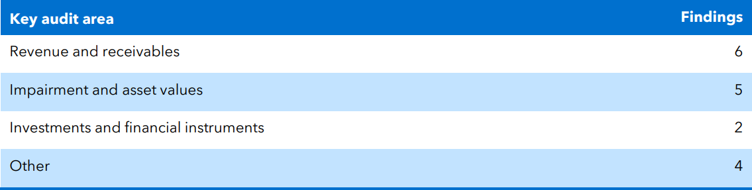
Revenue and impairment drew 11 of the 17 audit findings in ASIC’s 2025-26 company audit surveillance. [ASIC]
Financial reporting shortfalls start in the risk section
On the company side, 30 reports went to full surveillance. Sixteen companies changed, or agreed to change, 20 areas.
The biggest group was the operating and financial review. Ten companies across eight industries had to improve how they describe business risk. In some cases, the risk disclosure was missing entirely.
Names on that list include ADX Energy, Southern Hemisphere Mining and Timah Resources. Timah also admitted it left out a consolidated entity disclosure statement that public companies must include.
Viva Energy is the dollar example. It tested convenience sites inside one Shell Card unit instead of site by site. After ASIC’s inquiries, the company booked $558.8 million of impairment on those sites, and $25 million of it came from the change in approach.
Pure Foods Tasmania cut $4.5 million from deferred tax assets after five straight years of losses.
Miners should read the next bit twice. In 2026-27, ASIC will check decommissioning and site restoration disclosures against new AASB 137 guidance. This round, one mid-tier auditor fell short on a restoration provision, where the question was whether costs would stay below a rehabilitation bond.
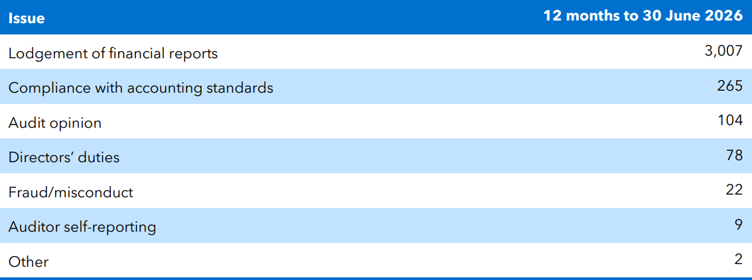
Auditor breach notifications rose almost five-fold after ASIC reissued its guidance. [ASIC]
Auditor independence is where named firms feel the most heat
Three files were picked because of independence worries. Each involved a large firm.
Deloitte had audited one large private company for more than 15 years. A former Deloitte partner had been that company’s secretary and CFO since 2022-23, and non-audit fees had beaten audit fees since 2023-24.
PwC had audited a listed company for over 25 years. That company’s audit committee chair was a former PwC partner.
Grant Thornton had kept the same lead partner on a large private client for more than 10 years.
Fixes followed. Deloitte’s lead partner rotates off after this year’s audit. Grant Thornton added a second partner to review key judgements. PwC wrote down its thinking on the former-staff question.
ASIC sent the six biggest firms back for a second self-assessment aimed at root causes. It also warned that independence can’t be treated as “a compliance exercise”.
Auditors also reported far more to the regulator. ASIC received 3,341 notifications in 2025-26, nearly five times the 696 of the year before. More than 85% concerned companies that failed to lodge their reports.
Nineteen files is a thin sample, but it points at where to look
ASIC picks files by risk, and 10 of the 19 were chosen at random. This is not a league table. About 500 registered auditors work on listed entities, and ASIC saw a sliver of their output.
Still, the same two weak spots keep surfacing. One is judgement in revenue and valuations. The other is thin paperwork, with another 17 findings about documentation.
To a regulator, an undocumented judgement is a missing one.
Retail investors can run a few checks without special tools:
- Read the risk section in the directors’ report and ask whether it describes this company or any company
- Note how long the same firm has signed the accounts
- Compare audit fees with non-audit fees in the auditor’s remuneration note
- Look at the discount rates and rehabilitation assumptions behind big impairments and provisions
ASIC financial reporting and audit quality will get another round next year. The regulator plans at least 200 company reports, 25 audit files and 20 managed schemes, and it will chase whether the promised fixes happened. A separate review of internal complaints at the four largest firms is already under way.
ASIC also admits a limit. It can act on individual auditors more easily than on firms. Until that changes, naming is the sharpest tool in the drawer.
Also Read: PLS Group’s FY27 Results Reveal a Lithium Trade-Off
FAQs
Q: What is ASIC Report 842?
A: ASIC’s yearly review of financial reporting and audit quality, released on 29 October 2026.
Q: Which audit firms did ASIC review?
A: Twelve firms, including BDO, Deloitte, EY, Grant Thornton, KPMG and PwC.
Q: Do audit findings mean the accounts were wrong?
A: No. They mean the evidence behind the audit opinion fell short.
Q: What happens next?
A: ASIC will check in 2026-27 whether the promised fixes were completed.
Disclaimer: This article is general information only and is not financial advice. It does not consider anyone’s objectives, financial situation or needs. Investing in ASX-listed securities carries risk. Readers should do their own research and speak to a licensed adviser before making investment decisions.

Luke Carlino is a seasoned Copywriter, Content Strategist, and Social Media Manager specialising in Mining, Finance, and Business journalism. With more than a decade of industry experience, he brings rigorous editorial standards and commercial acuity to every project.