Back in February, plenty of people had written AMP off. The FY25 result landed badly and the shares dropped about 28% in the opening weeks of 2026. Six months on, the picture reads differently.
The AMP 1H26 results, out on 6 August, show underlying profit up a third to $174 million and a fresh $150 million buyback on the table. Statutory profit rose 57% to $154 million. The stock climbed around 3.669% on the day to roughly $2.26.
Here is the bit most headlines will skip. The profit was old news.
AMP told the market on 16 July to expect underlying net profit between $170 million and $180 million. So $174 million lands smack in the middle. Anyone paying attention got no surprise at all. What actually moved today was the capital.
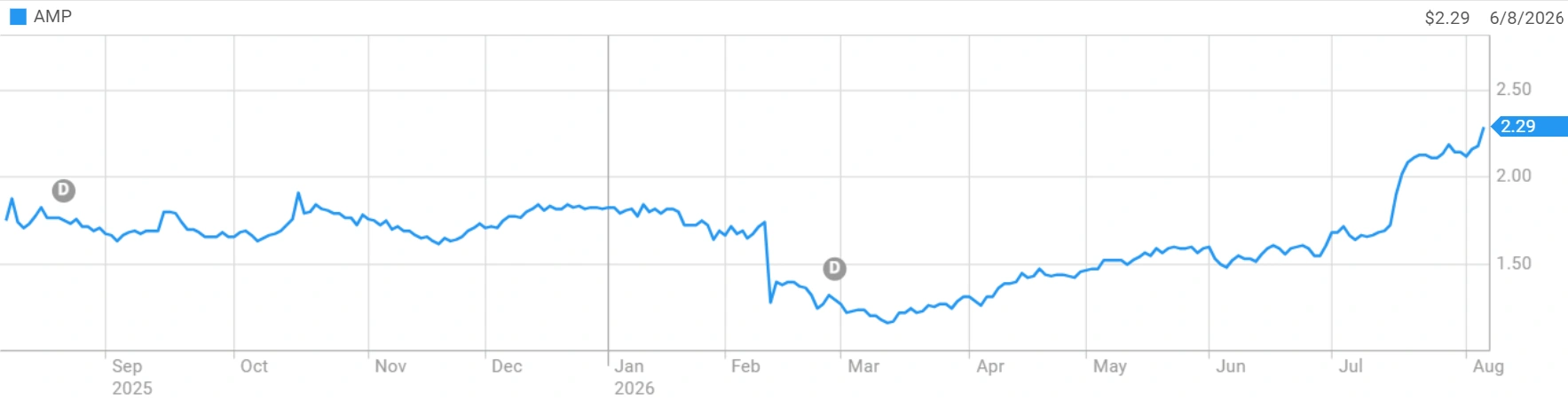
AMP Limited (ASX: AMP) share price over the past year [Courtesy: ASX]
The profit was already spoken for
Brokers had a fortnight to chew over the number. Jefferies pointed out that consensus had been sitting near $142 million before the July upgrade, so on paper the guidance was a big beat. The same note flagged the fine print.
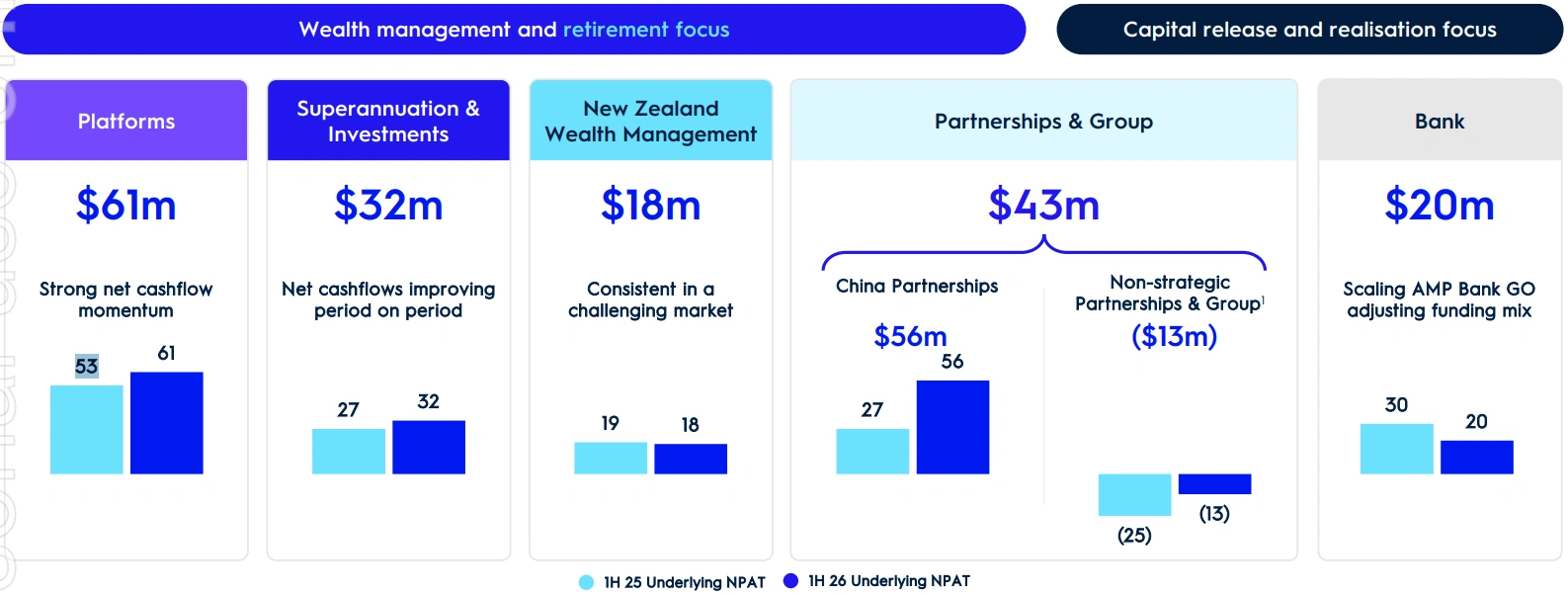
AMP business-unit underlying NPAT, first half 2025 versus first half 2026 [Courtesy: AMP]
Roughly $13 million of the half came from carried interest on a legacy fund. Another $5 million came from a hedging gain in Platforms. A $12 million writedown on sponsor investments pushed the other way. Strip the one-offs and the beat shrinks.
That matters. A buyback is a bet on earnings that repeat, not a one-off sugar hit.
AMP 1H26 results hinge on a nine-year turnaround
Now the part worth stopping on. AMP’s Superannuation and Investments arm booked positive net cashflow of $76 million for the half. First time it has managed that since 2017. Read that again. For nine years, more money walked out of AMP’s super than walked in. A year ago the same line was a $75 million outflow.
Cash leaving a super fund is the slow death of a wealth business. Reversing it is harder than any buyback. Platforms pulled its weight too, with North cashflows up 33% to $3.1 billion and 74 net new advisers signing on with real money, plus 38 fresh distribution deals with licensees. Group assets under management sit at $167.6 billion.
The cashflow trend is the story. Profit is just the scoreboard.
The bank is losing money on purpose
AMP Bank looks like the odd one out. Underlying profit fell to $20 million from $30 million. In a result full of green, that reads like a stumble.
Dig in and it makes sense. AMP is pouring money into AMP Bank GO, its new digital bank, and it has closed the old bank to new deposits. GO deposits leapt from $310 million to $1.7 billion in a year, across about 34,500 customers.
The mortgage book actually shrank a touch to $23.6 billion, deliberately, because the bank would rather defend margin than chase volume. Net interest margin still slipped to 1.25% from 1.30%.
Short-term pain, and management is honest about it. The payoff hangs on how sticky those GO deposits prove to be.
China stopped being a rounding error
For years, AMP’s China partnerships were the line nobody bothered to model. Not now. The contribution more than doubled to $56 million, with China Life Pension Company assets climbing to about 2.6 trillion yuan.
The combined return on the two joint ventures jumped to 16% from 9%, and their carrying value rose to $705 million.
That is real money, and it reshapes the company. It also raises a fair question. How much of an Australian wealth manager’s profit do investors want tied to a pension market on the other side of the world?
Citi reckons the China lift looks durable. Others will want another couple of halves before they trust it.
Then the capital, which is what today was really about. AMP generated $236 million of surplus capital in the half and handed back $201 million through dividends and buybacks. The extra $150 million buyback announced today is the second of the year.
The first, wrapped up in June, soaked up roughly 99 million shares at an average of $1.52. The board also declared a 3 cent interim dividend.
One catch on that dividend. It is only 20% franked. Income investors who buy Australian financials for the franking credits will clock that straight away. Thin franking is the tell that a good slice of the profit is coming from offshore and from old tax losses, not from fully taxed local earnings.
Anyone hunting yield might prefer the names in ASX dividend shares income investors are watching or the steadier options in a long-term retirement portfolio.
So where does that leave a reader watching AMP? The buyback is genuine support and it trims the share count, which flatters earnings per share. But at roughly 5% of the company’s value, it is a steadying hand, not a rocket. The real test is whether North keeps hauling in cash, whether super stays in the black, and whether China holds.
Nail those three and the profit sorts itself out. Miss one and the one-offs get exposed. This is a very different company from the one Blair Vernon inherited at his first AGM as chief executive in April, and for a stock left for dead in February, doubling off the lows is a decent comeback.
The next chapter is about proving the run is the engine, not the tailwind. For income-focused readers weighing it up, it sits in very different territory to the classic ASX dividend shares bought for passive income.
Also Read: Monadelphous Wins $200M BHP Contract at Nelson Point
For More Information: https://colitco.com/
FAQs
Q: What were AMP’s 1H26 results?
A: Underlying profit rose 33% to $174 million and statutory profit rose 57% to $154 million.
Q: How big is the new AMP buyback?
A: $150 million on-market, the second buyback of 2026.
Q: What is AMP’s interim dividend?
A: 3 cents per share, franked at 20%.
Q: Why did AMP Bank’s profit fall?
A: It is spending to grow AMP Bank GO and has shut its old bank to new deposits.
Q: When did AMP’s super business last see positive cashflow?
A: Not since 2017, before this half’s $76 million inflow.
Q: How is AMP’s China business performing?
A: Its partnerships contributed $56 million, more than double a year ago.
Disclaimer:
This article is general information only and not financial product advice. It does not consider your objectives, financial situation or needs. COLITCO LLP accepts no responsibility for any claim, loss or damage arising from the information provided or its accuracy. Consult a licensed financial adviser before making any investment decision. Investing carries risk, including loss of capital.
Source:

Luke Carlino is a seasoned Copywriter, Content Strategist, and Social Media Manager specialising in Mining, Finance, and Business journalism. With more than a decade of industry experience, he brings rigorous editorial standards and commercial acuity to every project.