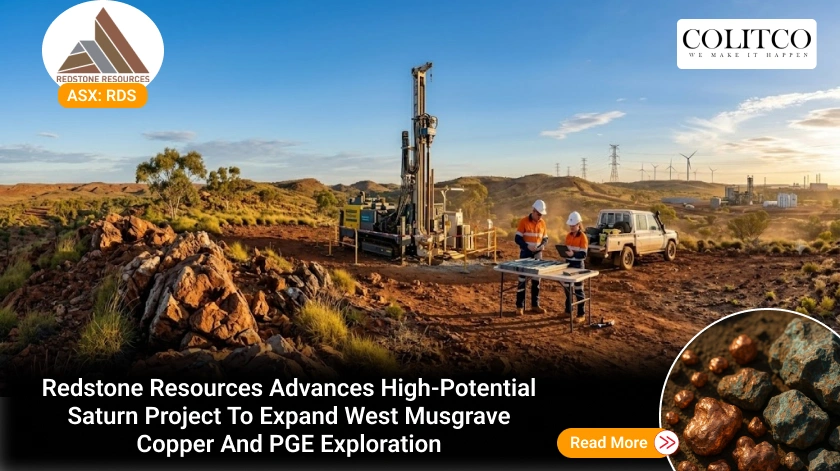
Redstone Resources Limited (ASX: RDS) (‘Redstone’ or the ‘Company’) has taken another significant step towards expanding its exploration footprint in Western Australia by advancing the recently granted Saturn PGE Reef and Cu-Ni-Co-PGE Layered Mafic Intrusion Project.
Announced on 14 July 2026, the Project adds 330 km² of highly prospective tenure within the renowned West Musgrave Province, strengthening the Company’s exposure to copper, nickel, cobalt and platinum group elements (PGEs).
A Strategic Position in Australia’s Premier Copper-PGE Province: The Saturn Project and the West Musgrave Project
The Saturn Project sits within the highly prospective Giles Intrusive Complex, a geological province that hosts several world-class mineral discoveries. Its strategic location places Redstone immediately adjacent to major copper and PGE deposits, including:
- BHP’s Nebo-Babel Cu-Ni-Co-PGE Deposit,
- The Succoth Copper Deposit, and
- Terra Metals’ rapidly emerging Dante Project.
Importantly, the Project also contains a large magnetic feature known as the Saturn Anomaly, measuring up to 13 kilometres wide. The Company noted that its magnetic signature closely resembles that of the internationally recognised Panton PGM Project in Western Australia, highlighting the scale of the geological opportunity available for future exploration.
Rather than representing a standalone exploration opportunity, Saturn complements Redstone’s existing 100%-owned West Musgrave Project, located only 10 kilometres to the east and home to the Company’s flagship Tollu Copper Deposit. The addition significantly broadens Redstone’s exploration pipeline while reinforcing its long-term focus on discovering large-scale magmatic sulphide systems within one of Australia’s most prospective mineral provinces.
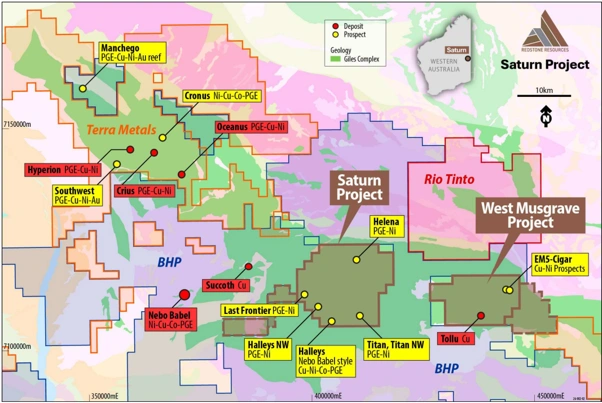
Figure 1: Regional map showing Redstone’s Saturn Project and flagship West Musgrave Project, including the Tollu Copper Deposit, in relation to neighbouring world-class mineral deposits such as BHP’s Nebo Babel and Succoth Projects, as well as Terra Metals’ Dante PGE reef and sulphide discoveries. [Image source: Redstone Resources]
Historical Exploration Reveals Multiple High-Priority Targets
Although historical exploration on the Saturn Project was relatively limited, the work successfully outlined several encouraging mineralised zones that now form the foundation of Redstone’s exploration strategy.
Among the standout discoveries are the Halleys Cu-Ni-Co-PGE Prospect, the Halleys NW PGE Prospect, and the Last Frontier PGE Prospect. Together, these prospects demonstrate that mineralisation occurs across multiple parts of the tenure and support the Company’s belief that the broader Project hosts significant discovery potential.
The historical drilling programmes identified thick mineralised intervals, widespread platinum group element anomalism and encouraging copper-nickel sulphide mineralisation, all of which remain open for follow-up exploration.
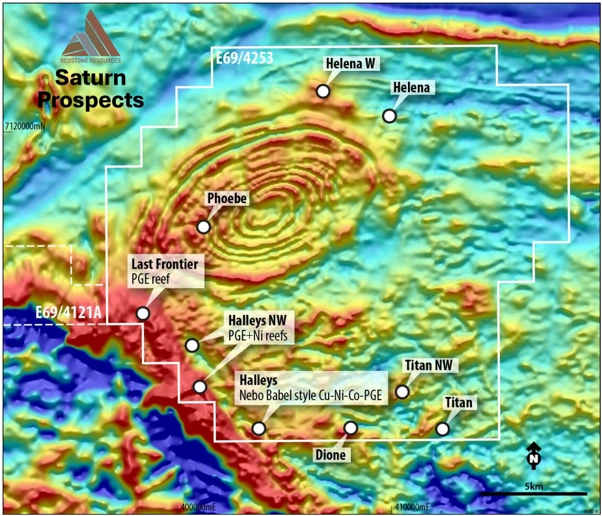
Figure 2: Saturn Project tenure map displaying the Halleys, Halleys NW and Last Frontier prospects, along with multiple anomalous copper and nickel targets across the Project area. [Image source: Redstone Resources]
Halleys Prospect Demonstrates Strong Copper-Nickel-PGE Potential
The Halleys Prospect represents the most advanced exploration target within the Saturn Project.
Historical drilling between 2007 and 2009 defined a substantial pipe-like intrusive body approximately 250 metres thick, hosting copper, nickel and platinum group element mineralisation. Importantly, mineralisation remains open both at depth and along strike, suggesting considerable upside beyond the areas previously drilled.
Previous drilling intersected several significant mineralised zones, including:
- 58 metres at 0.35% copper, 0.08% nickel and 0.21g/t Pt+Pd+Au from 20 metres, including 15 metres at 0.63% copper, 0.15% nickel and 0.33g/t Pt+Pd+Au.
- 44 metres at 0.23% copper, 0.07% nickel and 0.29g/t Pt+Pd+Au from surface.
- 35 metres at 0.29% copper, 0.12% nickel and 0.16g/t Pt+Pd+Au from surface.
The drilling also returned peak metal concentrations of:
- 1.1% copper
- 1.2g/t gold
- 1.1g/t Pt+Pd+Au
These higher-grade intervals suggest the mineralising system may contain richer zones capable of supporting more substantial sulphide accumulations.
Redstone believes the Halleys system has the potential to host significant Cu-Ni-Co-PGE mineralisation and plans to evaluate the target further through modern exploration programmes.
Halleys NW Highlights the Potential for Extensive PGE Reef Mineralisation
Another major opportunity lies within the Halleys NW PGE Prospect, where historical regional geochemical surveys outlined an 11-kilometre-long platinum group element anomaly.
Subsequent shallow drilling confirmed a fertile intrusion hosting a distinct PGE reef reaching up to 45 metres thick, reinforcing comparisons with other layered mafic intrusion systems across the Giles Complex.
Historical drilling produced encouraging results, including:
- 25 metres at 0.18g/t Pt+Pd+Au
- 33 metres at 0.15g/t Pt+Pd+Au
- 32 metres at 0.16g/t Pt+Pd+Au
Each interval included higher-grade sections that demonstrate consistent mineralisation within the reef structure.
Redstone also noted that the mineralised reef likely continues beneath shallow cover towards the northwest, leaving considerable strike potential yet to be evaluated.
Last Frontier Adds Further Scale to the Exploration Opportunity
Approximately five kilometres northwest of Halleys NW lies the Last Frontier Prospect, where limited reconnaissance drilling identified additional platinum group element mineralisation.
Although drilling density remains extremely sparse, the results indicate that the Halleys NW reef system could extend for at least five kilometres beyond its currently recognised limits. Historical drilling intersected intervals including 15 metres at 0.18g/t Pt+Pd+Au and 8 metres at 0.17g/t Pt+Pd+Au, highlighting the broader scale of the mineralised corridor.
Large sections between Halleys NW and Last Frontier remain completely untested, presenting Redstone with multiple high-priority exploration targets.
Chairman Highlights Saturn’s Discovery Potential
Commenting on the significance of the Project, Redstone Chairman Richard Homsany said:
“The Saturn Project represents an exciting exploration opportunity for Redstone, given its strategic location within the Giles Intrusive Complex and close proximity to several major Cu-Ni-Co-PGE and PGE reef deposits and discoveries, including BHP’s Nebo-Babel and Succoth, and Terra Metals’ Dante Project.”
Mr Homsany also highlighted the significance of the historical exploration results:
“Despite only limited historical exploration, the Project has already generated several encouraging mineralised targets, including Halleys, Halleys NW and The Last Frontier, which highlight the broader prospectivity of the tenure for PGE Reef and Cu-Ni-Co-PGE style deposits, similar to those of our neighbours BHP and Terra Metals.”
He concluded by emphasising the Company’s confidence in the Project’s long-term exploration potential:
“The thickness and grades of the sulphide mineralisation already discovered in the initial historical exploration, from over 15 years ago, give Redstone confidence that the Saturn Project has the potential to contain one or more significant sulphide mineralising systems, including PGM Reef and Cu-Ni-Co-PGE + Au.”

Figure 3: Richard Homsany, Non-Executive Chairman of Redstone Resources and Non-Executive Director of Brookside Energy. [Image Source: Brookside Energy]
Saturn Project Strengthens Redstone’s West Musgrave Portfolio
Beyond its standalone exploration potential, the Saturn Project significantly enhances Redstone’s existing asset base in the West Musgrave region. The newly granted tenure sits only 10 kilometres west of the Company’s flagship West Musgrave Project, which hosts the JORC-compliant Tollu Copper Deposit containing 3.8 million tonnes at 1.0% copper and previously confirmed prospective layered mafic gabbroic intrusions.
This proximity allows Redstone to leverage its existing geological understanding of the region while expanding exploration across a much larger prospective land package. The Company’s growing footprint also increases its exposure to multiple mineralisation styles, including copper sulphides, nickel-cobalt systems and platinum group element reefs.
The Saturn Project is particularly significant because it lies within the broader Giles Complex, one of the world’s largest layered mafic intrusive systems. Comparable geological settings globally have produced some of the largest platinum group metal deposits ever discovered, including South Africa’s Bushveld Complex.
By securing this strategic tenure, Redstone has positioned itself within a district that continues to attract exploration interest from major and junior mining companies alike.
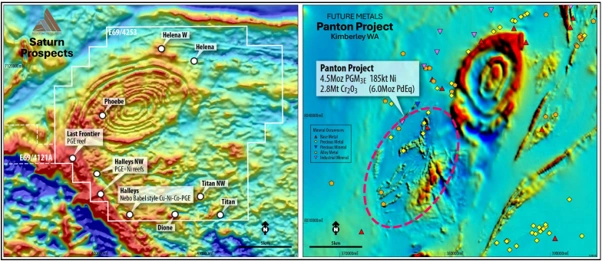
Figure 4: Comparative aeromagnetic images of Future Minerals NL’s Panton Project McIntosh Intrusion (a) and the Saturn Complex (b), showing the association between the McIntosh Intrusion and the occurrence of nickel and PGE deposits. [Image source: Redstone Resources]
Building Momentum Following the June Portfolio Expansion
The Saturn Project announcement follows another important milestone for Redstone announced on 18 June 2026, when the Company agreed to acquire a 100% interest in a suite of highly prospective gold and critical mineral exploration Projects across Western Australia. That transaction substantially diversified Redstone’s exploration portfolio beyond its established copper assets while maintaining a strong focus on Tier-1 mining jurisdictions.
The acquisition introduced several promising exploration Projects targeting gold, lithium, copper and base metals, including:
- Mt Cauden Gold and Lithium Project, located near the Marvel Loch Gold Operation and Mt Holland Lithium Mine.
- Twin Hills Gold Project, positioned within the prolific Menzies Gold District.
- Rudall East Copper-Gold and Base Metals Project, targeting Mt Isa-style mineral systems.
- Cockatoo Rocks Lithium Project, prospective for lithium-caesium-tantalum pegmatites.
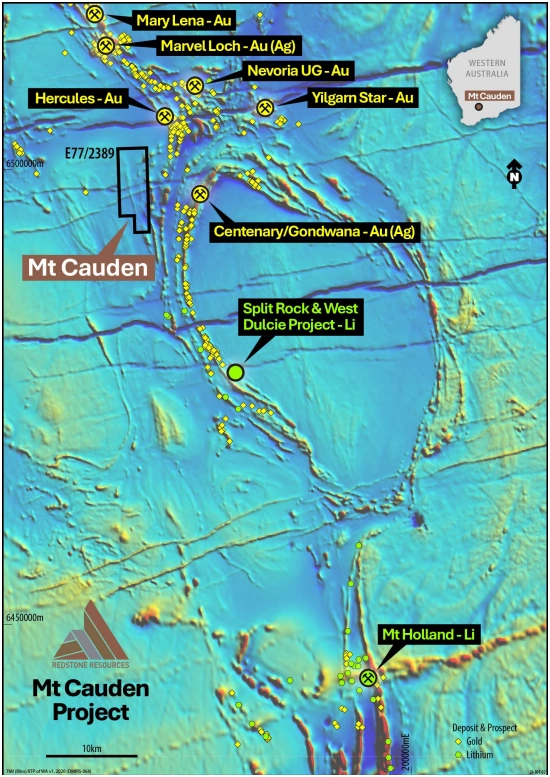
Figure 5: Regional magnetic map showing the location of the Mt Cauden Gold-Lithium Project in relation to major gold deposits and the Mt Holland Lithium Mine. [Image source: Redstone Resources]
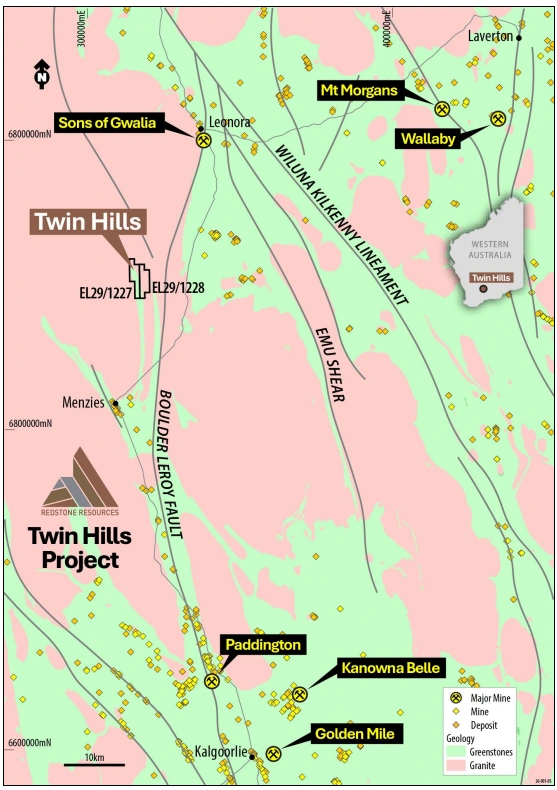
Figure 6: Map showing the location of the Twin Hills Gold Project in relation to the surrounding geology, nearby gold mines, and established gold deposits. [Image source: Redstone Resources]
Importantly, Program of Work approvals had already been secured for initial drilling at both Mt Cauden and Twin Hills, enabling Redstone to commence exploration rapidly after completing the acquisition. The transaction also required no cash consideration, allowing the Company to preserve capital for exploration activities while expanding its Project pipeline.
The June acquisition and the July Saturn announcement collectively demonstrate Redstone’s strategy of building a diversified exploration portfolio while maintaining its core focus on discovering large-scale copper and critical mineral systems.
Clear Exploration Priorities Ahead
With the Saturn Project now granted, Redstone has outlined several immediate priorities designed to accelerate exploration.
The Company plans to:
- Progress access negotiations with Traditional Owners.
- Complete technical assessments across the Project.
- Finalise exploration planning and target prioritisation.
- Advance RC drilling programmes across the broader West Musgrave Project.
- Continue evaluating recently acquired gold, lithium and copper Projects across Western Australia.
Given the extensive historical dataset already available, modern geological interpretation combined with contemporary exploration techniques could rapidly refine drill targets and unlock additional discoveries across the Project.
Share Price Activity Reflects Positive Market Sentiment
Following the Company’s recent exploration announcements, Redstone Resources has recorded encouraging share price performance.
ASX Share Price Activity
| Metric | Performance |
|---|---|
| Last Price | $0.0035 |
| 1 Week | +16.67% |
| 1 Month | +16.67% |
| 2026 YTD | +16.67% |
| Market Capitalisation | $4.57 million |
While Redstone remains a micro-cap explorer, recent market performance indicates growing investor interest as the Company expands its Project portfolio and advances multiple exploration initiatives across Western Australia. The combination of the Saturn Project, newly acquired gold and critical mineral assets, and ongoing work at the Tollu Copper Deposit provides investors with exposure to several near-term exploration catalysts.
Looking ahead, there are several near-term catalysts, including:
- Access agreements,
- Exploration planning,
- RC drilling programmes and
- Further updates from both the Saturn and West Musgrave Projects.
Positive outcomes from these programmes could significantly enhance Redstone’s understanding of the region’s mineral potential and support the Company’s ambition to discover large-scale copper and PGE mineral systems in Western Australia.
Disclaimer
This article has been prepared by Colitco in collaboration with Redstone Resources as part of a commercial content and investor communications arrangement. Colitco may receive compensation for the production and distribution of this content. This article is intended for informational purposes only and does not constitute financial product advice, investment advice, or a recommendation to buy or sell any securities. The content reflects information available at the time of publication and may not be updated. All figures, data and statements have been sourced from Redstone Resources’ official ASX announcements and publicly available sources. Readers should conduct their own independent research and seek professional financial advice before making any investment decisions. Past performance is not a reliable indicator of future results. Exploration results are not a guarantee of future resource definition or commercial production.

Luke Carlino is a seasoned Copywriter, Content Strategist, and Social Media Manager specialising in Mining, Finance, and Business journalism. With more than a decade of industry experience, he brings rigorous editorial standards and commercial acuity to every project.