Askari Metals Limited (ASX: AS2) has materially expanded its exploration target inventory at the Uis Project in Namibia, announcing seven new high-priority pegmatite targets on 18 June 2026.
The targets were identified through an advanced in-house hyperspectral remote sensing study. They join the existing pipeline and bring the total number of prospects at Uis to the most comprehensive level yet.
Reverse circulation (RC) drilling is set to begin next quarter, targeting the DP, OP, PS, and K9 pegmatite targets at EPL 7345. On-site LIBS and pellet press equipment has also been commissioned, expected to significantly speed up assay turnaround times.
Uis is increasingly taking shape as a polymetallic system offering exposure to tin, tantalum, lithium, rubidium, and caesium. Against a backdrop of a tightening global tin supply and rising critical mineral demand, the timing of this expansion carries strategic weight.
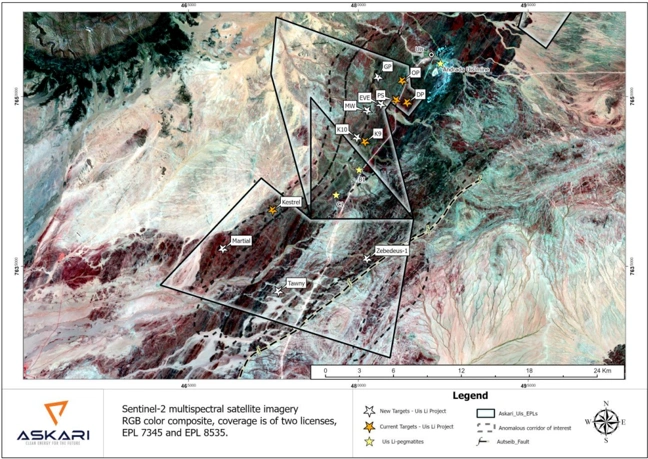
Figure 1: Uis Project showing all newly identified pegmatite targets alongside existing targets, with the Sentinel-2 multispectral satellite imagery backdrop. The anomalous Corridor of Interest is outlined with dashed lines. [Source: Askari Metals Limited]
Why Expanding the Target Pipeline Changes the Game at Uis
Until now, Askari’s Uis strategy centred on a defined set of pegmatite targets. Adding seven new targets in one announcement significantly increases the scale of what the Uis Project could ultimately represent.
The new targets fall entirely within the previously defined Corridor of Interest, a 15km-long by 5km-wide prospective zone identified through regional magnetic and chemical data analysis. That means every new target sits inside an area already flagged as geologically favourable.
With more targets comes more optionality. The Company now has a deeper bench of prospects to test through trenching, geochemical surveys, and eventually drilling.
Executive Director Mr Gino D’Anna stated in the announcement:
“This study marks another important step in unlocking the scale and polymetallic potential of Uis. Our in-house hyperspectral work has now delivered seven new high-priority pegmatite targets, materially expanding the project’s pipeline ahead of the next phase of RC drilling.”
— Gino D’Anna, Executive Director, Askari Metals Limited
The Seven New Targets: Locations and Strike Lengths
The hyperspectral study identified four new targets on EPL 7345 and three on EPL 8535. All fall within the Corridor of Interest delineated in an ASX announcement dated 21 September 2023.
Table 1 below shows each target and its estimated total strike length, which is the horizontal distance over which the pegmatite structure has been interpreted to extend. Longer strike lengths generally indicate greater potential volume.
| Target | EPL | Strike Length (km) |
|---|---|---|
| EVE | EPL 7345 | 1.7 |
| GP | EPL 7345 | 2.4 |
| MW | EPL 7345 | 0.9 |
| K10 | EPL 7345 | 3.1 (largest) |
| Zebedeus-1 | EPL 8535 | 1.4 |
| Tawny | EPL 8535 | 2.2 |
| Martial | EPL 8535 | 1.7 |
| Table 1: List of new prospective pegmatite targets generated by the in-house hyperspectral study, with estimated total strike lengths. K10 is the largest with an interpreted strike of 3.1km. [Source: Askari Metals Limited] | ||
K10 stands out with an interpreted strike length of 3.1km, the longest of the seven new targets. GP follows at 2.4km, while Tawny on EPL 8535 reaches 2.2km.
These strike lengths are estimates based on hyperspectral interpretation and require field validation through mapping, rock-chip sampling, and eventually trenching and drilling to confirm. They represent where work should happen next, not confirmed resource volumes.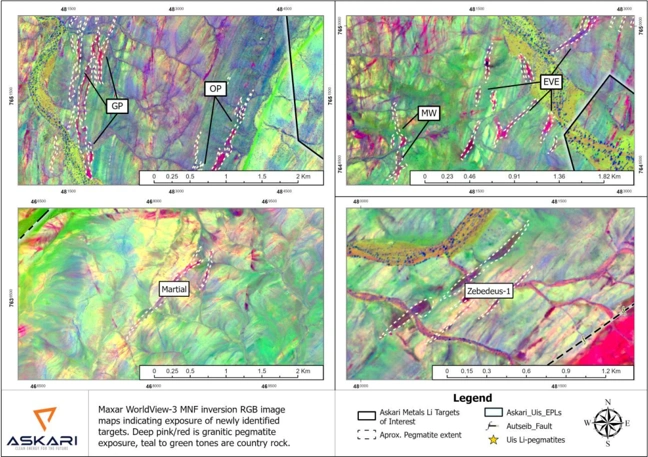
Figure 2: Selected newly identified pegmatite targets on a Maxar WorldView-3 MNF RGB colour composite. Deep pink/red denotes granitic pegmatite exposure; teal-blue/green indicates host rock schist. [Source: Askari Metals Limited]
How Satellites Found Seven New Targets in Namibia
The Company conducted an advanced in-house hyperspectral remote sensing study across the two Uis tenements.
The study combined two data sources: Sentinel-2 multispectral satellite imagery and high-resolution Maxar WorldView-3 hyperspectral data. Each source brings different strengths to geological interpretation.
Sentinel-2 is effective for distinguishing rock types and surface mineralogy using visible and shortwave infrared (SWIR) bands. It is widely used in exploration because it is cost-efficient and covers large areas.
WorldView-3 provides much finer spatial resolution at 1.24m for visible bands and 3.7m for SWIR. This detail is particularly valuable for delineating individual pegmatite bodies from surrounding host rock schist.
The study applied three techniques to process the satellite data:
- False-colour RGB composites to delineate pegmatites from host pelitic schist and granitic bodies.
- Decorrelation stretch, heightening colour contrast between rock types, vegetation, and urbanised regions.
- Minimum Noise Fraction (MNF) and Principal Component Analysis (PCA) inversions to reduce noise and enhance spectral features.
These techniques, combined with regolith mapping and ground truthing, produced detailed geological and regolith maps across the two licences. The output gave the Company’s geologists a clear picture of where previously unidentified pegmatite bodies may lie.
The Corridor of Interest was identified through earlier work combining regional magnetic and chemical data (K/Rb ratios). The current hyperspectral study refined target identification within this corridor, adding precision to the exploration model.
Faster Field Analysis: On-Site LIBS and Pellet Press Now Commissioned
One of the most practical developments in this announcement is the commissioning of on-site analytical equipment at Uis.
The Company has installed and commissioned a LIBS machine, which stands for Laser-Induced Breakdown Spectroscopy, and a pellet press.
LIBS is a technology that fires a laser pulse at a sample, creating a plasma flash. The light emitted is analysed to determine which elements are present and in what concentrations.
For a polymetallic project like Uis, this is particularly useful for detecting light elements including lithium (Li), beryllium (Be), magnesium (Mg), and boron (B).
Having LIBS on-site means all future exploration samples can be prepared and analysed in Namibia, rather than being shipped to a laboratory overseas or in South Africa. This removes weeks of transit time from the assay process.
Mr D’Anna noted the significance of this development:
“Importantly, the commissioning of our on-site pellet press and LIBS machine is expected to materially improve assay turnaround times and accelerate exploration decision-making as multiple workstreams advance in parallel.”
— Gino D’Anna, Executive Director, Askari Metals Limited
Faster assay turnaround directly impacts how quickly the Company can make decisions about where to drill next. It also reduces the time between fieldwork and public reporting, which benefits shareholders watching the news flow.
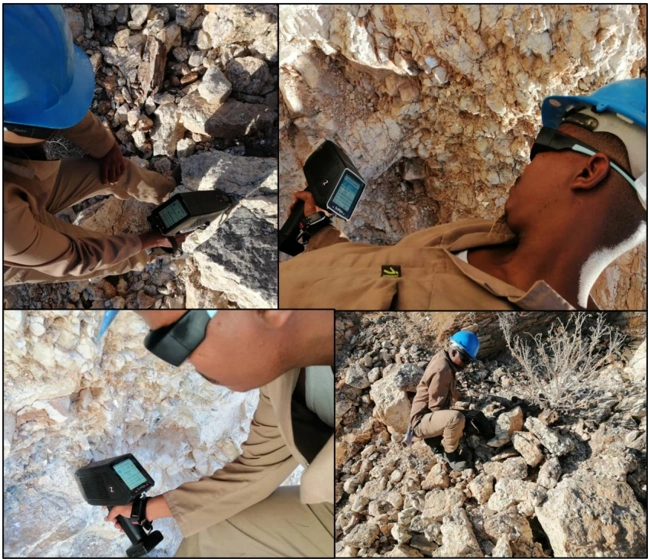
Figure 3: Field team using a handheld LIBS (Laser-Induced Breakdown Spectroscopy) instrument at the Uis Project. The LIBS machine analyses light elements including lithium, beryllium, magnesium, and boron to rapidly assess pegmatite potential in the field. [Source: Askari Metals Limited]
The Corridor of Interest: Where Every New Target Sits
The Corridor of Interest is Askari’s high-priority exploration focus zone at Uis. It was defined using regional magnetic surveys and potassium-rubidium (K/Rb) geochemical ratios, and measures approximately 15km long by 5km wide.
The corridor strikes in a northeast-southwest direction and runs across both EPL 7345 and EPL 8535. All seven new targets fall within it.
Within the corridor, the Company has further identified distinct sub-zones:
- Lithium-Tin-Tantalum (Li-Sn-Ta) prospective zones, which carry the broadest critical minerals interest.
- Tantalum (Ta) prospective zones, which may have narrower but high-value potential.
- Interpreted extensions of previously known mineralised zones, indicating the system may extend further than existing data suggests.
The corridor framework gives the Company a systematic way to prioritise where ground truthing, geochemical sampling, and trenching should be focused in the near term.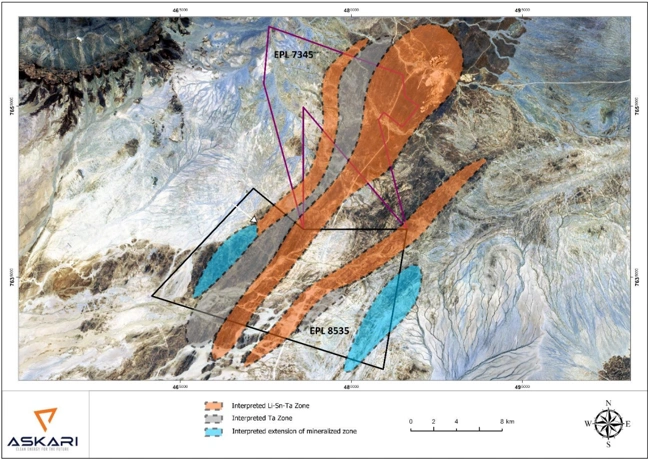
Figure 4: High-priority prospective Corridor of Interest at Uis, with re-defined Li-Sn-Ta prospective zones (orange), Ta prospective zones (blue), and areas of potential mineralisation extensions. [Source: Askari Metals Limited]
What Happens Next: A Structured Path to Drilling
Askari has laid out a clear sequence of workstreams to progress the new targets from discovery to drill-ready status. Each stage feeds into the next.
- Detailed mapping and rock-chip sampling of priority target areas are already underway.
- Regional stream sediment geochemical sampling will be conducted across the broader Corridor of Interest.
- Regional soil geochemical sampling will follow, targeting additional concealed pegmatite bodies beneath the surface.
- All field, assay, and geochemical data will be compiled and assessed to prioritise trench-ready targets.
- Phase 1 trenching is planned for EPL 8535; Phase 2 trenching for EPL 7345.
- RC drilling will commence next quarter on the DP, OP, PS, and K9 targets at EPL 7345.
The structured sequencing reflects how exploration actually works. Mapping confirms outcrops. Geochemistry finds concealed targets. Trenching exposes mineralisation at surface. Drilling then tests it at depth.
Mr D’Anna summarised the near-term outlook:
“With field programs active on the ground, RC drilling set to commence next quarter on the DP, OP, PS and K9 pegmatite targets, and further trenching planned to expand the broader pipeline, we see a strong stack of near-term catalysts at Uis that we believe can continue to build momentum and unlock value.”
— Gino D’Anna, Executive Director, Askari Metals Limited
Uis Sits Inside a Proven Critical Minerals Belt
The Uis Project is located in Namibia’s Cape Cross-Uis Pegmatite Belt, within the Erongo Region of west-central Namibia.
The project sits within 2.5km of the operating Andrada Mining Uis Tin-Tantalum-Lithium Mine. Andrada’s neighbouring project hosts an 81 Mt resource at 0.73% Li₂O, 0.15% Sn, and 86ppm Ta (refer to Andrada Mining RNS announcement, 6 February 2023). Proximity to an operating mine validates the geology and demonstrates that the belt can host significant mineralisation.
Askari’s Uis tenements cover more than 100 mapped pegmatites, with many historically mined for tin and semi-precious stones. The new targets identified in this announcement add to that existing body of work, extending the Company’s reach across the Corridor of Interest.
Infrastructure is already in place. Sealed road access connects Uis to Walvis Bay Deepwater Port, approximately 230km away. This logistics advantage reduces future development costs should the project reach a stage where material needs to be transported.
We have previously covered Askari’s progress at Uis, including the confirmation of a 950-metre polymetallic system at K9 and the high-grade trenching results at the PS Pegmatite Target.
Tin Supply Is Tightening as Demand from Tech Sectors Accelerates
The broader market context gives the Uis Project additional weight. Tin prices reached approximately USD 50,000 per tonne in early 2026, a rise of around 70% year-on-year, according to a market update from Coface.
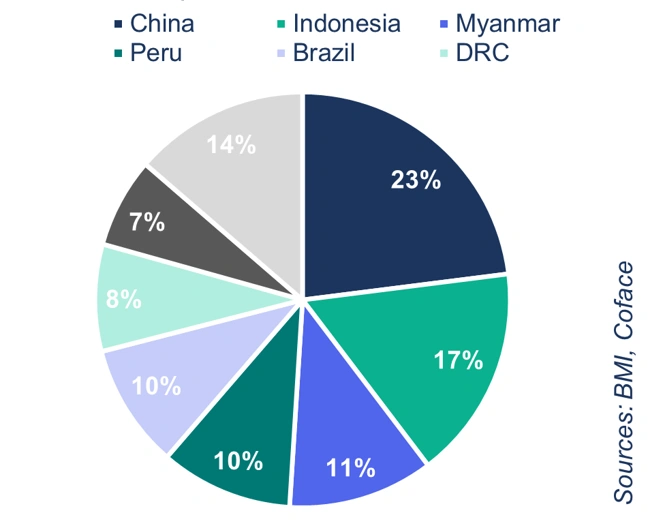
Figure 5: Global production of Tin ores (in volume, 2025) [Coface]
Two structural forces are driving this: constrained supply from key producing nations and rising demand from the electronics and semiconductor sectors.
On supply, Myanmar’s Wa State, which historically contributed significant tin ore volumes to Chinese smelters, has faced repeated export disruptions since 2023. Indonesia, the world’s largest refined tin exporter, has also experienced production delays linked to permit approvals.
On demand, solder for circuit boards and semiconductors accounts for roughly 50% of global tin consumption. The ongoing expansion of AI data centres and semiconductor fabrication is adding new demand that existing supply chains were not built to absorb.
The World Bank’s metals outlook projects tin market conditions to remain tight through 2027, with supply constraints in Myanmar and Indonesia keeping prices elevated despite modest volume growth.
The tin market reached 439.89 kilotons in 2026 and is forecast to grow at a 2.48% CAGR through 2031, according to Mordor Intelligence.
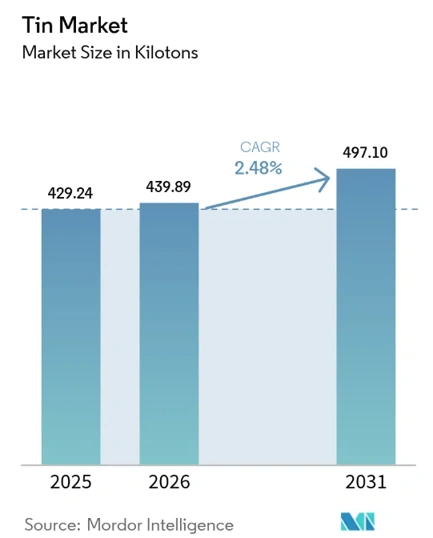
Figure 6: Global Tin Market forecast [Mordor Intelligence]
For a project like Uis, which sits within a well-established pegmatite belt close to an operating tin mine, this market backdrop strengthens the fundamental case for continued exploration investment.
Investors’ Outlook
Askari Metals (ASX: AS2) continues to build its exploration pipeline at the Uis Project through systematic, technology-driven target generation.
The identification of seven new targets in a single study materially expands the addressable area within the Corridor of Interest. It gives the Company more runway to discover new mineralisation across EPL 7345 and EPL 8535 before committing the resource cost of a drill campaign.
The commissioning of on-site LIBS and pellet press equipment is a practical step that will reduce assay turnaround time and speed up exploration decision cycles. This should translate to faster news flow as drilling and sampling activities ramp up in the coming quarters.
RC drilling is set to start next quarter on the DP, OP, PS, and K9 pegmatite targets. These are the targets that have already been partially characterised through trenching and earlier campaigns. Drill results from these will be the most closely watched data points for investors.
| Metric | Data |
|---|---|
| Last Price | A$0.008 |
| Market Cap | A$6.25 million |
| 52 Week Range | A$0.005 – A$0.019 |
| Shares on Issue | 781,533,823 (approx. per public data) |
Near-term catalysts to watch:
- RC drilling commencement at DP, OP, PS, and K9 targets, EPL 7345 (next quarter)
- Rock-chip sampling and mapping results from the seven new targets
- Regional stream sediment and soil geochemical survey results across the Corridor of Interest
- Phase 1 trenching results from EPL 8535
- Phase 2 trenching results from EPL 7345
- First drill assay results and advancement toward a maiden JORC resource estimate
Disclaimer
This article has been prepared by Colitco in collaboration with Askari Metals Limited as part of a commercial content and investor communications arrangement. Colitco may receive compensation for the production and distribution of this content. This article is intended for informational purposes only and does not constitute financial product advice, investment advice, or a recommendation to buy or sell any securities. The content reflects information available at the time of publication and may not be updated. All figures, data and statements have been sourced from Askari Metals Limited’s official ASX announcements and publicly available sources. Readers should conduct their own independent research and seek professional financial advice before making any investment decisions. Past performance is not a reliable indicator of future results. Exploration results are not a guarantee of future resource definition or commercial production.

Luke Carlino is a seasoned Copywriter, Content Strategist, and Social Media Manager specialising in Mining, Finance, and Business journalism. With more than a decade of industry experience, he brings rigorous editorial standards and commercial acuity to every project.