
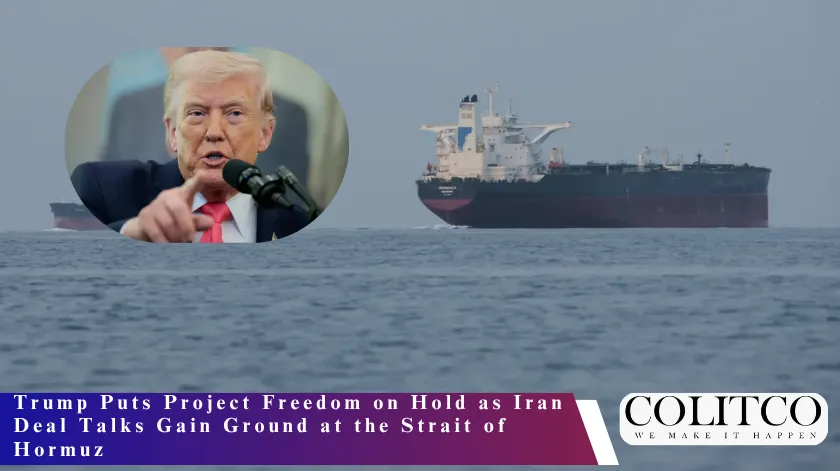
Donald Trump announced Tuesday he was suspending Project Freedom, the US military operation to guide commercial ships through the Strait of Hormuz, just 24 hours after it launched. The reason: both sides are apparently closer to a deal than the world was led to believe.
In a Truth Social post, Trump wrote that “Great Progress has been made toward a Complete and Final Agreement” with Iran. He added the operation would be “paused for a short period of time” to see whether a final deal could be signed.
The US naval blockade of Iranian ports stays in place.
“We have mutually agreed that, while the Blockade will remain in full force and effect, Project Freedom (The Movement of Ships through the Strait of Hormuz) will be paused for a short period of time to see whether or not the Agreement can be finalized and signed…” – President… pic.twitter.com/R9SlC4w68g
— The White House (@WhiteHouse) May 5, 2026
What Project Freedom Was Actually Doing
Project Freedom launched Monday morning, backed by more than 100 aircraft, 15,000 service members, and US guided-missile destroyers.
The mission was not a naval escort, officials clarified. The US military advised ships on mine avoidance, stood ready to respond to attacks, and was authorised to strike immediate threats.
Two commercial vessels made it through the strait on Monday. That was roughly the extent of it before Trump hit pause.
Secretary of State Marco Rubio had framed the operation in stark terms just hours before the suspension: around 23,000 sailors from 87 countries had been stranded in the Persian Gulf, at least 10 had died, and Iran’s blockade had effectively left civilian crews isolated and vulnerable.
“They’re sitting ducks,” Rubio said.
Clear military objectives from day one.@SecRubio 🔥⬇️ pic.twitter.com/Hz1jXzzQGX
— The White House (@WhiteHouse) May 5, 2026
What Triggered the Reversal
Iran blocked the Strait in early March, retaliating against US and Israeli strikes that began in late February. The ceasefire reached April 8 was extended indefinitely on April 21, but it has been under pressure since.
Monday was particularly tense. Iran launched ballistic missiles, cruise missiles and drones at the United Arab Emirates, marking the first such strikes on a Gulf neighbour since the ceasefire. CENTCOM reported Iranian forces also attacked US naval and commercial vessels in the strait. The US destroyed six to seven Iranian patrol boats.
A South Korean-operated cargo ship also caught fire in the strait. Trump later attributed that to Iran.
Despite all of this, Trump’s Tuesday evening post took a noticeably softer tone.
He said the pause came “at the request of Pakistan and other countries,” citing Islamabad’s role as a key mediator in talks between Washington and Tehran.
Pakistani Prime Minister Shehbaz Sharif had posted on X earlier that day urging all parties to protect the ceasefire and allow space for diplomacy.
Iran’s Response and Market Reaction
Iran’s Foreign Minister Abbas Araghchi had labelled Project Freedom “Project Deadlock” on Monday, warning that any military solution to what he called a political crisis would fail. He suggested talks were progressing and urged the US not to be “dragged back into a quagmire.”
Markets moved quickly after Trump’s announcement. Brent crude futures dropped roughly 4 per cent to close at USD 109.87 per barrel Tuesday. West Texas Intermediate fell a similar amount to settle at USD 102.27.
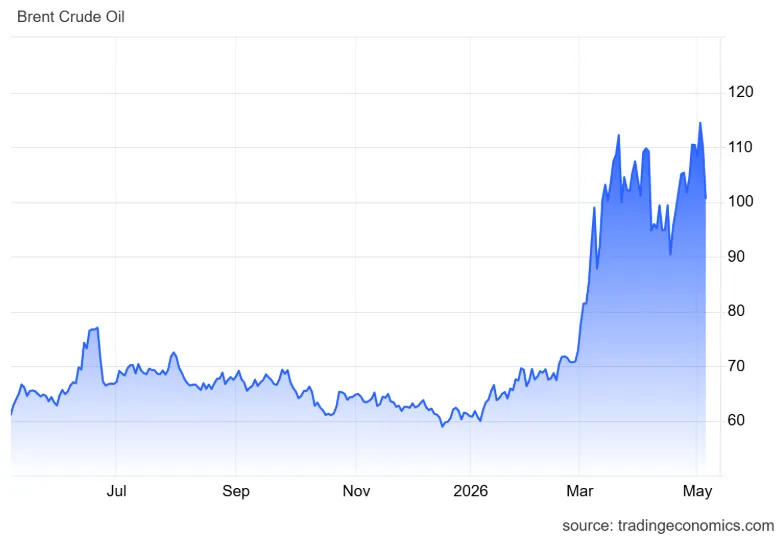
Brent crude price movement [Trading Economics]
That followed a sharp rise Monday, when Brent hit USD 114.44 and WTI climbed to USD 106.42 as news of the strait clashes broke.
For context, the national average price of petrol in the US has risen 49 per cent since the Iran conflict began in late February. The Strait disruption has contributed to airlines cutting routes and planning for oil above US$175 per barrel.
Where Talks Stand
Analysts at Eurasia Group had warned on Monday that Project Freedom would fail without Iranian buy-in. “It takes both sides to unblock,” Bjorn Hojgaard, CEO of ship manager Anglo-Eastern, told reporters.
The ceasefire has technically held, despite the clashes. Defense Secretary Pete Hegseth told reporters Tuesday the exchanges of fire fell “below the threshold of restarting major combat operations.”
Trump said Iranian officials “know what to do” to avoid triggering a ceasefire breakdown, without giving specifics.
The blockade on Iranian ports remains the primary US pressure mechanism. Iran has refused to reopen the strait until that blockade is lifted. It is not yet clear which side will move first.
Also Read: HSBC Q1 2026 Results: What a Fraud Charge and a War Did to the World’s Biggest Bank
FAQ
Q: What is Project Freedom?
A: Project Freedom was a US military operation launched 5 May 2026 to restore freedom of navigation in the Strait of Hormuz, using more than 100 aircraft and 15,000 service members to guide stranded commercial ships out of the Persian Gulf. Trump paused it on 6 May 2026.
Q: Why did Trump pause Project Freedom?
A: Trump cited progress toward a final agreement with Iran and a request from Pakistan, which is mediating negotiations between Washington and Tehran. The US naval blockade of Iranian ports remains in effect.
Q: What is the Strait of Hormuz and why does it matter?
A: The Strait of Hormuz is a 21-mile-wide chokepoint between Iran and Oman. It carries roughly one-fifth of the world’s daily oil supply. Iran has blocked commercial transit since early March 2026, causing the largest oil supply disruption on record.
Q: Has the US-Iran ceasefire collapsed?
A: No, though it is under significant pressure. US and Iranian forces exchanged fire on 5 May 2026, but defence officials described the incidents as below the threshold for restarting major combat.
Q: How is the Hormuz situation affecting oil prices?
A: Brent crude was trading above USD 109 per barrel as of 6 May 2026, down from a high of USD 114.44 reached the previous day. Prices have risen more than 40 per cent since the conflict began in late February.
Disclaimer: This article is for informational purposes only and does not constitute financial advice. The situation is evolving rapidly. Readers should refer to official government sources and credible news outlets for the latest developments.
2. https://www.axios.com/2026/05/06/iran-us-deal-one-page-memo


