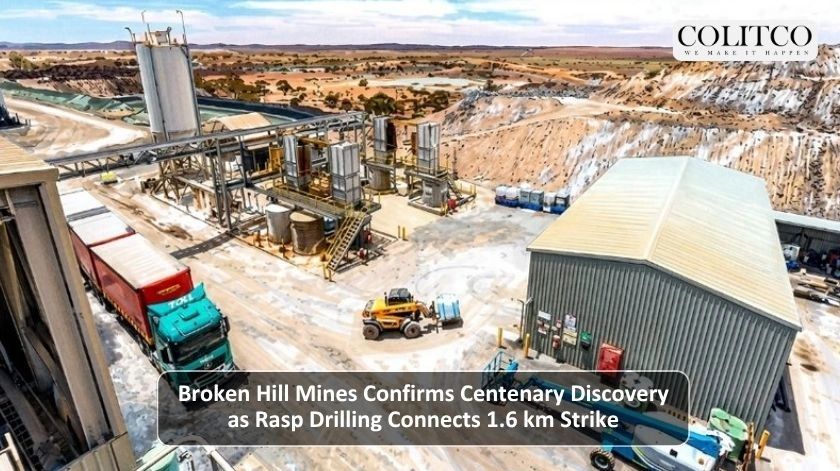
Broken Hill Mines Limited (ASX: BHM) has released new drilling results from the Centenary Zone at its Rasp Mine in New South Wales. The results confirm a high-grade, bulk-tonnage silver-lead-zinc discovery beneath the Globe-Vauxhall Shear, the company states.
Hole WMDD6400W1 returned 17.8m of 10.1% zinc equivalent and 280 grams per ton silver equivalent from 420m. The interval was 5.4m at 19.5% ZnEq and 540g/t AgEq from 432.4m. The higher-grade zone returned 173g/t silver, 7.9% lead and 6.5% zinc.
A second hole delivered two broad mineralised intervals. Combined with an earlier July result, the assays have led Broken Hill Mines to interpret a mineralised connection across Centenary’s 1,600m strike.
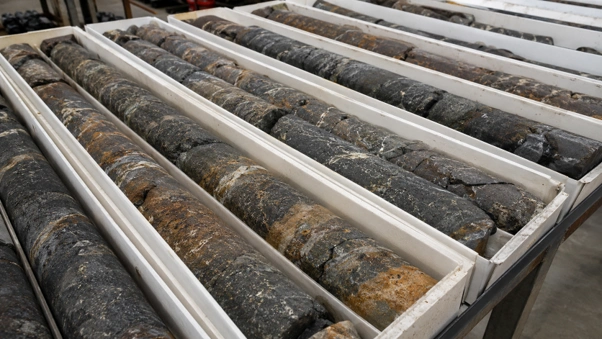
Broken Hill Mines’ drill core from Centenary shows the broad mineralised interval now being tested. [Courtesy: Broken Hill Mines]
Key Centenary Drilling Results
The latest Broken Hill Mines Centenary discovery update includes several figures that will guide the next drilling phase:
- 8m at 10.1% ZnEq and 280g/t AgEq from 420m in WMDD6400W1.
- 4m at 19.5% ZnEq and 540g/t AgEq within the same hole.
- 1m at 9.4% ZnEq and 261g/t AgEq from 394.8m in WMDD6391W1.
- 1m at 9% ZnEq and 248g/t AgEq from 420m in WMDD6391W1.
- An interpreted mineralised connection across roughly 1,600m of strike.
Equivalent grades combine several metals using price and recovery assumptions. Individual silver, lead and zinc assays therefore remain important.
New Drilling Method Reaches The Under-Tested Zone
Centenary was discovered in 1983, a century after the discovery of Rasp’s Main Lode. Yet only 24 holes had tested the zone before the current campaign. Most were drilled from surface during the 1980s.
The Globe-Vauxhall Shear created a practical problem. Earlier holes could deviate while passing through the structure, making it difficult to hit the planned target below it.
Broken Hill Mines has used a larger-diameter parent hole through the shear and installed casing. Smaller daughter holes can then pass through that opening into Centenary from underground drill positions near Western Mineralisation.
Why the 1.6 km Connection Matters
The company interprets the new holes as joining the northern and southern portions of Centenary. The zone has an approximate 1,600m strike and a vertical plunge of about 280m. Mineralisation remains open at depth and along strike.
Another hole, WMDD6389A, sits between the latest assay-backed intersections. Visual logging indicates a possible mineralised zone up to 35m thick. Assays are expected within four to six weeks. Visual observations cannot establish metal grades, so the laboratory result will be the meaningful test.
Continuity still needs to be demonstrated through closer-spaced drilling and resource modelling.
Centenary Silver Lead Zinc Expansion Could Reshape Rasp
The Centenary silver lead zinc expansion is also changing the geological interpretation of the zone. Broken Hill Mines has identified hedenbergite and tetrahedrite in the drill core. The company believes this mineral assemblage makes Centenary look more like the historic Main Lode than the adjacent Western Mineralisation orebody.
Geological controls influence how mineralisation is modelled and where later holes are placed. The company is reviewing historic drilling and plans more mineralogical work before its next resource update.
The 4.8Mt Centenary estimate is entirely inferred. New assays must show whether the thicker, higher-grade sections continue far enough to change its tonnage, grade or classification.
What Comes Next For Broken Hill Mines
Drilling is continuing across Centenary. Broken Hill Mines plans to define an exploration target before updating the mineral resource estimate for Centenary and the wider Rasp Mine during the December quarter of 2026.
The next catalyst is the assay result from WMDD6389A. Follow-up holes will test the interpreted connection and open areas at depth and along strike.
Investors will be watching more than headline equivalent grades. True widths, metal distribution, geological continuity, metallurgical response and access requirements will all influence the zone’s value to Rasp.
The latest holes have moved Centenary beyond a single promising intercept. The coming work must show whether that picture holds across the broader system.
Also Read: Silver North Ignites Dual Exploration Push as Veronica Targets Expand Beyond Haldane Drilling Boom
FAQs About Broken Hill Mines’ Centenary Discovery
What did Broken Hill Mines discover at Centenary?
Ans: Broken Hill Mines reported broad, high-grade silver-lead-zinc intersections outside parts of the current Centenary resource model. The company interprets the new holes as connecting mineralisation across a 1.6km strike.
What is the strongest result from the latest announcement?
Ans: WMDD6400W1 17.8m @ 10.1% ZnEq and 280g/t AgEq from 420m. This included 5.4m at 19.5% ZnEq and 540g/t AgEq.
What is the present resource size of the Centenary?
Ans: Centenary hosts an inferred mineral resource of 4.8mt at 9.2% ZnEq and 255g/t AgEq. Further drilling will support an update due out later.
When is the next Rasp resource update expected?
Ans: Broken Hill Mines is targeting an updated Centenary and broader Rasp mineral resource estimate during the December quarter of 2026. Assays from WMDD6389A are expected earlier, within four to six weeks.
Disclaimer
This article is for informational purposes only and does not constitute investment advice. Drilling results and visual observations remain subject to geological interpretation, laboratory verification and further technical work. Mineral resource estimates do not represent ore reserves or guarantee economic extraction. Investors should review Broken Hill Mines’ ASX announcements and technical disclosures independently. Commodity prices, operating conditions and exploration outcomes can change rapidly.
Sources
- https://mining.com.au/broken-hill-mines-confirms-major-centenary-discovery/
- https://www.listcorp.com/asx/bhm/broken-hill-mines-limited/news/confirmation-of-major-discovery-at-centenary-rasp-mine-3389990.html
- https://brokenhillmines.com/projects/rasp-mine

Luke Carlino is a seasoned Copywriter, Content Strategist, and Social Media Manager specialising in Mining, Finance, and Business journalism. With more than a decade of industry experience, he brings rigorous editorial standards and commercial acuity to every project.