
Total Metals Corporation confirmed gold assays reaching 102 grams per tonne at the Menary Project. The exploration team completed a phase two chip sampling program across the property. During this phase, geologists collected eleven samples from quartz veins and wall rocks.
To ensure data accuracy, workers chiselled rock chips across intervals. One sample across a 1.20-metre section returned 13.6 grams per tonne of gold. Another sample yielded 23.4 grams per tonne over a 0.28-metre width.
Field personnel observed gold particles within this sample, labelled E5551178. Pyrite dissemination appeared alongside the gold in the 13.6-gram sample. The sampling highlights include the following results:
- Assay results include 102 grams per tonne of gold.
- Sample E5551178 returned 23.4 grams per tonne of gold.
- A 1.20-metre section yielded 13.6 grams per tonne of gold.
Metallurgy studies proved the gold responds to gravity separation. Operators can separate the metal using gravity methods. The Company finished a drone magnetism survey across the boundaries in October.
Company personnel placed all rock samples into sample bags alongside identification tags. The workers sealed these bags to prevent contamination during transit. Couriers delivered the batches directly to AGAT Laboratories for laboratory analysis.
The Company identified Robert Penczak, Vice President of Exploration, as the Qualified Person for these results. Penczak reviewed all data before the Company published the findings. The firm enforces quality control protocols throughout the sampling chain.
The team executed a strategy to verify archive reports. The geologists focused on extracting material that represents the widths of the mineralisation zones. They avoided grab samples, which often misrepresent the grade of a deposit.
Why This Discovery Matters
These exploration results confirm the presence of a gold system. Due to corporate consolidations, investors watch this region closely. The proximity to infrastructure reduces development costs.
The findings validate exploration data on the claims. Modern data gives shareholders confidence in the project viability. The region represents a mining jurisdiction with a regulation framework.
Gold requiring free milling needs reduced processing infrastructure compared to ores with refractory properties. When gravity separation works, mining companies spend reduced capital on extraction plants. This metallurgy advantage improves the economics of any mine on the site.
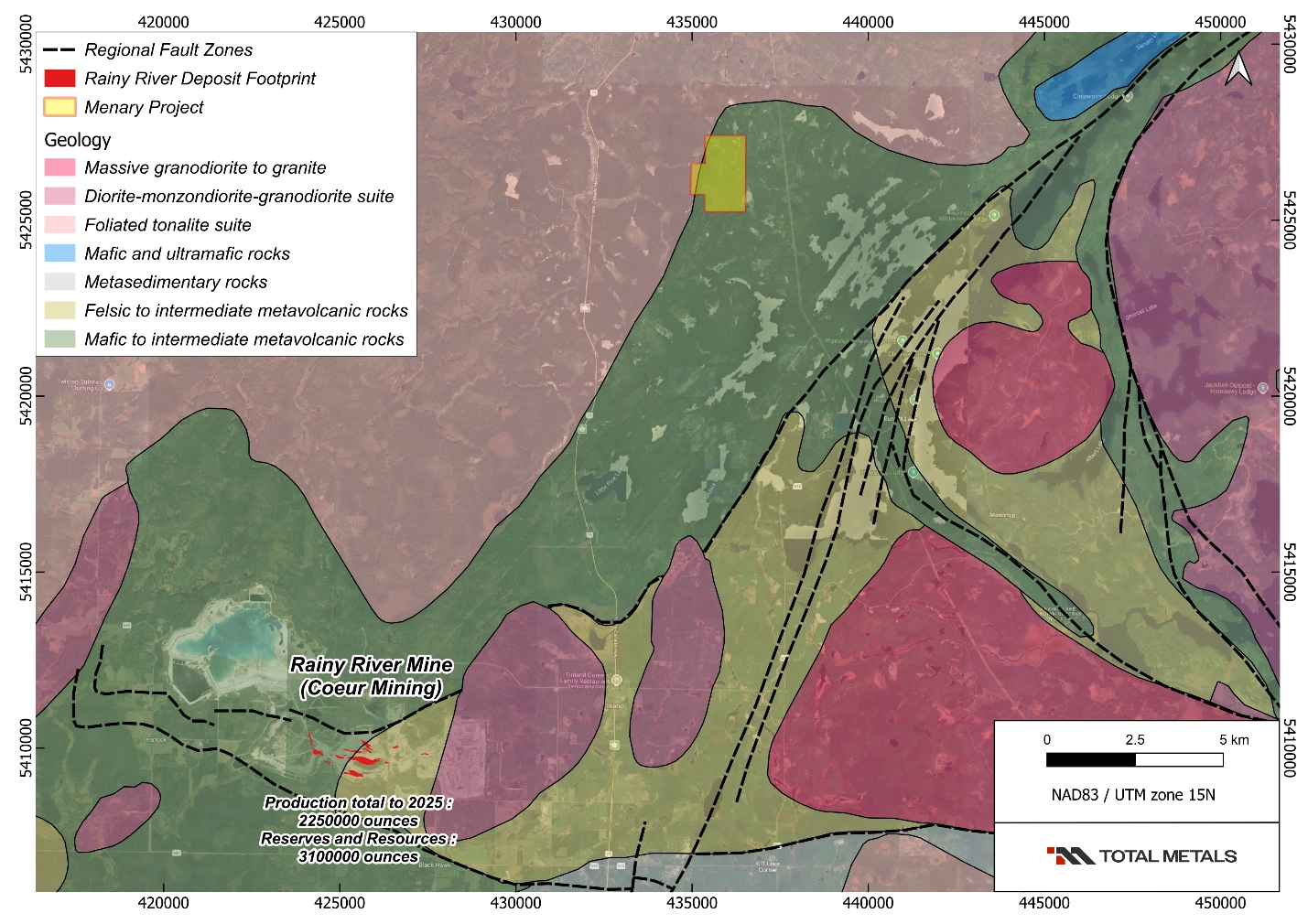
Regional geology of the Rainy River greenstone belt showing the location of the Menary Gold property [Total Metals]
The mining sector looks for deposits that can quickly enter production. Surface samples indicate mineralisation under the ground. Market participants evaluate these results to project corporation value.
Coeur Mining spent seven billion dollars to acquire New Gold Incorporated. This transaction highlights the strategy value of the Rainy River greenstone belt. Explorers like Total Metals benefit from operating near industry players.
Shareholders look for these catalysts to drive equity prices higher. The validation mitigates exploration risk for the Company. An expanding asset base allows the management team to negotiate financing terms.
Key Players & Industry Impact
Total Metals Corporation leads the exploration activities at the Menary Project. The Company trades on the TSX Venture Exchange under the ticker symbol TT. Management focuses on exploring and developing metal assets in Canada.
Robert Penczak guides the technology direction of the current exploration programs. AGAT Laboratories provides assaying services to ensure data accuracy. Destroismaisons CLM Holdings Corporation holds the title to the property.
Total Metals signed an option agreement with Destroismaisons to earn ownership. The Company must make cash payments and issue shares to fulfil the agreement terms. Western Troy Capital Corporation and William McNerney retain net smelter royalties on production.
Coeur Mining Incorporated plays a role in this narrative. The producer operates the Rainy River Gold Mine. Coeur Mining controls the boundary touching the Menary claims.
The sector for junior mining relies on these discoveries. Exploration companies generate value by identifying and defining mineral resources. Mining houses eventually acquire these resources to replace depleted reserves.
The community of investments monitors the Kenora Mining Division for opportunities. Institution investors allocate capital to companies operating next to producers. To capitalise on discovery phases, individual investors follow the drill results.
Location & Geological Setting
Geologists executed the exploration at the Menary Project in Ontario. Within the Kenora Mining Division, the property spans 275.6 hectares. The claim block sits eighteen kilometres northeast of the Rainy River Gold Mine.
Geologists focus their work on the Rainy River greenstone belt. This geology formation hosts gold deposits across the region. The property features year-round road access, which simplifies logistics for field crews.
Workers operate sixty-five kilometres northwest of Fort Frances. The land package shares a border with Coeur Mining holdings. This location places the project in the centre of a mining hub.
The chip sampling tested the veins at the Wagg zone. Geologists map these structures to understand the geology framework. The targets on site include the following zones:
- Galbraith A
- Wagg
- New Shear
- Road
Ontario provides a jurisdiction for resource extraction. The provincial government operates a permitting process. Local communities provide labour and services to exploration camps.
The Canadian Shield underpins this geography area. Volcano activity formed the greenstone belts that now host these metals. Glaciation events scraped the rock beds clean, which allows geologists to identify surface veins.
Project Timeline & Next Steps
Total Metals released the chip sampling results on November 10, 2026. During the preceding weeks, the field team conducted the rock sampling. Technicians completed the drone magnetism survey in October 2026.
The Company will receive the interpreted magnetism data in the coming weeks. Before the end of the year, management plans to submit exploration permit applications. The firm targets 2027 for the next phase of exploration.
Also Read: Australia’s Mining Investment Pipeline Faces an Important Project Delivery Test
Total Metals executed the option agreement for the property in December 2025. The Company completed a winter exploration program earlier in 2026. Field crews finished mapping and sampling in June 2026.
Market analysts expect news flow throughout the winter months. Geologists spend this time integrating all collected data into a model. This timeline allows the Company to finalise drill targets for the spring season.
Coeur Mining finalised its acquisition of the neighbouring assets. The timing brings market attention to the district today. Total Metals leverages this interest to fund exploration efforts.
The exploration team operates within weather windows. Snow cover dictates the types of surveys crews can execute during the winter. The 2027 drilling program will commence once the spring thaw concludes.
Exploration Strategy & Execution
Field geologists walked the property to locate quartz veins. They used rock hammers and chisels to extract rock chips across the vein widths. The team intentionally sampled both the veins and the wall rocks.
Using GPS coordinates, workers documented the locations of each sample. They noted mineralisation styles, including gold visibility and pyrite dissemination. To determine the gold content, the laboratory crushed the samples and used fire assay techniques.
Total Metals integrates the assay results with the magnetism survey data. Geologists build space models to visualise the structures under the ground. The technology team uses these models to plan the locations for drill holes.
Management prepares to apply for exploration permits. These permits will allow the Company to conduct diamond drilling next year. The firm also plans to expand surface trenching activities during the 2027 field season.
The Company will raise capital to fund the 2027 drilling campaign. Management presents the project data to investors and institution funds. Drill results could lead to resource estimation and mine development studies.
The Company employs technology to accelerate the discovery process. Drones fly grids over the property to map magnetism anomalies in the rock beds. Geologists interpret these magnetism signatures to find fault zones that act as gold traps.
Disclaimer: This editorial is for informational purposes only and does not constitute financial, investment, or legal advice. Mineral exploration and mining ventures involve substantial risk; historical results, chip sampling, and preliminary assay data do not guarantee future economic viability or resource definitions. Readers should conduct their own independent due diligence and consult with qualified professionals before making any investment decisions.

Luke Carlino is a seasoned Copywriter, Content Strategist, and Social Media Manager specialising in Mining, Finance, and Business journalism. With more than a decade of industry experience, he brings rigorous editorial standards and commercial acuity to every project.