
The Zip Co share price hit $1.03 at the lowest point on Friday, then clawed back to around $1.45 by midday. Bloomberg described the drop as the largest on record for the stock.
The trigger was the first quarter update for July to September. Organised fraud hit the US business, and the cost landed in the one quarter where the market wanted a clean result.
The Zip Co financial results look better with one cost removed
Total transaction volume (TTV) reached A$4.6 billion, up 18%. Cash EBTDA came in at A$65.0 million, up 3.4%.
Strip out the fraud and that number becomes A$75.1 million, a 19.5% rise. The fraud itself cost A$10.1 million in cash operating expenses.
Analysts had pencilled in A$76.9 million. So the headline number missed by about 15%, and the cleaned-up one still landed slightly short.
The fraud was simple. Coordinated individuals opened new accounts with legitimate credentials, then ran transactions that were never paid. Zip says it found the problem and contained it.
The quarter in five lines:
- Group TTV: A$4.6 billion, up 18%
- US TTV: up 34.1% in US dollars
- Cash EBTDA: A$65.0 million, up 3.4%
- Net bad debts: 1.97% of TTV, up from 1.65%
- Active customers: 6.4 million, against about 6.67 million expected
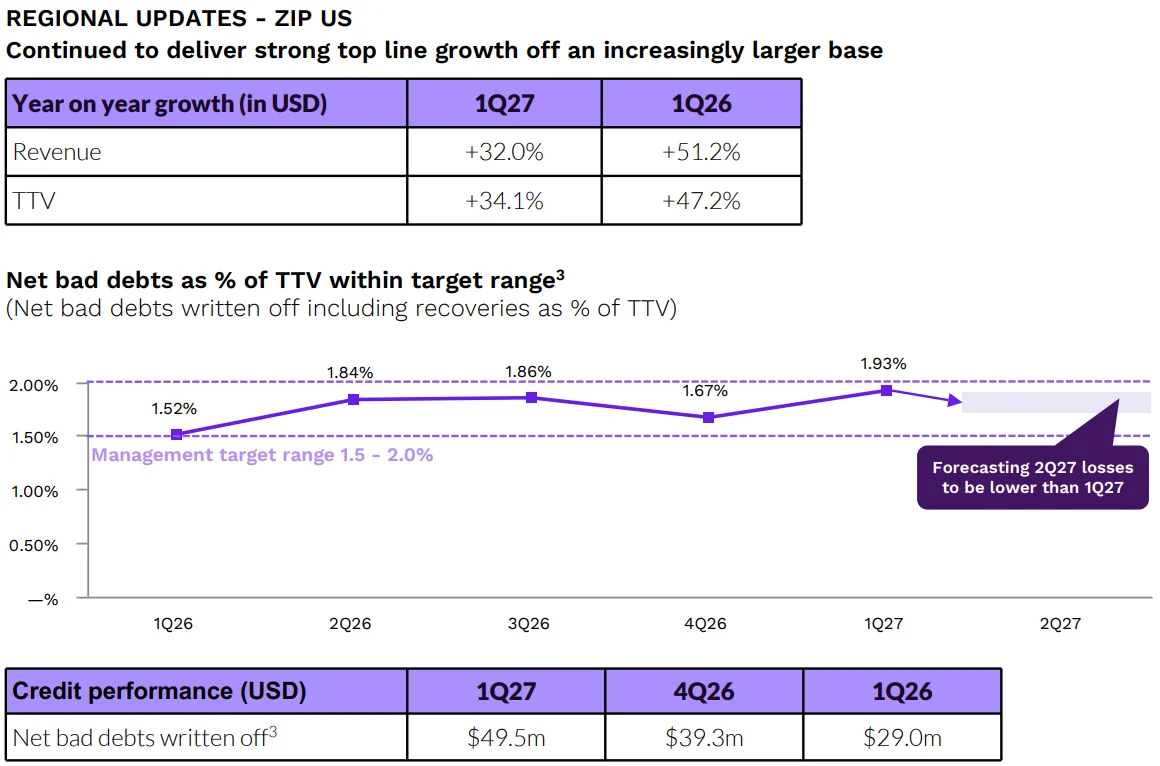
Zip’s first quarter missed estimates on earnings, bad debts and customer numbers, but not on volume. [ZIP Co]
Zip Co US market growth slowed, then found its feet in September
In FY26, US TTV grew 42.5% in US dollars. This quarter it grew 34.1%. That is still quick, but it is a step down.
Then comes the part the market skipped past. Zip says US TTV growth reached 41% in September, with October also positive. If that holds, the fraud was a speed bump.
The US made up 76% of group volume last financial year. What happens there is what happens to Zip.
Existing customers are not the worry. US transactions per customer rose 27%, which is people using the product more often. New customers are the soft spot.
Here is the expert read. The fraudsters came in through new accounts, so the weak point was the front door. In consumer credit, fast growth and loose entry checks tend to travel together.
Brokers were already asking about Zip’s onboarding controls. Tighter checks usually turn away a few good customers along with the bad ones. Slower customer adds for a couple of quarters would not be a surprise.
Bad debts leave less room than the guidance suggests
Net bad debts rose to 1.97% of TTV across the group. Zip’s target band for US losses is 1.5% to 2%, so the quarter sat near the ceiling.
Part of the jump is a maths effect. Zip held some volume back to contain the fraud, and the same losses then sat on a smaller base.
Management expects US bad debts to fall in the second quarter but stay in the top half of the band. The top half means 1.75% to 2.0%. That is not much runway.
The second quarter also covers the holiday rush. Losses in buy now, pay later lag behind sign-ups. A customer who misses a payment in February was probably signed up in November.
The A$340m target needs a bigger back half
Zip kept all its FY27 guidance. That means cash EBTDA of A$340 million, up 26%, with US TTV growth above 30% and an operating margin of 20% to 22%.
Some back-of-envelope maths shows the gap. Last year’s first quarter was roughly A$63 million, or about 23% of the A$268.9 million full-year total.
Apply that same split to A$75.1 million and the year lands near A$321 million. Apply it to A$65 million and it lands near A$278 million. Both sit below A$340 million.
That is one year of seasonality, so treat it as a rough guide. Still, the remaining three quarters need about A$275 million, or around A$92 million each. The quarter just posted was A$65 million.
There is support on the other side. Zip bought back A$15.7 million of shares in the quarter, under a A$50 million program. Management is putting money behind its own numbers.
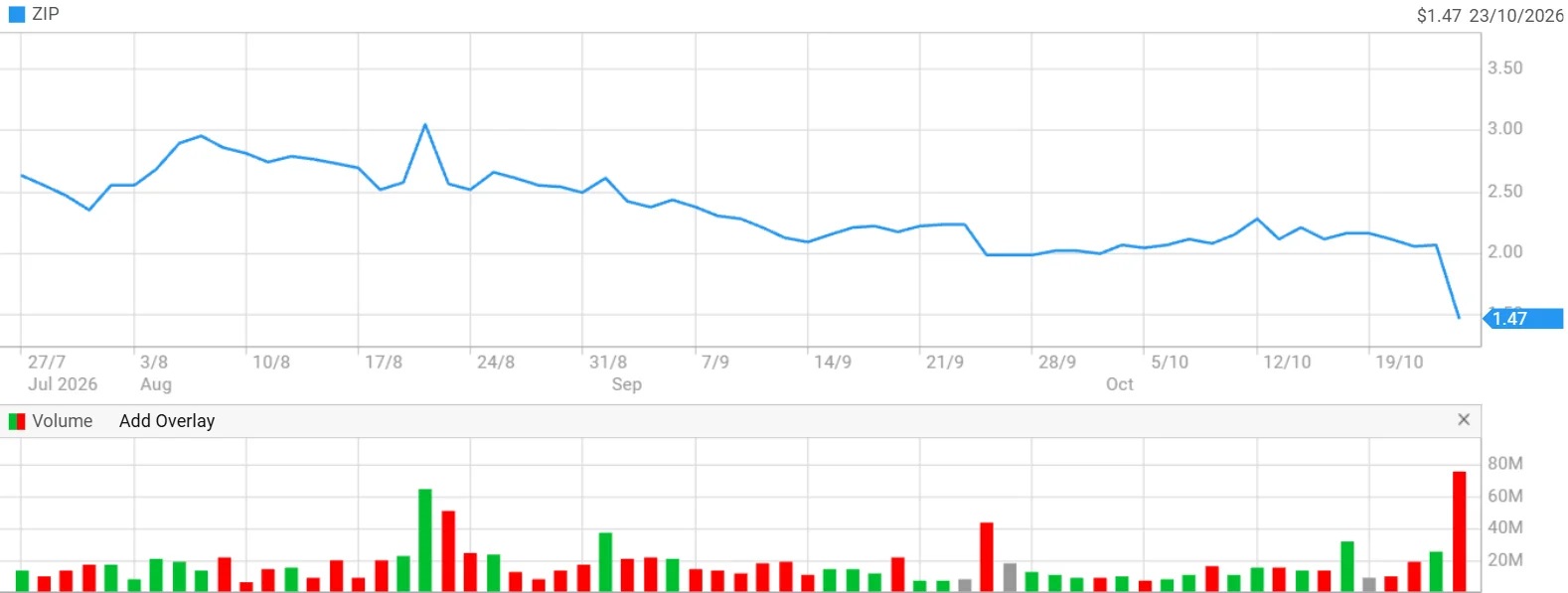
Zip’s shares fell by as much as half on Friday morning before recovering part of the loss. [ASX]
Yet a reaffirmed target did not stop the fall. The market wants proof, and the next proof is the second quarter update, historically released in late January. Readers tracking ASX financial results will want that date marked.
Fast-growing ASX fintech stocks tend to get punished hard on credit surprises. The Zip Co share price now carries a simple question: is the fraud a one-off, or a sign of a thin control layer? Wider ASX news has been quiet on this kind of risk for months.
Also Read: BHP Q1 Production Results 2026: The Copper Catch-Up Test
FAQs
Q: Why did the Zip Co share price fall?
A: A US fraud cost A$10.1 million, and bad debts and earnings missed forecasts.
Q: Did Zip change its FY27 guidance?
A: No. Cash EBTDA of A$340 million and US TTV growth above 30% both stand.
Q: What was the fraud?
A: Coordinated individuals opened accounts with legitimate credentials and ran unpaid purchases.
Q: How important is the US to Zip?
A: It made up 76% of group TTV in FY26.
Q: Is the fraud over?
A: Zip says it is contained, and US volume grew 41% in September.
Disclaimer: This article is general information only and is not financial advice. Share prices move quickly. Readers should consider their own circumstances and speak to a licensed adviser before making investment decisions.

Luke Carlino is a seasoned Copywriter, Content Strategist, and Social Media Manager specialising in Mining, Finance, and Business journalism. With more than a decade of industry experience, he brings rigorous editorial standards and commercial acuity to every project.