ResMed shut its 2026 financial year with a quarter that looked great on the top line and messier underneath.
Revenue for the three months to 30 June came in at $1.464 billion, up 9% on the same quarter a year earlier. Every figure here is in US dollars, since the company reports out of San Diego and lists on both the New York Stock Exchange and the ASX under the code RMD.
The board wanted people to see the record. Some investors zeroed in on a number further down the page.
Chairman and CEO Mick Farrell called it “strong fourth quarter results, reflecting continued momentum of our global business.” He has said versions of that line for years, and the growth keeps backing him up. Then there is the fine print.
The $42 million line that split the numbers
Two gross margin figures came out of this quarter, and they point in opposite directions.
The gross margin was reported at 58.8 percent, which’s a drop of 200 basis points compared to last year. The operating margin was hit harder falling 300 points to 30.7 percent. For a company built on steady, rising margins, that stings.
Take one item out though. The picture looks completely different. On a non-GAAP basis the gross margin increased 90 points to 62.3 percent.
The whole gap is a single charge: $42 million tied to an Astral field safety notification. Astral is ResMed’s life-support ventilator. A safety notice on that kind of device is not a rounding error, and the company took the full hit in the quarter instead of smoothing it out.
Take the charge away and the underlying story holds. Adjusted earnings were $2.95 per share which’s up 16 percent. The reported amount changed little, going up just 2 percent to $2.64 per share. Same business, two very different growth rates, one line sitting between them.
Where ResMed revenue growth came from
The engine here is not the machines. It is the masks.
Mask and accessory sales rose 11% in the quarter to $542 million. Devices added 8% to reach $750 million. And the machines keep giving: every night a patient spends on one, cushions and straps wear thin, so back they come to replace them. That resupply habit is the quiet money.
By region, the Americas lifted 8% to $853 million. The rest of the world grew 13%, or 10% once currency swings wash out. Residential care software, the slower piece, added 3% to $172 million.
Behind all of it sits the weight-loss drug question that has shadowed ResMed for two years. The fear ran simple: if Ozempic and its cousins shrink waistlines, fewer people get sleep apnoea, and ResMed loses customers.
Two years on, the machines keep selling. Farrell has turned the argument on its head, telling investors that all the drug and tech attention on obesity pushes more people into the sleep system, not fewer.
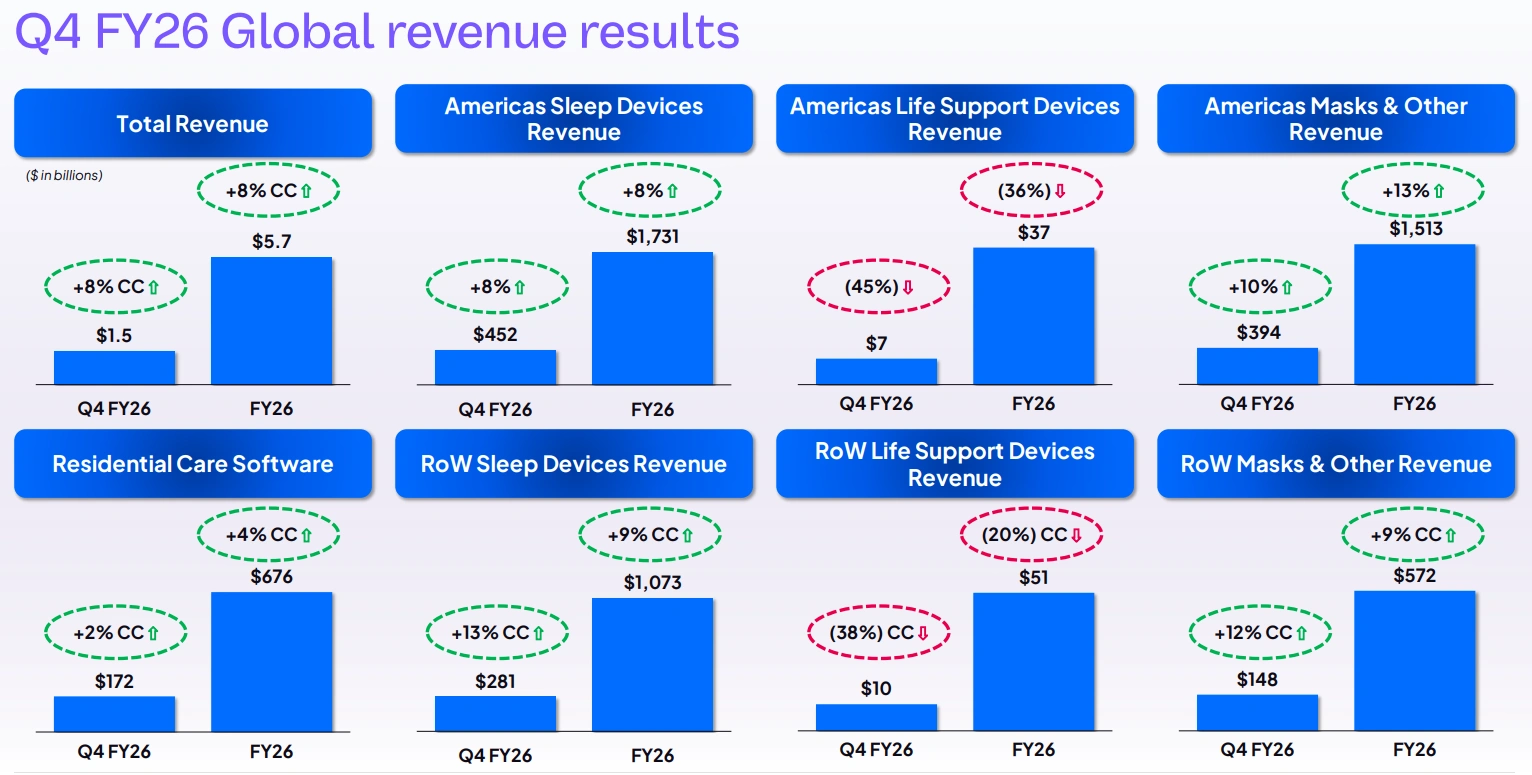
ResMed’s June-quarter revenue split by product line, with masks and accessories growing faster than devices. [RMD]
Selling one business, buying another
The other big move had nothing to do with the quarter’s arithmetic.
ResMed agreed to sell MatrixCare, its residential care software arm, with the deal set to close early in the new financial year. That business already sits on the balance sheet as held for sale, valued at roughly $457 million. It is part of the same software push the company spent years and real money building. Now a chunk of it is going.
In the same breath, ResMed finished buying Noctrix Health, which makes a wearable that treats restless legs syndrome. It also struck a partnership with Ōura, the smart-ring firm, to steer more people toward sleep care.
Read together, the moves sketch a company trimming its software edges and leaning harder into sleep and breathing. The recurring software income that long-term ASX investors tend to prize stays in the mix, just in a leaner form.
Cash going back to shareholders
The cleanest win in this report is the cash.
Free cash flow for the full year came in at $1.6 billion. ResMed handed more than $1 billion back to shareholders across FY2026 through buybacks and dividends, over 70% more than the year before. Against the FY2025 result, the capital return taps have been opened well up.
The directors increased the dividend by 10 percent raising it from $0.60 to $0.66. In addition the company mentioned than $1.85 billion in shareholder returns, for FY2027. That is a real step up, and a clear read on how much cash the business now throws off.
For the full year, revenue hit $5.653 billion, a 10% lift. Adjusted earnings per share did better still, rising 17% to $11.17.
And yet the market’s first reaction was cool. ResMed beat the roughly $2.90 a share that analysts had pencilled in, and the stock still slipped in after-hours US trade. The Astral charge, the MatrixCare sale, and a soft reported profit line gave the doubters enough to chew on, even after a run of insider activity like the CFO’s share sale kept the stock in the headlines earlier in the year.
For anyone sizing up ResMed, the FY26 numbers say the core is fine. Sales grow. Cash builds. Dividends climb. The catch sits in the quality of this quarter’s profit and in a portfolio being reshaped mid-stride. Steady still beats sudden, and steady is what the ageing-population demand story keeps selling.
Also Read: AMP 1H26 Results: The Buyback Isn’t the Real Win
Check our about page: https://colitco.com/about-us/
FAQs
Q: What were ResMed’s Q4 FY2026 results?
A: Sales climbed 9% to a record $1.5 billion, and adjusted earnings per share rose 16% to $2.95.
Q: Why did ResMed’s reported margin fall?
A: A $42 million Astral ventilator safety charge pulled GAAP gross margin down to 58.8%.
Q: How much did ResMed revenue grow in FY2026?
A: Revenue for the full year grew 10%, reaching $5.65 billion.
Q: Is ResMed selling a business?
A: Yes. It agreed to sell its MatrixCare residential care software arm, with the deal closing early in FY2027.
Q: Did ResMed raise its dividend?
A: Yes, by 10% to $0.66 per share each quarter.
Q: Does ResMed trade on the ASX?
A: Yes, under RMD, through CDIs at a 10:1 ratio to its NYSE shares.
Disclaimer:
This article is for informational purposes only and does not constitute financial product advice, investment advice, or a recommendation to buy or sell any securities. All figures are sourced from ResMed’s official announcements and publicly available material at the time of writing. Readers should conduct their own research and seek professional financial advice before making any investment decision. Past performance is not a reliable indicator of future results.
Source:

Luke Carlino is a seasoned Copywriter, Content Strategist, and Social Media Manager specialising in Mining, Finance, and Business journalism. With more than a decade of industry experience, he brings rigorous editorial standards and commercial acuity to every project.