Transurban Group (ASX: TCL) closed the book on NSW toll reform on 3 August 2026. The Direct Deal is done, at least in principle, and the Transurban NSW toll reform outcome looks very different depending on which page of the presentation gets read.
Ten concessionaires across ten assets. Years of negotiation.
And when the arithmetic settles, Transurban’s net funds flow over the next five years comes to zero.
That number is not buried in a footnote. It sits in a table in the presentation lodged with the announcement. Roughly $0.6 billion out, $0.6 billion back, net $0.0 billion.
The NSW toll reform Direct Deal costs Transurban nothing over five years
Here is the mechanism.
Transurban’s concession entities hold two sets of IOUs owed to Transport for NSW. Hills M2 promissory notes worth about $0.5 billion. Eastern Distributor concession notes worth about $0.1 billion. Both are non interest bearing. Both have been sitting there for years.
The deal pulls those payments forward to 2028. The State collects the cash. The State then pays it back to concessionaires as equalisation payments spread across 2028 to 2032, sized to offset the toll revenue lost to the price cuts.
Money travels in a circle and lands close to where it started.
The M2 settlement is expected to come out of corporate liquidity. The Eastern Distributor one is expected to be debt funded. So Transurban wears the outflow first and collects the offset over four years afterwards. That timing gap is the question worth asking on the FY26 call.
Distributions are untouched. The announcement says that plainly, with the standard rider that the Board has final say.
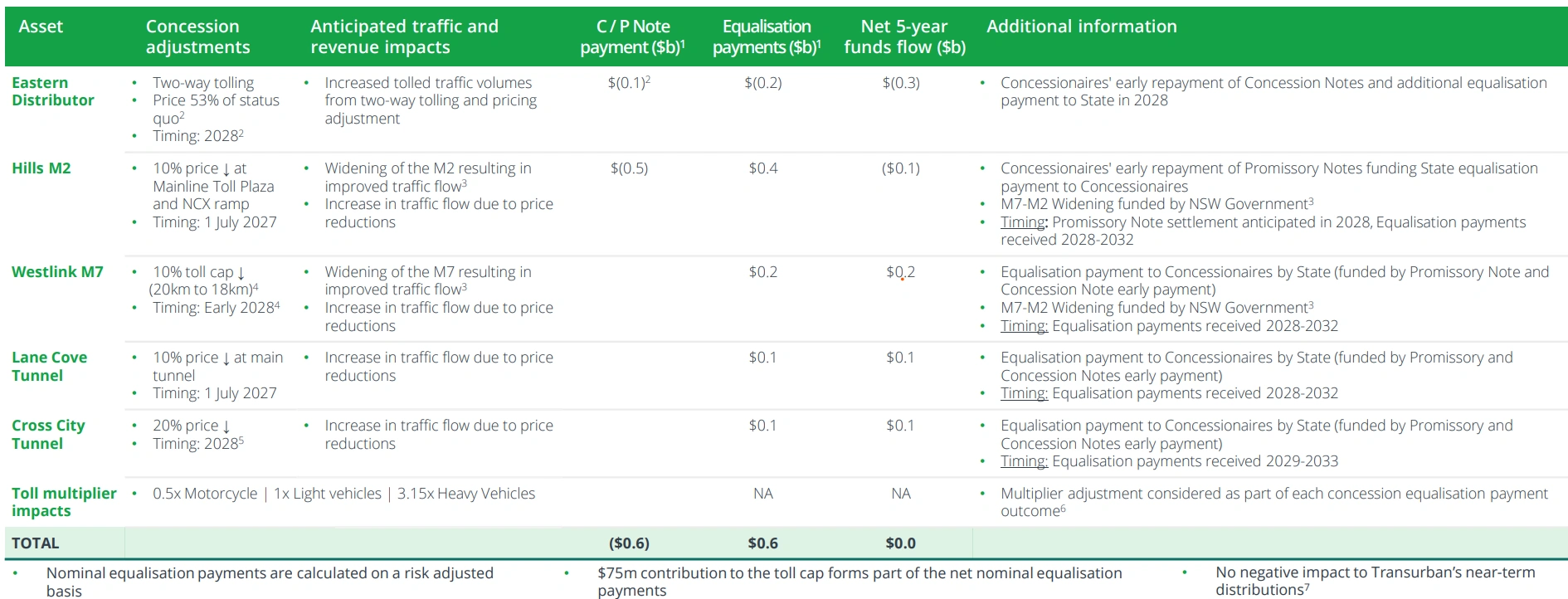
Net five-year funds flow across the five affected Transurban concessions totals zero.
Motorcyclists win, trucks and return drivers pay more
The headline cuts read well enough. Ten per cent off the Lane Cove Tunnel and the M2 mainline plaza from 1 July 2027. Twenty per cent off the Cross City Tunnel once the Western Harbour Tunnel opens in 2028. The M7 distance cap trimmed from 20 kilometres to 18.
Motorcycles get a new class at half the light vehicle rate, phased from July 2027.
The Eastern Distributor is a different animal.
Today the toll is $10.48 and it applies once, northbound. From 2028 the price drops to 53 per cent of the status quo and applies in both directions.
Do the sum. A return trip costs 106 per cent of what it costs now. A one way trip costs roughly half.
Heavy vehicles have their own story. The multiplier standardises at 3.15 times the light vehicle toll across the network. On the Eastern Distributor and the Cross City Tunnel it currently sits at 2.0 times.
Transurban’s own document states that incremental revenue from the multiplier change, net of traffic impacts, gets passed through to the Government. Freight is helping fund the car discounts. Two heavy vehicle relief schemes have been flagged for a two year pilot, with the detail still to come.
WestConnex missing from the price list says plenty
Run down the asset list and one name is absent from the price changes.
WestConnex.
The Government’s release states that the parties could not reach an outcome on WestConnex that represented value for both motorists and taxpayers inside the timeframe required.
That is an unusually blunt admission for a media release. WestConnex is the largest single piece of Sydney’s tolled network, and the M4, M5 East and M8 carry the Western Sydney drivers this whole reform program was pitched at.
Western Sydney keeps the weekly cap and the M5 Cashback Scheme. On the price of the roads themselves, nothing changes.
One more line deserves attention. Concessionaires will contribute $75 million over five years towards the weekly toll cap, which the Government frames as recognition of induced demand from cheaper tolls.
Transurban’s presentation states it has observed no induced demand across the first two and a half years of the cap operating.
A payment is being made for an effect the operator says its data does not show. Read it as a goodwill contribution and it makes more sense.
June traffic gave Transurban a cleaner run into the FY26 result
Group average daily traffic rose 3.8 per cent in June against the prior corresponding period. Excluding the West Gate Tunnel, 2.4 per cent.
Sydney lifted 2.5 per cent. That is the strongest month of the calendar year, helped by construction disruption easing after the M7-M12 Integration Project wrapped up.
Melbourne excluding West Gate managed 1.5 per cent, ending four straight months of decline.
West Gate Tunnel remains the soft patch. Average daily traffic for the year to 30 June 2026 was 37,000, and the ramp up has been flat since February.
North America ran hot. Traffic up 6.9 per cent, with average dynamic toll prices up 18.9 per cent on the 95 Express Lanes and 36.1 per cent on the 495.
July is tracking broadly in line with June. Full detail arrives with the FY26 result on 13 August 2026.
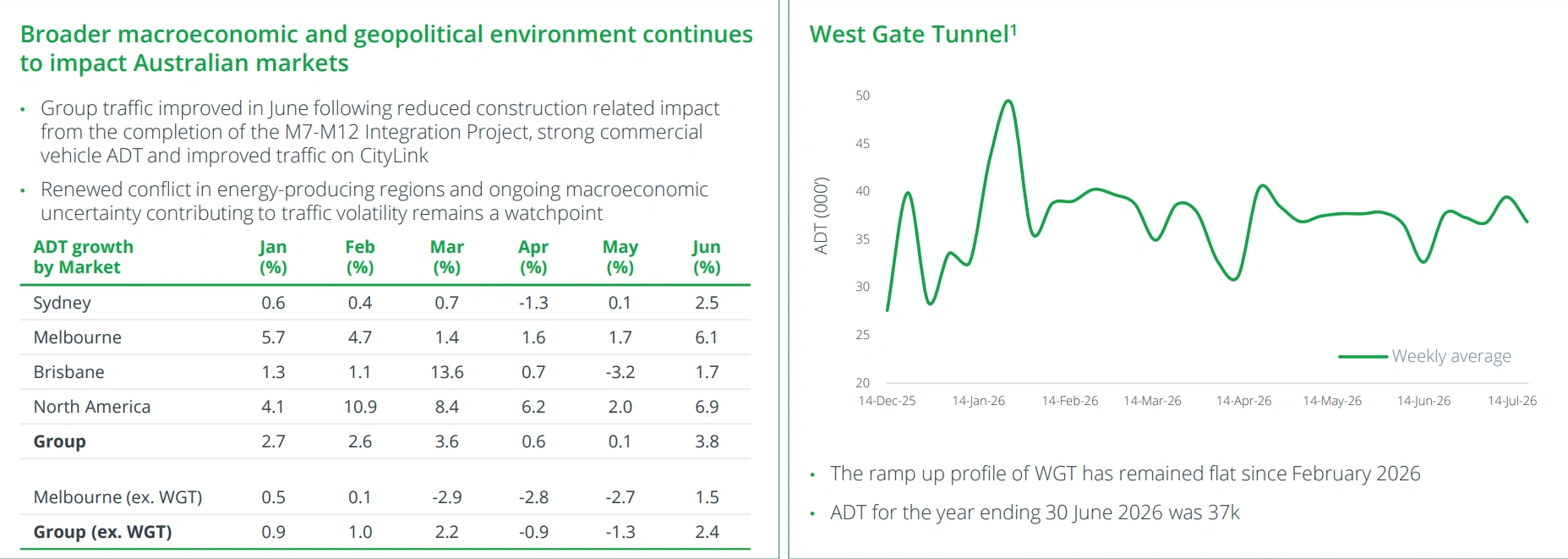
Sydney traffic growth recovered to 2.5 per cent in June after a negative April. [TCL]
What still has to happen before any of this is real
Nothing is signed. Formal documentation, financier consents and regulatory approvals are expected in the second half of 2026.
The M7 cap reduction depends entirely on the M7-M2 Widening proceeding, and that needs a final business case plus a Government investment decision. Construction is pencilled in for 2028 with opening around 2031.
The Cross City Tunnel and Eastern Distributor changes wait on the Western Harbour Tunnel opening.
Most of the motorist savings land on 1 July 2027 and through 2028. The NSW state election is due in March 2027.
For securityholders, the pricing overhang that sat across the Sydney book has been cleared without a permanent revenue cut. That is the takeaway. The rest is timing.
Also Read: MetalSource Extends Silver Hill Project 65m to the South
For more information: https://colitco.com/
FAQs
Q: What is the NSW toll reform Direct Deal?
A: An agreement between the NSW Government and private toll road concessionaires to cut some tolls and standardise pricing.
Q: Which Sydney tolls are being cut?
A: Lane Cove Tunnel, Hills M2, Cross City Tunnel and the M7 distance cap.
Q: When do the toll cuts start?
A: Most begin 1 July 2027, with others in 2028.
Q: Is WestConnex included?
A: Not in the price changes. The Government said no agreement was reached in time.
Q: Does the deal reduce Transurban’s distributions?
A: The company says there is no negative impact to near-term distributions.
Q: What is the weekly toll cap now?
A: $50 per week until July 2027, then $60 permanently.
Q: When is Transurban’s FY26 result?
A: 13 August 2026.
Disclaimer:
This article is general information only. It does not consider any individual’s objectives, financial situation or needs, and is not financial product advice. Figures are drawn from Transurban’s ASX release of 3 August 2026 and the NSW Government’s media release of the same date. Proposed toll changes remain subject to definitive agreements, financier consents and regulatory approvals. Seek advice from a licensed financial adviser before making any investment decision.
Source: https://yourir.info/resources/a50955429d255a58/announcements/tcl.asx/3A698074/TCL_NSW_Toll_Reform_and_June_traffic.pdf

Elizabeth Jones is a finance and mining content specialist with over 10 years of experience creating clear, SEO-driven content across fintech, investing, banking, insurance, cryptocurrency, and resource markets. She transforms complex financial data and industry trends into engaging, reader-focused articles that improve understanding and audience engagement.