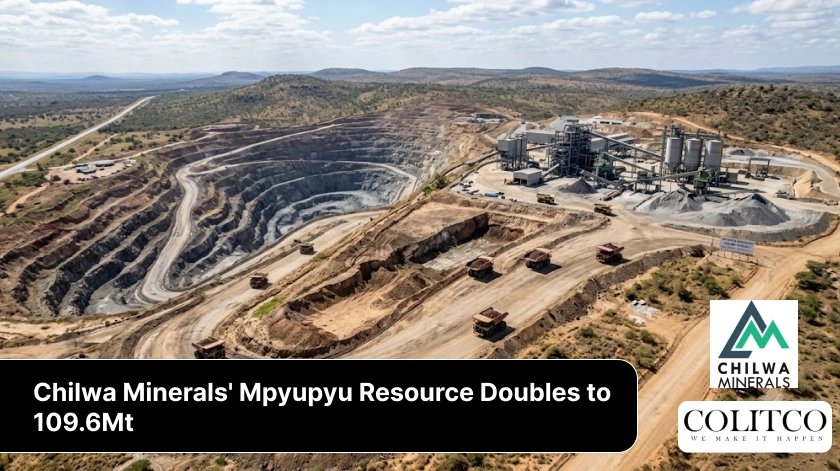
Chilwa Minerals Limited (ASX: CHW) released an updated resource number on 19 June 2026 for its Mpyupyu deposit at the Chilwa Critical Minerals Project in southern Malawi.
The tonnage more than doubled. It now stands at 109.6 million tonnes, up from 51.2 million tonnes a year earlier.
That’s a 114% jump in size alone.
The bigger number isn’t really the headline, though. Almost 89% of that tonnage now sits in the Measured and Indicated categories, the two confidence levels that actually let engineers plan a mine.
A year ago, most of Mpyupyu sat in the lowest rung, Inferred.
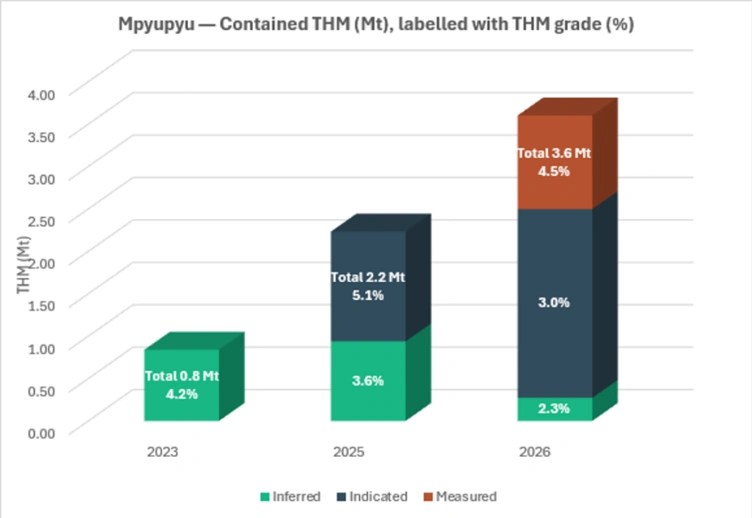
Measured and indicated tonnes now make up almost 90% of the upgraded Mpyupyu resource. [Chilwa Minerals]
Mpyupyu Becomes Chilwa Minerals’ Largest Mineral Sands Deposit
Mpyupyu now outranks every other target Chilwa holds across the ten heavy mineral sands deposits scattered around Lake Chilwa.
Managing Director Cadell Buss called it a defining step in the Company’s shift from explorer to potential developer.
The breakdown at a 1% total heavy mineral (THM) cut-off looks like this:
- Measured: 24.5 million tonnes
- Indicated: 73.6 million tonnes
- Inferred: 11.6 million tonnes
Buss said the geological confidence is now solid enough to start the design, procurement and approval work a real mine needs. No decision to mine has been made, and the Company is upfront about that.
Denser Drilling Drove the Jump in Confidence
The 2025 estimate leaned on older aircore holes. This year’s update ran on 1,398 sonic drill holes, totalling 6,174 metres, averaging just 4.42 metres a hole.
A tighter grid, down to 50 metres by 50 metres through the deposit’s centre, is what flipped so much Inferred ground into Measured and Indicated.
Here’s the part that trips people up. Average grade actually fell, from 4.36% THM down to 3.28%. Tonnage grew 114% while contained heavy mineral rose only 62%, because the wider drill coverage picked up plenty of lower-grade sand sitting on the margins.
A High-Grade Core Still Sits Inside the Bigger Number
Strip out the thinner edges and there’s a solid heart left over. At a 3% cut-off, 50.6 million tonnes grade 4.65% THM.
The Dune domain in the southwest carries the best grade, 12.82 million tonnes of Measured resource running just over 5% THM. That’s the part likely to feed a plant first, if Chilwa ever pulls the trigger on mining.
Ilmenite and zircon dominate the mineral mix. Those are the two products Chilwa actually plans to sell.
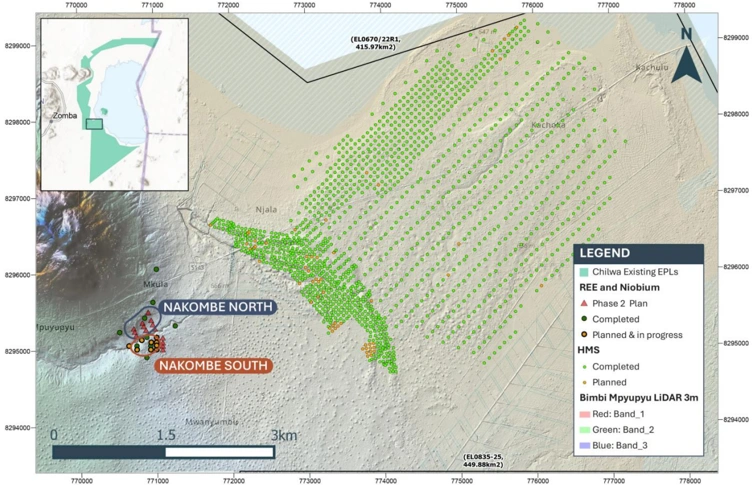
Mpyupyu sits roughly a kilometre from the Nakombe niobium-rare earths target, on the same licence. [Chilwa Minerals]
Niobium and Rare Earths Sit Right Next Door
Mpyupyu doesn’t sit on its own. The Nakombe niobium-rare earths target lies about a kilometre away, on the same contiguous licence.
QEMSCAN testing also picked up monazite running right through the Mpyupyu sand. Monazite carries rare earth elements, which opens the door to a by-product credit sitting alongside the ilmenite and zircon.
Buss laid out the strategy plainly. Get the mineral sands into production first, then let the cash flow, roads, power and water that come with it help fund the niobium and rare earth work nearby.
That’s the plan on paper. A feasibility study, permits and funding still have to land before any of it becomes real.
The market has been quick to reward confidence upgrades like this one across junior mineral sands stories this year.
Banks generally won’t lend against Inferred tonnes, so a shift to nearly 90% Measured and Indicated is the kind of detail a lender actually reads.
What Happens Next for Chilwa Minerals
A Scoping Study covering Mpyupyu is due in the third quarter of 2026. That document turns rock into a rough mine plan, complete with cost estimates and a development timeline.
Sonic drilling is also underway right now at Mpyupyu West, a fresh target about five square kilometres in size, identified only weeks ago.
Australia’s own heavy mineral sands deposits carry a similar story, where monazite recovered alongside ilmenite and zircon has quietly become a rare earth source in its own right.
Chilwa’s bet on co-located commodities echoes what’s playing out at St George Mining’s niobium and rare earths project in Brazil, where one licence is being asked to carry several critical mineral stories at once.
It also fits a broader theme, with juniors from Spain to Malawi chasing the kind of EU and global critical minerals exposure that comes from sitting on more than one strategic commodity.
That theme links back to the bigger picture too, as countries look for an alternative rare earths supply chain outside China, and small explorers with monazite in their sand suddenly look more interesting than they used to.
FAQs
Q: What is the Mpyupyu deposit?
A: Chilwa Minerals’ largest heavy mineral sands deposit, at Lake Chilwa in southern Malawi.
Q: How big is the resource now?
A: 109.6 million tonnes, up from 51.2 million tonnes a year ago.
Q: How much of it is high confidence?
A: About 89% sits in the Measured and Indicated categories.
Q: What’s next for the project?
A: A Scoping Study is due in the third quarter of 2026.
Q: Has Chilwa decided to build a mine?
A: No. The Company has made no decision to mine.
Disclaimer:
This article is for general informational purposes only and does not constitute financial or investment advice. Readers should conduct their own research and consult a licensed financial adviser before making any investment decisions. Colitco accepts no responsibility for any loss or damage arising from reliance on this content.
Source:
https://wcsecure.weblink.com.au/pdf/CHW/03101820.pdf

Elizabeth Jones is a finance and mining content specialist with over 10 years of experience creating clear, SEO-driven content across fintech, investing, banking, insurance, cryptocurrency, and resource markets. She transforms complex financial data and industry trends into engaging, reader-focused articles that improve understanding and audience engagement.