
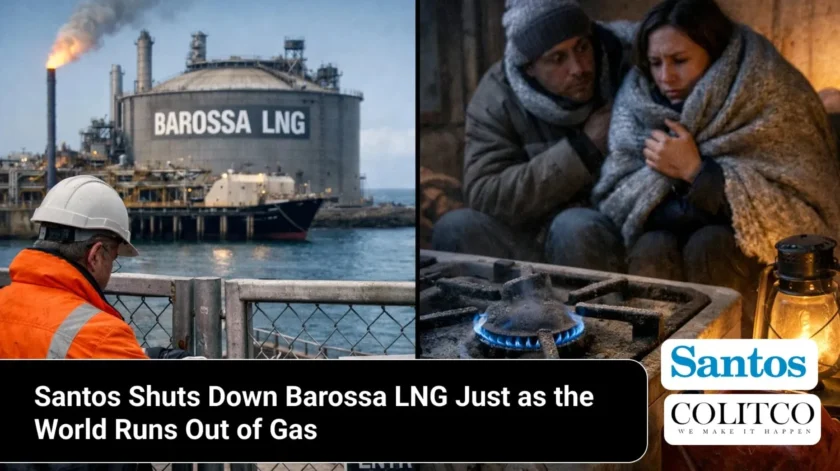
Santos, which has seen its share price jump 19 per cent in a month due to a global oil and gas shortage, has quietly shut down its flagship Barossa LNG export project for several weeks. The timing could not be worse.
Twenty per cent of global liquefied natural gas capacity is currently isolated by the Strait of Hormuz, which Iran has blocked. With supply already at crisis levels, Santos’ Barossa going dark leaves its customers with nowhere to turn.
The Barossa LNG Shutdown: What Santos Told Stakeholders
On March 19, Santos emailed stakeholders in the Darwin area about a “planned shutdown” of its 3.7 million tonnes-per-year Darwin LNG plant. “Flaring will occur at the facility and may continue for a number of weeks until the plant is restarted and operational,” the email said.
Santos did not make a public announcement. The shutdown only came to light after the email was obtained by energy outlet Boiling Cold. The company did not respond to questions.
The Darwin LNG plant processes gas from the Barossa offshore gas field, located 300km north of Darwin. Its shutdown will deprive Santos’ customers of the supply they are actively scrambling to secure.
Global LNG Supply Crisis Deepens the Blow
The Barossa stoppage is not just a Santos problem. It arrives as the global LNG market faces its worst disruption in decades.
The Strait of Hormuz closure has taken roughly 20% of global LNG off the market, primarily Qatari supply. This has pushed gas prices sharply higher across Asia and Europe, with Dutch TTF gas benchmarks surging as European storage levels sit at critically low levels following a harsh winter.
Santos was ideally placed to pick up that demand. Its Barossa project produces gas entirely outside the Middle East corridor. Instead, it is offline.
Darwin LNG Ownership and the BW Opal Vessel Problems
The Barossa LNG project is operated and 50 per cent owned by Santos. Japan’s JERA holds a 12.5 per cent stake, and the Korean firm PRISM Energy International Australia owns 37.5 per cent.
The issues trace back to the BW Opal, a 358-metre floating production, storage and offloading vessel owned by BW Offshore and leased to Santos.
BW Offshore said commissioning of the vessel had been delayed by the need to reinforce pipes carrying seawater and to replace gas seals on compressors. The Norwegian company had expected to hit practical completion by mid-March. As things stand, the vessel may produce nothing for the rest of March.
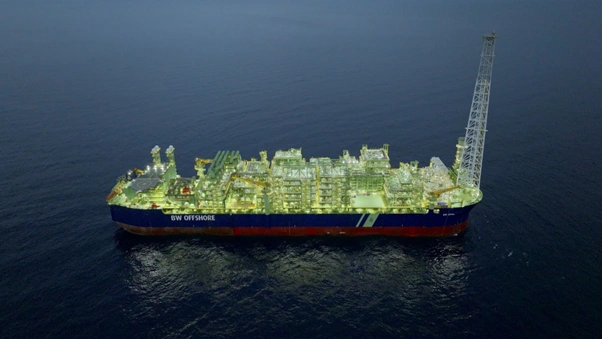
BW Opal floating production vessel leased to Santos at the Barossa LNG gas field, Timor Sea. [Oil and Gas World]
A $5.7 Billion Project That Has Never Run Smoothly
Santos went ahead with the Barossa final investment decision in 2021, committing to what became a $5.7 billion development. It faced legal challenges from Tiwi Island traditional owners, regulatory delays, and multiple construction hurdles throughout.
The first LNG carrier from Barossa only left Darwin on 25 January this year, after Santos missed its end-of-year target. Since then, shipping data shows just one vessel, the Kool Husky, has docked at the Darwin LNG berth. A second carrier, the Bishu Maru, had its March 16 arrival cancelled entirely.
This is not Barossa’s first unplanned outage either. The facility experienced a two-week shutdown in late 2025 due to a software fault, prompting Santos to trim its full-year production outlook. This latest halt may force a similar revision.
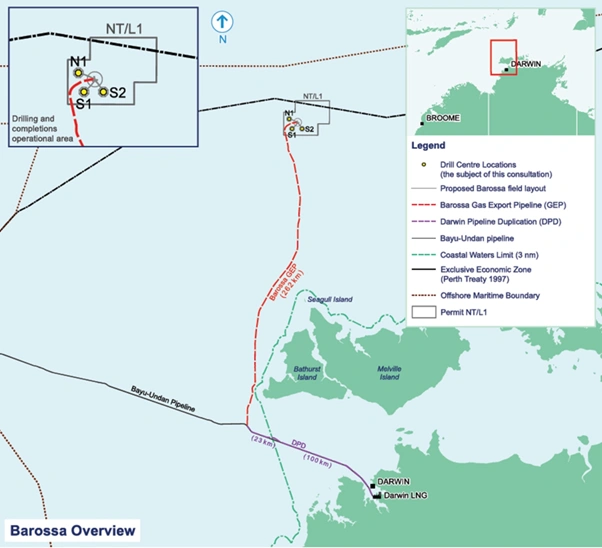
Map of the Barossa gas field offshore Darwin, Northern Territory, showing subsea pipeline route to Darwin LNG processing plant. [Santos]
Santos Production Targets Under Pressure
Santos had projected full-year production of 101 to 111 million barrels of oil equivalent, compared with 87.7 MMboe in 2025. Whether those targets hold after this latest setback remains to be seen.
The broader industry picture is stark. Australia is already facing east coast gas supply pressure heading into winter, and the Barossa halt removes one more source of supply from a market that can ill afford it.
Santos shares had risen 19% in the month prior to the shutdown announcement, reflecting strong investor interest tied to the global gas price rally. The shutdown may weigh on that momentum if the outage extends or production guidance is cut.
Also Read: Australia’s Biggest Property Tax Shake-Up in Decades Is Coming. Here’s Who Wins and Who Doesn’t
FAQs
Q: Why has Santos shut down the Barossa LNG project?
A: Santos notified Darwin stakeholders on 19 March of a “planned shutdown” of the Darwin LNG plant. The facility is expected to be offline for a number of weeks. Santos has not publicly explained the specific cause, but the BW Opal vessel had ongoing commissioning problems, including seawater pipe reinforcements and gas seal replacements on compressors.
Q: How does the Strait of Hormuz closure affect Australian LNG exports?
A: The Strait of Hormuz closure has removed roughly 20% of global LNG supply from the market. This has driven gas prices sharply higher across Asia and Europe, creating an opportunity for Australian LNG producers outside the Middle East corridor. The Barossa shutdown means Santos cannot fully capitalise on that price surge.
Q: Will Santos revise its 2026 production guidance after the Barossa outage?
A: Santos has not yet indicated a formal revision to its production targets. However, given that the Darwin LNG plant processes all Barossa gas, an extended outage of several weeks will reduce overall output. Analysts will be watching closely for any updated guidance.
Q: What is the BW Opal and why does it matter to Barossa LNG?
A: The BW Opal is a 358-metre floating production, storage and offloading vessel owned by BW Offshore and leased to Santos. It serves as the offshore production hub for the Barossa gas field before gas is piped to Darwin for LNG processing. Commissioning delays on the vessel have contributed to multiple production setbacks at the project.
Disclaimer: This article is for informational purposes only and does not constitute financial or investment advice. Readers should conduct their own research or consult a qualified adviser before making any investment decisions.
Source: