
Microsoft shares fell sharply after its latest earnings report raised concerns about heavy AI spending and slower cloud growth. The decline erased hundreds of billions in market value and weighed on broader markets, prompting investors to reassess valuations tied to artificial intelligence.

Microsoft shares fell sharply following its latest earnings report amid concerns over AI spending and cloud growth. (Image: Bloomberg)
Microsoft Shares Slide After Earnings
Microsoft stock dropped about 10 to 12 percent following the release of its fiscal second-quarter results. The fall wiped out roughly $360 billion in market capitalization within a single trading session.
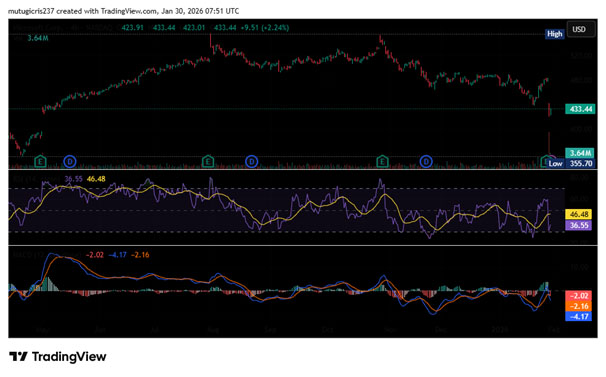
Microsoft’s share price dropped by double digits, wiping out hundreds of billions in market value in one session. (Source: TradingView)
The company reported revenue of about $81 billion, beating analyst estimates. However, investors focused on rising costs linked to artificial intelligence infrastructure and moderating Azure cloud growth.
Capital expenditure reached approximately $37 billion during the quarter. That figure marked a sharp year-over-year increase driven by data centers and advanced chips.
Rising AI Spending Draws Investor Attention
Microsoft has accelerated spending to expand its AI capabilities across cloud and enterprise products. The company is investing heavily in data center capacity to support generative AI services.
Executives stated that AI demand remains strong across corporate clients. Yet market participants reacted cautiously to the pace of spending compared with near-term revenue growth.
Several analysts noted that returns on AI infrastructure may take time to materialize. As a result, traders reassessed risk exposure within major technology stocks.
Posts circulating on X reflected the market’s reaction. Some users described the selloff as a reset in AI valuations rather than a collapse of long-term demand.
Azure Growth Slows Amid Expansion Efforts
Azure, Microsoft’s cloud computing division, posted growth during the quarter. Still, the expansion rate came in slightly below market expectations.
Cloud performance remains central to Microsoft’s broader strategy. Therefore, any deceleration tends to influence investor sentiment.
Management indicated that AI services contributed meaningfully to Azure revenue. However, capacity constraints and investment cycles shaped near-term growth patterns.
Market observers tracked commentary shared online during the earnings call. Tweets referenced slower cloud momentum while acknowledging continued enterprise adoption of AI tools.
Broader Market Reaction to Tech Weakness
The selloff extended beyond Microsoft shares. The Nasdaq Composite and S&P 500 both traded lower as technology stocks faced pressure.
Large-cap companies tied to artificial intelligence saw mixed performance. Some firms declined in sympathy, while others gained on separate earnings results.
Live market coverage from financial networks reported cautious trading conditions. Investors rotated into sectors viewed as less exposed to high capital expenditure trends.
Meanwhile, volatility increased during intraday trading. Market participants closely monitored statements from major technology executives.
AI Spending and Market Repricing
Recent gains in technology stocks have been driven partly by expectations of AI-driven revenue growth. As spending levels rise, investors appear focused on measurable returns.
Reports described the current environment as a repricing phase rather than a broad retreat from AI themes. Companies demonstrating revenue acceleration linked to AI appear to be receiving stronger support.
Market commentary shared on social media emphasized capital discipline. Users noted that elevated infrastructure costs require clear earnings visibility.
Financial analysts echoed similar observations in televised interviews. They pointed to the balance between innovation spending and shareholder expectations.
Divergence Among Major Technology Firms
While Microsoft shares declined, other technology companies reported varied outcomes. Some firms posted earnings that reassured investors about AI monetization.
Meta Platforms, for example, recorded stock gains after its results. Investors responded positively to its revenue trajectory despite continued AI investment.
The contrast illustrated differences in market perception. Traders evaluated each company’s spending profile against revenue delivery.
At the same time, Apple and other technology names remained under close watch. Earnings season continued to shape broader equity performance.
Also Read: Clarity Pharmaceuticals Advances Multiple Registrational Trials, Backed by $226m Cash Reserve
Outlook for AI-Driven Markets
Artificial intelligence remains central to corporate technology strategies. However, recent trading sessions show greater scrutiny of spending levels.
Microsoft’s earnings triggered a wider discussion about valuation and growth pacing. Market participants are tracking how quickly AI services translate into sustained revenue.
Online discussions continued as investors assessed the developments. Tweets cited the scale of capital expenditure and the scale of the stock move.
Trading volumes reflected elevated interest in technology equities. For now, the market appears focused on balancing long-term AI ambitions with short-term financial performance.
Microsoft has not signaled a slowdown in planned infrastructure expansion. The company continues to position AI services across its product ecosystem.
Even so, equity markets reacted swiftly to cost and growth signals. The coming quarters may provide further clarity on revenue trends and cloud demand.
As earnings season progresses, investors remain attentive to capital allocation. Technology stocks are likely to stay sensitive to updates on AI spending and cloud growth.
FAQs
- Why did Microsoft’s stock fall after its earnings report?
Microsoft shares declined after investors reacted to record spending on artificial intelligence infrastructure and slower growth in its Azure cloud division. While earnings exceeded expectations, market attention centered on rising capital expenditure and growth momentum.
- How much did Microsoft spend on capital expenditures in the quarter?
The company reported capital spending of about $37 billion for the quarter. This marked a sharp increase compared with the same period last year, largely due to investments in data centers and AI-related hardware.
- Did Microsoft beat revenue and profit expectations?
Yes. Microsoft reported revenue and earnings per share above analyst forecasts. Despite that performance, investors focused more on forward-looking growth signals and spending levels.
- What happened with Azure cloud growth?
Azure continued to expand year over year. However, its growth rate came in slightly below some market expectations, which contributed to investor caution following the earnings release.
- Why are investors concerned about AI spending?
Investors are closely monitoring whether heavy spending on AI infrastructure will generate proportional revenue growth. Many are looking for clearer timelines on returns from these investments.
- How did the broader market respond to Microsoft’s decline?
Major stock indices, including the Nasdaq and S&P 500, traded lower as technology shares faced pressure. Other AI-focused companies saw mixed reactions depending on their earnings results.
- Is this viewed as the end of the AI boom?
Market commentary suggests the recent selloff reflects valuation adjustments rather than a collapse in AI demand. Investors appear to be reassessing pricing in light of spending levels and growth trends.