
Catalyst Metals (ASX: CYL) just found proof that ground everyone else had written off still had gold left in it. The company’s Keillor deposit, an underground and open pit gold mine on the Plutonic Gold Belt in Western Australia, is the case in point.
On 9 September 2026, Catalyst told the market that Keillor’s Mineral Resource Estimate has grown from 81,000 ounces at 3.6 grams per tonne to 307,000 ounces at 3.0 grams per tonne.
That’s a 3.2 million tonne resource now sitting where a much smaller one used to be, a jump of roughly 280 per cent. The indicated portion, the gold Catalyst can actually plan a mine around, rose even harder, up 500 per cent to 187,000 ounces.
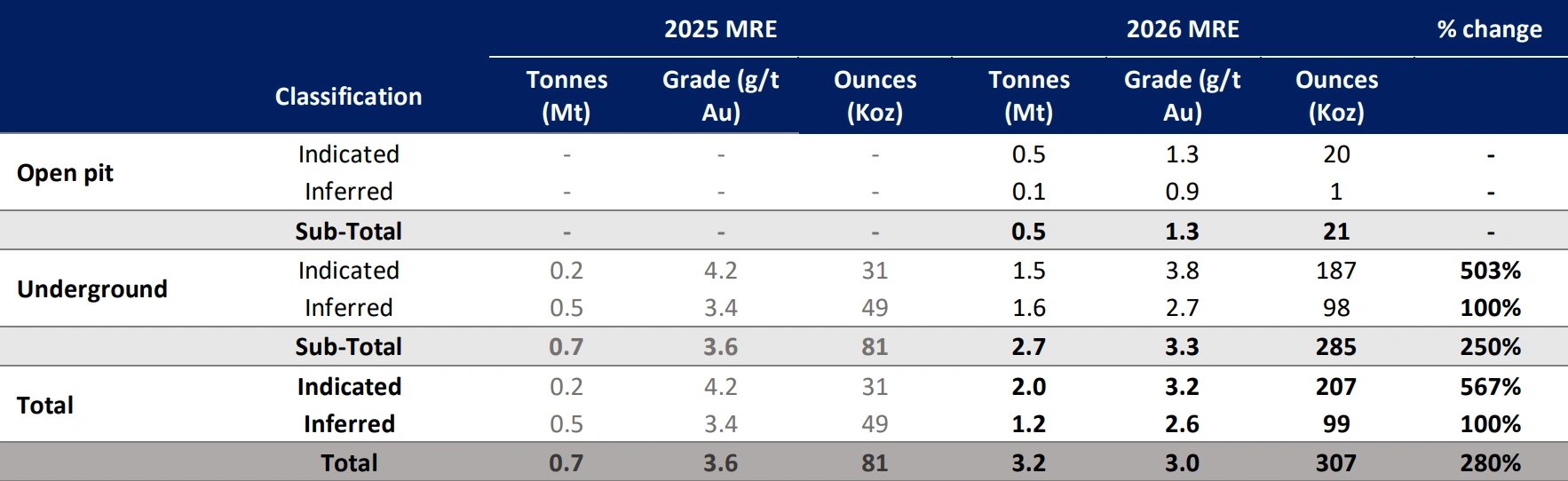
Keillor’s resource by classification, before and after the 2026 drilling program. [Source: Catalyst Metals].
A Mine Left Alone for Twenty-Five Years
Keillor isn’t new. The pit was discovered in the 1980s by a Resolute Mining geologist named Brett Keillor and the pit still carries the name Brett Keillor. Between 1992 and 1995 Resolute Mining extracted 124,000 ounces of gold from a pit at this location.
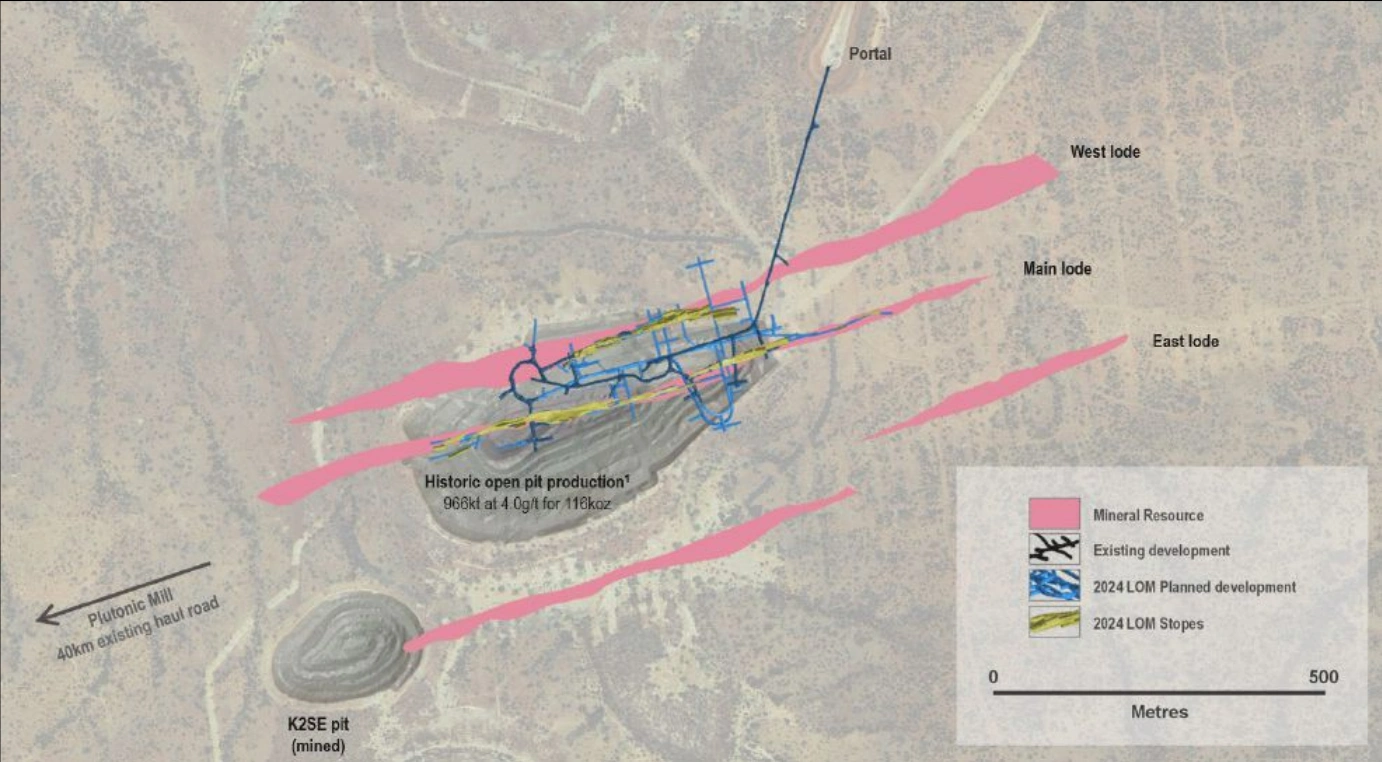
Plan view of the Keillor deposit showing the main mining lodes. [Source: Catalyst Metals].
A decline was started in 1997 to chase the ore underground then the whole operation was shut down before a single tonne of stope ore was produced.
What happened next was 27 years of no activity. Ownership of the ground changed hands with half a dozen companies, a dispute stretched on and nobody drilled the pit properly. Catalyst only settled that legal fight in November 2025.
Once the ground was clear, drill rigs went in and stayed in, racking up 30,000 metres of underground drilling on dedicated platforms built specifically to test Keillor.
Forget the 280 percent for a second. It was always down there. Nobody had the legal clarity or the will to go and count it properly until now.
The Numbers Behind the Keillor Resource Growth
The updated estimate breaks down like this:
- Open pit: 0.5Mt at 1.3g/t for 21,000oz
- Underground: 2.7Mt at 3.3g/t for 285,000oz
- Total: 3.2Mt at 3.0g/t for 307,000oz
First ore came out of Keillor in the June 2026 quarter. The mine is now ramping up with work focused on the main lode and west lode.
Metallurgical testing shows a recovery rate above 92 percent, which is a strong number for free milling ore and means little of that gold gets lost on the way to a gold bar.
Managing Director James Champion de Crespigny framed the result against Catalyst’s bigger target, a 2 million ounce Reserve across the whole Plutonic Belt.
He said the Keillor result, alongside recent success at the nearby Cinnamon deposit, makes that target look increasingly achievable, and that extending Keillor’s mine life gives the company high grade, low capital ounces to support a ten year plan aimed at roughly 200,000 ounces of annual production.
Why the grade drop is not the main worry
Sharp‑eyed readers might notice that the average grade fell from 3.6 grams per tonne to 3.0 grams per tonne. That change looks like a downgrade on paper. It isn’t.
The old 81,000 ounce figure came from a tiny, cherry-picked dataset drilled mostly before the year 2000. A resource that small and that old tends to hug the highest grade parts of a deposit because that’s all anyone had sampled.
Drill a much wider footprint, as Catalyst has now done, and the average always softens a little as genuine but slightly lower grade ore gets counted too.
What actually matters is the indicated underground grade, which sits at 3.8g/t, still comfortably high grade by Australian underground standards.
The ounces Catalyst can mine with confidence in the near term haven’t gotten weaker. There are just a lot more of them.
There’s also a hint that Keillor isn’t finished growing. Deeper holes returned 7 metres at 5.1g/t gold some 350 metres beneath the existing West Lode and 4 metres at 10g/t gold 180 metres, below the East Lode. Those intercepts sit outside the current resource boundary entirely.
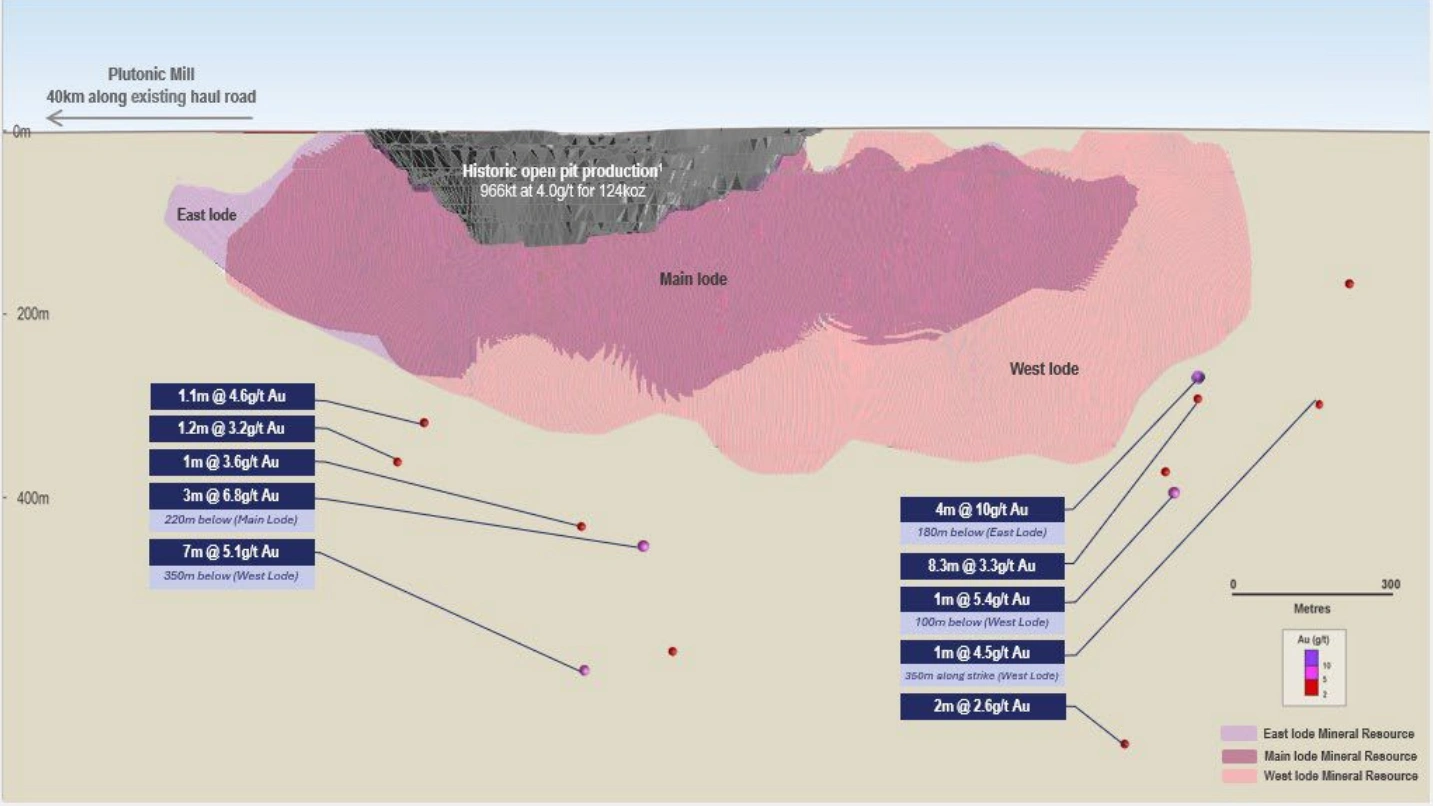
Long section showing Keillor’s resource and deeper intercepts pointing to further growth. [Source: Catalyst Metals].
An updated Ore Reserve is due within weeks, and Catalyst has already flagged that the initial three year mine life is expected to stretch out further.
The Next Three Mines on Catalyst’s Gold Belt
Keillor is the third of six mines Catalyst plans to bring into its Plutonic hub, following Plutonic Main and Plutonic East. Trident, Cinnamon and Old Highway are next in line, and all three are also higher grade sources feeding the same underused 2Mtpa processing plant.
Was Keillor a one-off? Probably not. The same fragmented ownership history that left Keillor undrilled for 25 years applied across most of the Plutonic Belt, so there’s a reasonable chance similar upgrades turn up at the other three mines as drilling catches up with old, patchy datasets.
Money-wise, Catalyst isn’t stretched thin chasing this growth. The company held A$331 million in cash and bullion against zero debt at last count, meaning the Keillor drilling was funded from the balance sheet rather than a dilutive capital raise, something plenty of WA gold juniors can’t say.
Catalyst was also clear about something its September 2025 ten‑year production guidance should be read as a general guide, not a fixed forecast because permitting timelines, reserve updates and processing capacity keep shifting the plan.
That kind of caveat is easy to miss in an announcement of big percentage gains, but it is a fair signal that the 200,000 ounce target is a direction of travel, not a promise carved in stone.
For a stock trading with a market capitalisation north of A$1.7 billion and a 52-week range stretching from roughly A$4.48 to A$9.80, Keillor shows what patient underground drilling on known ground can find, gains that rival any greenfield discovery. Investors watching Catalyst Metals now have three more mines, Cinnamon, Trident and Old Highway, to see whether the pattern repeats.
For deeper context on how gold juniors turn resource estimates into production, our guide to evaluating a gold mining project before production breaks down what investors should check before backing a build. Catalyst’s own path through the Plutonic Belt was covered when first stoping ore came out of Plutonic East, while Westgold’s own resource upgrade at Fletcher shows the same underdrilled-ground story playing out elsewhere in WA.
For a broader framework on reading ASX mining announcements like this one, Colitco’s step-by-step guide to analysing ASX mining stocks is a useful companion piece.
Also Read: Carbonxt Group Delivers First Positive Operating Cash Flow as Kentucky Facility Nears Commissioning
FAQs
Q: What is Keillor?
A: An operating underground and open pit gold mine on Catalyst Metals’ Plutonic Gold Belt in Western Australia, formerly known as K2.
Q: How much did the resource grow?
A: The Mineral Resource Estimate grew 280 percent from 81,000 ounces to 307,000 ounces of contained gold.
Q: When did mining start at Keillor?
A: First ore was mined in the June 2026 quarter and ramp‑up continued through the rest of the year.
Q: What’s next for Catalyst Metals?
A: An updated Ore Reserve for Keillor within weeks, plus contributions from Cinnamon, Trident and Old Highway toward a belt-wide 2 million ounce Reserve target.
Disclaimer: This article has been prepared by Colitco for informational purposes only and does not constitute financial product advice, investment advice, or a recommendation to buy or sell any securities. Figures and statements have been sourced from Catalyst Metals Limited’s ASX announcements and publicly available sources current at the time of writing. Share price and market capitalisation figures move daily and should be verified against the ASX before relying on them. Readers should conduct their own independent research and seek professional financial advice before making any investment decisions. Past performance is not a reliable indicator of future results, and exploration and resource figures are not a guarantee of future economic extraction.

Luke Carlino is a seasoned Copywriter, Content Strategist, and Social Media Manager specialising in Mining, Finance, and Business journalism. With more than a decade of industry experience, he brings rigorous editorial standards and commercial acuity to every project.