Vault Minerals’ ASX announcement landed on 3 September, just as the deal machinery grinds toward shareholder votes and court dates. For anyone tracking the Leonora gold rush, this wasn’t a routine box-ticking exercise. It was the final piece of the puzzle before the combined entity steps onto the stage as Australia’s third-largest gold producer.
What the 2026 numbers actually say
Group Mineral Resources sit at 12.1 million ounces as at 30 June 2026. Ore Reserves come in at 3.9 million ounces. That’s a near-10 per cent lift in reserves year-on-year, even after a full year of mining depletion.
Leonora did the heavy lifting. Ore reserves there climbed 7 per cent to 2.7 million ounces after depletion. Darlot underground drove most of that gain, up 48 per cent net of depletion.
King of the Hills (KoTH) underground saw its mineral resource jump 30 per cent net of depletion, with new mineralisation picked up in the granodiorite host and nearby sedimentary units.
Drilling backed the upgrade. Vault logged 64,839 metres across KoTH and Darlot in FY26. That’s not scout drilling. That’s resource definition work tied directly to the reserve and resource models.
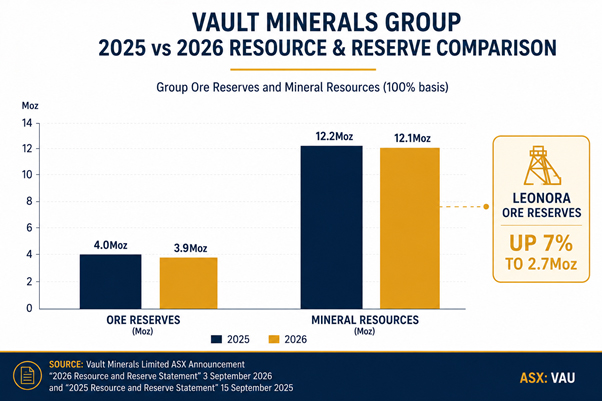
Vault’s 2026 reserves held up after a year of production, with Leonora driving growth. [Vault Minerals]
Why this matters for the Genesis deal
Genesis Minerals has been selling the merger on one promise: scale with substance. The pro forma combined group was always pitched at 33.6 million ounces in resources and 9.4 million ounces in reserves.reuters+2
Vault’s 2026 statement keeps that math intact. The 3.9 million ounces of reserves and 12.1 million ounces of resources slot neatly into the pro forma model Genesis has been running for investors and lenders. No nasty surprises. No write-downs. Just enough growth to offset the ounces mined out in FY26.
That’s the quiet win here. In a sector where reserve replacement is a constant battle, Vault managed to grow reserves at Leonora while still feeding the mill. For Genesis, that means the combined balance sheet and production profile stay on script.
Annual output of 600,000 to 700,000 ounces remains in play. So does the 15-year reserve life at current run rates.
King of the Hills reserves and the owner-mining pivot
KoTH sits at the centre of this story. The underground operation has been the growth engine, with high-grade intersections like 7.60 metres at 31.7 g/t gold guiding the model.
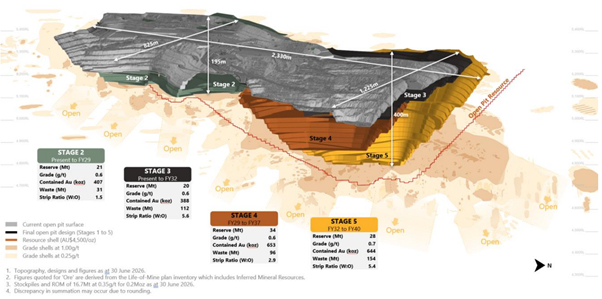
King of the Hills open pit Ore Reserve pit shell and open pit development stages [Vault Minerals]
There’s a operational wrinkle most summaries gloss over. Vault flagged in late 2025 that it would shift KoTH load-and-haul to an owner-mining model from 1 January 2027, once the current Macmahon contract expires.
That move is about margin, not just pride. Contractor rates have been climbing. Owner mining lets the combined group capture more of the upside when grades hold.
For Genesis, that’s a lever to pull post-merger. The KoTH plant expansion and underground development were already on the growth list. Add owner mining into the mix and the cost curve tilts the right way.
It also gives the merged entity more direct control over sequencing and grade management, which matters when you’re trying to hit 650,000 ounces a year across the Leonora hub.
What investors should watch next
Three things stand out from this statement and the merger path.
- Reserve replacement rate: Vault replaced what it mined and added a bit more at Leonora. The combined group needs to keep that pace to justify the 15-year reserve life story.
- Grade trajectory at KoTH underground: The 30 per cent resource lift net of depletion is a good sign, but conversion to reserves and sustained head grades will drive cash costs.
- Integration timing: ACCC clearance landed in late August. Court dates and scheme meetings are next. The 2026 numbers give lenders and off-takers the confidence to start pricing the combined entity now, not later.
For readers tracking ASX gold names, this fits a broader pattern. Northern Star and Evolution set the pace. Genesis–Vault is the next tier, built on geographic concentration and shared infrastructure. Vault’s 2026 statement says the orebody can back that ambition.
Also Read: How Zip Is Turning US BNPL Expansion Into a Profit Engine
FAQs
What are Vault Minerals’ 2026 reserves?
3.9 million ounces of gold ore reserves as at 30 June 2026.
Did King of the Hills reserves grow?
KoTH underground mineral resource rose 30 per cent net of depletion; reserves were replenished after FY26 mining.
How does this affect the Genesis merger?
Keeps the pro forma 9.4Moz reserve and 33.6Moz resource model intact for the combined group.
When does owner mining start at KoTH?
1 January 2027, after the current contractor deal ends.
Disclaimer: This article is for general informational purposes only and does not constitute financial, investment or trading advice. Colitco is not a licensed financial adviser. Readers should conduct their own research and consult a qualified financial professional before making investment decisions. Any figures, projections or ounce estimates referenced above are drawn from company announcements and public sources believed to be accurate at the time of writing but are not guaranteed. Past performance is not indicative of future results.

Luke Carlino is a seasoned Copywriter, Content Strategist, and Social Media Manager specialising in Mining, Finance, and Business journalism. With more than a decade of industry experience, he brings rigorous editorial standards and commercial acuity to every project.