St George Mining Limited (ASX: SGQ) is advancing Araxá from resource definition toward processing and feasibility work.
The Company’s latest price-sensitive operating update, dated 2 September 2026, concerns pilot-scale beneficiation test work at CIT-SENAI in Brazil.
The update matters for valuation because the work tests how Araxá’s rare earths and niobium can be separated into potential saleable products.
Araxá’s MRE is the starting point for the valuation case
The strongest argument for a higher SGQ valuation begins with the Mineral Resource Estimate, or MRE.
An MRE is a JORC-compliant estimate of mineralised material supported by geological evidence.
On 11 August 2026, the Company reported a 111.2 million tonne Araxá MRE.
The update increased Measured and Indicated resources by 155% to 75.2 million tonnes.
Measured material has the highest level of geological confidence, followed by Indicated material.
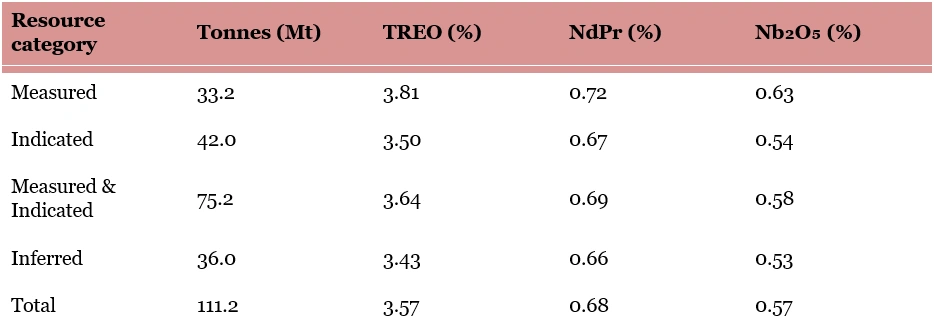
Table 1: Araxá JORC 2012 Mineral Resource Estimate, using a 2% TREO cut-off and effective 11 August 2026. [St George Mining]
The key valuation point is the shift toward higher-confidence tonnes. The Measured category is now 33.2 million tonnes, while the Indicated category is 42.0 million tonnes.
Together, those categories account for 75.2 million tonnes, or about two-thirds of the total MRE.
The M&I resource grades 3.64% TREO and 0.58% Nb₂O₅.
TREO means Total Rare Earth Oxides, a measure of rare earth content in the ore.
Why the 75.2Mt M&I resource changes the valuation discussion
Exploration companies are often valued on the market’s view of future mine potential rather than current earnings.
That makes resource size, grade and confidence important reference points. A larger M&I base can also provide a stronger foundation for mine scheduling and economic studies.
The Company is now working through metallurgy, permitting and feasibility work around that resource.
Araxá therefore has moved beyond a simple drilling story.
The resource also contains a second commodity that is not captured by a rare-earth-only valuation. The total MRE contains 630,000 tonnes of Nb₂O₅, or niobium pentoxide.
Niobium is mainly used to improve the strength and performance of steel. The same ore body can therefore support two potential product streams.
Comparing Araxá to Mountain Pass, Mt Weld, and Nolans
Executive Chairman John Prineas has previously highlighted that Araxá shares the exact same carbonatite-hosted geology as the world’s premier deposits.
Araxá now contains a larger volume of contained NdPr tonnes within its Measured & Indicated category than the two largest rare earth mines outside China.
NdPr refers to neodymium and praseodymium, the vital rare earths required to build high-strength permanent magnets.
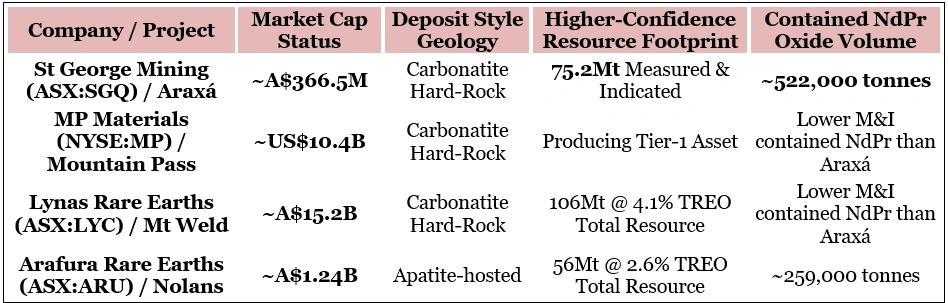
Table 2: Peer global asset resource metric comparison showcasing grade, scale, and market capitalization dynamics. [ASX Releases / Exchange Data]
The stark valuation gap highlights why SGQ can be considered undervalued. Geologically, Araxá has achieved the raw volume and grade status of multi-billion-dollar global producers.
The market continues to apply a steep discount to SGQ simply due to its early pre-revenue development phase.
Metallurgical recovery metrics for Araxá niobium and magnet rare earths
The 2 September announcement shifts attention from what is in the ground to what can be produced from it.
The Company has commenced a four-to-six-week pilot-scale beneficiation study at CIT-SENAI in Belo Horizonte.
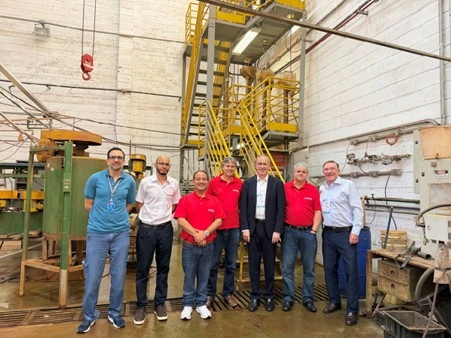
Figure 1: The St George team at the CIT-SENAI pilot plant in Belo Horizonte. Left to right: Elbert Muller Nigri (CIT-SENAI); St George staff Tiago Francisco Orozimbo, Alaercio Vieira, Ricardo Nardi, John Prineas, Adriano Rios and John Dawson. [Source: St George Mining]
The program is processing approximately 9 tonnes of near-surface saprolite from the Central Araxá area.
Saprolite is weathered rock near the surface that may form part of an early open-pit mining sequence.
- Approximately 9 tonnes of near-surface saprolite are being processed.
- Four to six weeks is the planned duration of the CIT-SENAI study.
- Locked-cycle flotation is being used to incorporate recycle streams and optimise the process.
- Grinding, magnetic separation and flotation form the main beneficiation stages.
- Niobium concentrate is one targeted product stream.
- Rare-earth-enriched tailings form the second stream for downstream evaluation.
The niobium concentrate will be tested for downstream conversion into ferroniobium containing approximately 65% niobium.
The rare-earth-enriched tailings will undergo hydrometallurgical testing.
Target products include mixed rare earth carbonate, or MREC, and rare earth oxalate.
Results from the CIT-SENAI beneficiation study are expected in the December 2026 quarter.
John Prineas, Executive Chairman, said: “Our aim is to replicate these strong results in the pilot plant study.”
The downstream economic viability of the Barreiro Carbonatite Intrusive Complex
Araxá’s location adds context to the processing work.
The project sits within the Barreiro Carbonatite in Minas Gerais, Brazil, beside established niobium operations.
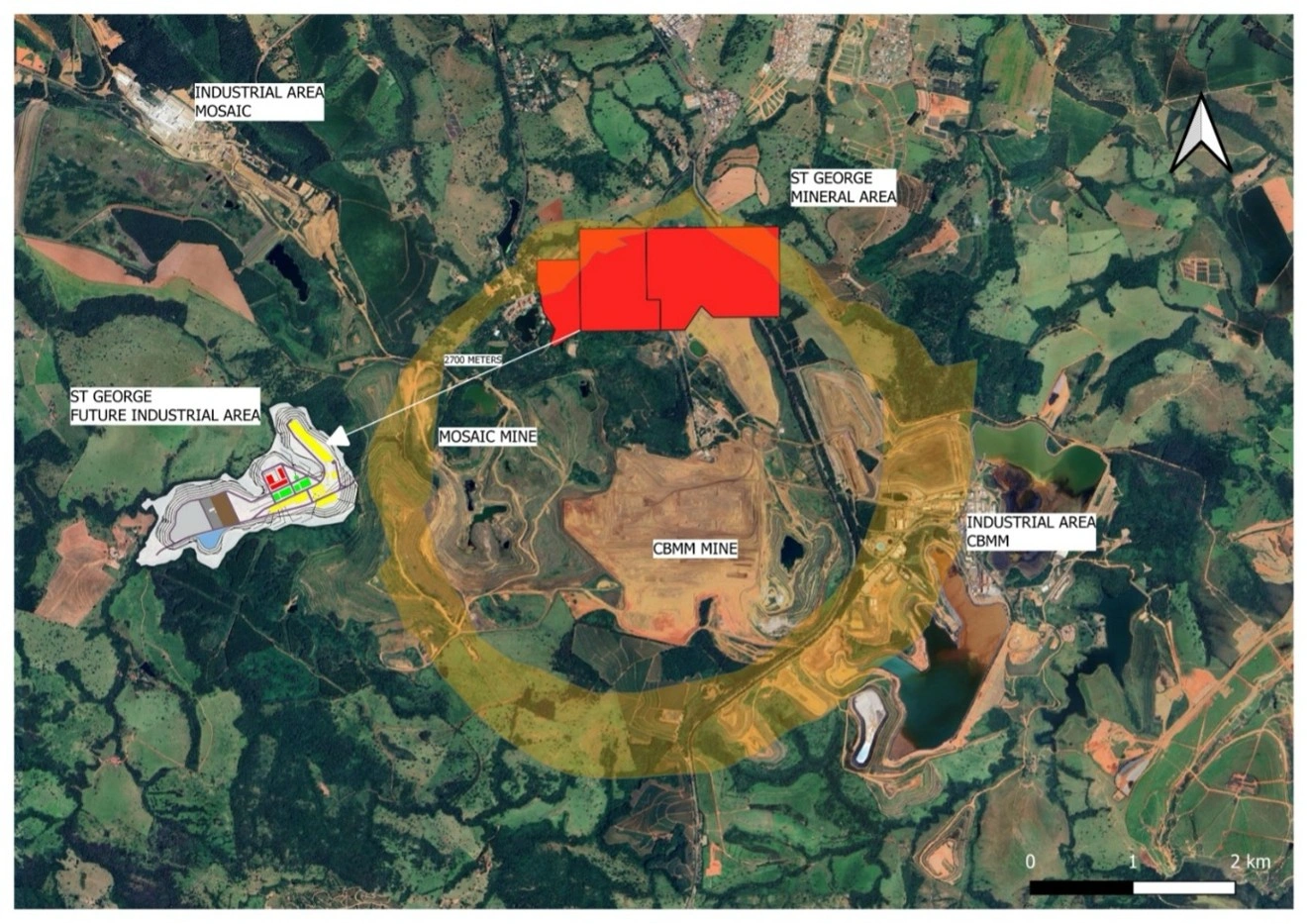
Figure 2: aerial Earth image of the Barreiro carbonatite complex showing the Araxa Project (red outline) as well as the adjacent CBMM niobium mine and the Mosaic phosphate mine. [Source: St George Mining]
The Company’s team includes technical personnel with direct experience in Brazilian niobium processing.
The CIT-SENAI work is designed to provide data for the flowsheet used in future development studies.
A flowsheet is the sequence of processing steps used to turn mined material into products.
The Company is also building its own large-scale pilot plant at CEFET-MG in Araxá.
- Up to 300kg per hour is the planned throughput capacity.
- December 2026 is the targeted completion date for the St George Technological Centre.
- January 2027 is the targeted first operation of the Company’s pilot plant.
- CEFET-MG is the Federal Center for Technological Education of Minas Gerais.
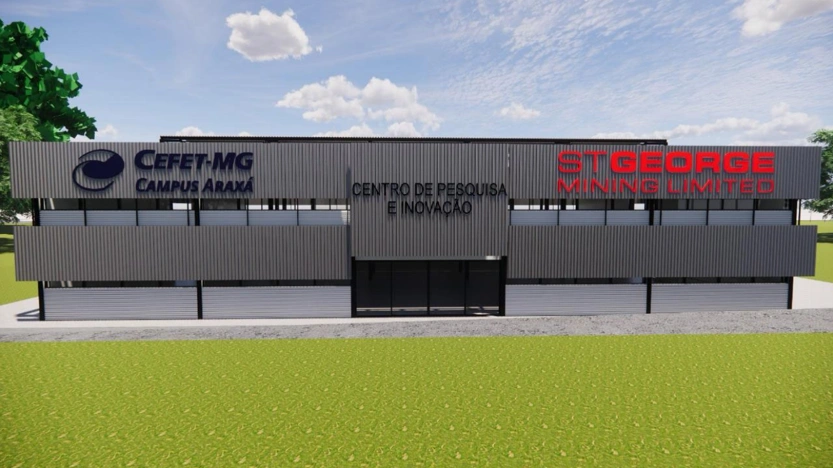
Figure 3: 3D model of the proposed St George Technological Centre at CEFET’s Araxá Campus. [Source: St George Mining]
The project’s processing pathway also has a historical reference point.
A 2012/13 pilot plant program on Araxá mineralisation produced rare earth oxalate at greater than 99% purity.
That program reported an overall TREO recovery of 86%.
The current work is intended to test a modernised flowsheet and improve confidence in repeatable processing outcomes.
Why is St George Mining undervalued relative to its peer group?
The case for an undervaluation is not that Araxá is already a mine. It is that the market value appears to recognise less than the full resource and development pathway.
At the time of drafting, ASX showed SGQ at A$0.073 and a market capitalisation of about A$357.10 million.
The June placement provides another observable reference point.
The Company raised A$60 million through a two-tranche institutional placement at A$0.10 per share.
Hancock Prospecting committed A$20 million. Following completion, Hancock was expected to hold an interest of approximately 10.5%.
Impact of Hancock Prospecting’s 10.5% stake on SGQ market valuation
Hancock’s participation does not establish a fair value for SGQ. It does, however, provide a market-tested funding reference at A$0.10 per share.
The current share price is below that placement price. The gap matters because the Company has since reported a larger M&I resource and progressed pilot-scale processing work.
The valuation question is therefore whether the market is fully crediting those developments.
The August MRE update provides the clearest numerical anchor. Araxá now has 111.2Mt of total resources and 75.2Mt in M&I categories.
The M&I inventory contains approximately 522,000 tonnes of NdPr oxides. The Company has also reported 630,000 tonnes of Nb₂O₅ across the total MRE.
NdPr refers to neodymium and praseodymium, the key light rare earths used in permanent magnets.
The valuation gap is about development stage, not resource visibility
The main reason SGQ can trade below the value implied by its resource metrics is development-stage uncertainty.
A resource is not an ore reserve, and it does not establish a profitable mine. The next valuation step requires metallurgical results, engineering work, permitting and economic studies.
Those milestones can convert geological inventory into a clearer development case.
This is where the current pilot program becomes important. Successful pilot-scale work would give engineers a stronger basis for the proposed processing flowsheet.
It would also provide products for downstream testing and potential customer discussions.
That sequence can narrow the gap between resource scale and project economics.
Strategic validation and the path toward a Brazilian supply chain
The Company has also been building a broader development platform around Araxá.
In August 2026, it announced a Protocol of Intent with Lima & Pergher Group’s START division and the State of Minas Gerais.
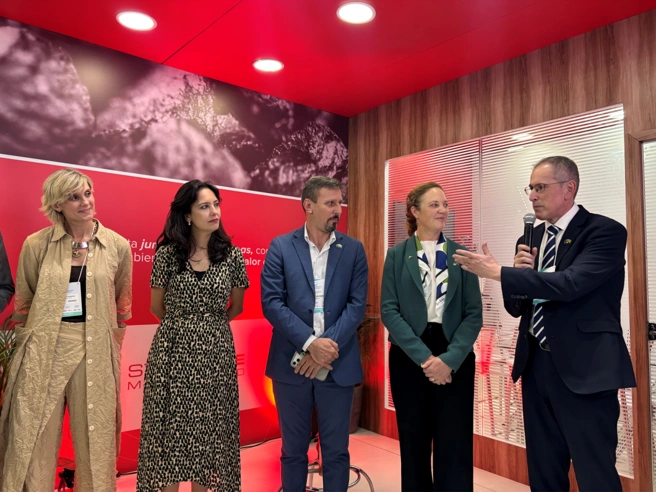
Figure 4: Signing Ceremony for the Minas Gerais Rare Earths Processing Centre at the St George Booth at EXPOSIBRAM. (left to right): Milena Andrade Pedrosa, Invest Minas President; Mila Batista Leite Corrêa da Costa, Secretary of State – SEDE; Thiago Amaral, Executive Director of St George Brazil; Sophie Davis, Australian Ambassador to Brazil; John Prineas. [St George Mining]
The parties are assessing a proposed Minas Gerais Rare Earths Processing Centre in Uberlândia.
The concept is aimed at refining rare earth concentrates, MREC and oxalate into magnet-making materials.
The initiative remains subject to further agreements, investment decisions and approvals.
For SGQ, the strategic significance is the possibility of retaining more value downstream.
The Company would potentially supply feedstock and technical expertise to the proposed centre. That is a longer-term option rather than a booked revenue stream.
SGQ share price and investor outlook
The stock trades as a growth-focused resource investment because Araxá is still moving through its development phase. The valuation thesis therefore depends on the conversion of resource data into economic and processing outcomes.
| Metric | Current reference |
| SGQ share price | A$0.073 |
| Market capitalisation | About A$357.10 million |
| Araxá total MRE | 111.2Mt @ 3.57% TREO; 0.57% Nb₂O₅ |
| Araxá M&I MRE | 75.2Mt @ 3.64% TREO; 0.58% Nb₂O₅ |
| June institutional placement | A$60 million at A$0.10/share |
| Hancock Prospecting commitment | A$20 million |
| Hancock post-placement interest | Approximately 10.5% |
Table 3: SGQ market and resource reference points for client review. Market data is time-sensitive. [ASX SGQ company page]
Upcoming catalysts
- December 2026 quarter: CIT-SENAI pilot plant beneficiation results.
- December 2026: Targeted completion of the St George Technological Centre at CEFET-MG.
- January 2027: Targeted first operation of the Company’s own pilot plant.
- December 2026 quarter: Maiden MRE for East Araxá is targeted.
- 2026: Ongoing feasibility work and development studies with technical adviser Worley.
The central argument is therefore simple. SGQ’s market value is currently priced like an early-stage exploration venture.
Its resource base, however, has advanced to a global tier-1 scale far faster than its market capitalisation reflects.
As the upcoming processing and economic studies validate the current geological model, a major valuation re-rating could follow.
Disclaimer
This report has been prepared by Colitco in collaboration with St George Mining Limited as part of a commercial content and investor communications arrangement. Colitco may receive compensation for the production and distribution of this content. This article is intended for informational purposes only and does not constitute financial product advice, investment advice, or a recommendation to buy or sell any securities. The content reflects information available at the time of publication and may not be updated. All figures, data and statements have been sourced from St George Mining Limited’s official ASX announcements and publicly available sources. Readers should conduct their own independent research and seek professional financial advice before making any investment decisions. Past performance is not a reliable indicator of future results. Exploration results are not a guarantee of future resource definition or commercial production.

Luke Carlino is a seasoned Copywriter, Content Strategist, and Social Media Manager specialising in Mining, Finance, and Business journalism. With more than a decade of industry experience, he brings rigorous editorial standards and commercial acuity to every project.