
Toronto-based royalty giant Franco-Nevada has gone back to the well. Barely seven months after handing Minerals 260 (ASX: MI6) A$220 million to get its Bullabulling gold project moving, it has come back with another A$200 million.
That takes Franco-Nevada’s total commitment to a single Western Australian gold project to A$420 million. Most junior gold developers don’t raise that much in a lifetime, let alone twice in under a year.
The announcement came out of Toronto on 13 September, and the deal is fairly straightforward once you strip away the jargon. Franco-Nevada’s Australian arm is paying A$170 million for an extra 1.45 per cent share of the gold sold from Bullabulling. That takes its gross royalty from 2.45 per cent to 3.90 per cent.
The remaining A$30 million gives Franco-Nevada a cornerstone position in the next equity raise Minerals 260 conducts.
The Franco-Nevada Minerals 260 Funding Round, Explained
In simple terms, a gross royalty means Franco-Nevada gets its share from the top of every ounce of gold Bullabulling produces. That’s before a cent goes toward wages, diesel, or tax. It’s a clean way for a royalty company to get gold exposure without ever running a mine.
For Minerals 260, the trade is straightforward. Hand over a slice of future revenue now, and pocket the cash today. That beats loading up on debt or flooding the market with new shares just to keep construction moving.
Quick numbers from the deal:
- A$170 million upfront for the extra 1.45 per cent royalty, paid on completion
- A$30 million cornerstone commitment into a future equity raise
- Gross royalty increases from 2.45 per cent to 3.90 per cent.
- The step-down threshold rises from 4 million ounces to 6 million ounces produced.
- The royalty area expands from a 2.5km buffer to 10km, covering roughly 650 square kilometres.
One detail buried in the fine print matters more than it looks. Franco-Nevada also picked up right of first refusal on any future royalties or streams Minerals 260 might sell over the same ground. In plain terms, MI6 can’t shop future financing deals around to Franco-Nevada’s rivals without giving Franco-Nevada first dibs.
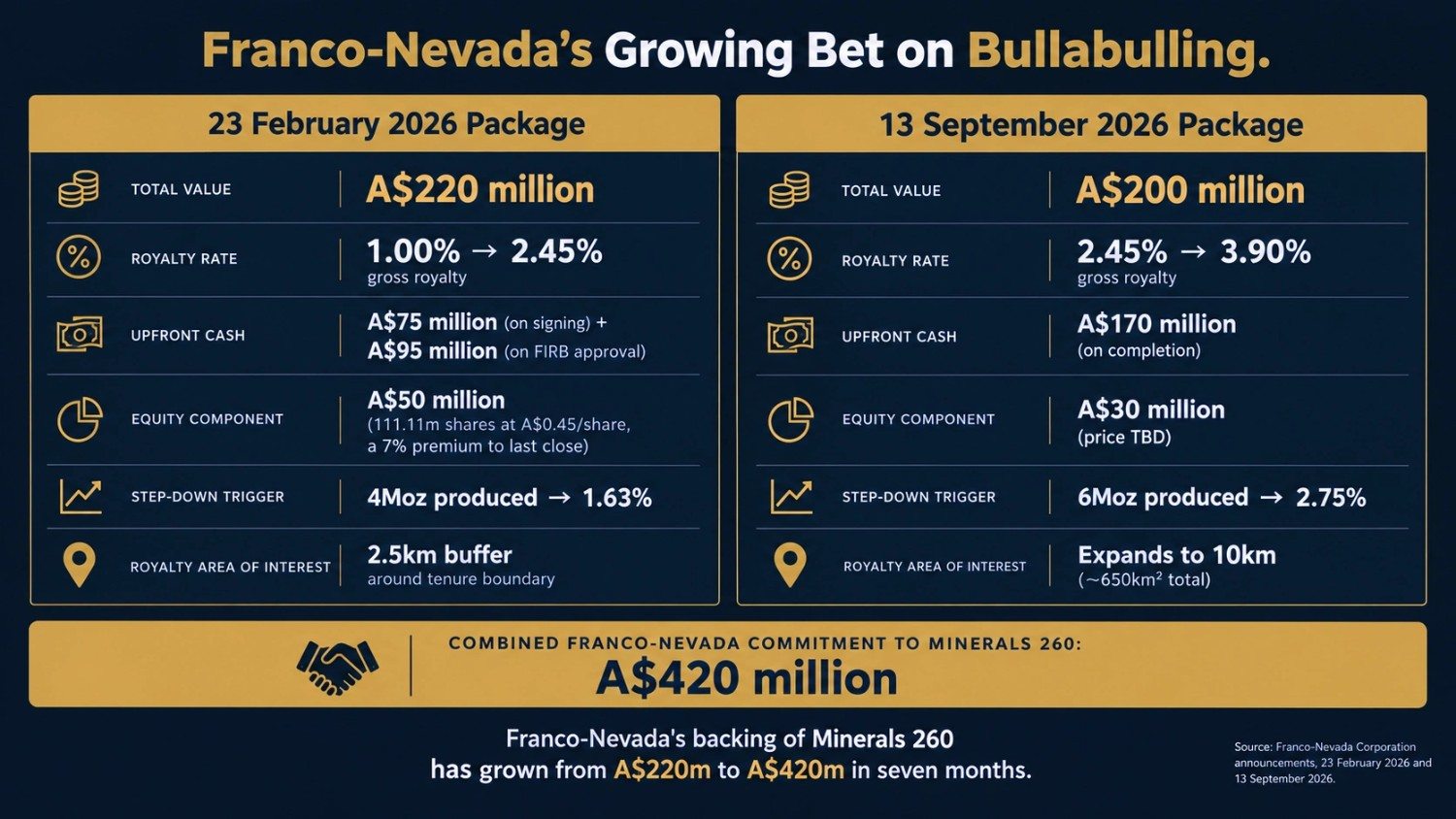 Franco-Nevada’s backing of Minerals 260 has grown from A$220m to A$420m in seven months. [Minerals 260 Limited]
Why the Royalty Now Climbs to 3.90 Per Cent
Franco-Nevada doesn’t write nine-figure cheques for nothing. Chief executive Paul Brink put it plainly in the announcement: “Minerals 260 is ahead of schedule on project development and financing.”
That’s a strong call from a royalty company that spent months digging through drill results, water studies and mine plans before writing the first cheque back in February. Since that first investment, Minerals 260 has nearly tripled its resource at Bullabulling. It also pushed out a pre-feasibility study months ahead of schedule.
Pace like that tends to earn a company more capital, not less.
Bullabulling’s growing resource base explains the confidence
Bullabulling is about 65 kilometres from Kalgoorlie in Western Australia’s Eastern Goldfields. It’s not new ground. Drillers first tested it back in 2011.
Minerals 260 picked up the project in 2025 and has drilled it harder than anyone has in over a decade. The resource now stands at 4.4 million ounces indicated and 1.7 million ounces inferred, spread across deposits named Phoenix, Bacchus, Dicksons and Kraken.
The project’s main deposits stretch across 8.5 kilometres of strike, with a separate zone called Gibraltar sitting about a kilometre away on a nearby trend. A pre-feasibility study completed in July points to a mine producing roughly 150,000 ounces of gold a year during its first decade, with a total mine life of 19 years.
Franco-Nevada’s technical team believes there is potential to increase throughput in later stages to around 7 to 8 million tonnes a year. That could push annual production closer to 200,000 ounces.
That’s not a small operation. Nineteen years is a long runway for any Western Australian gold mine.
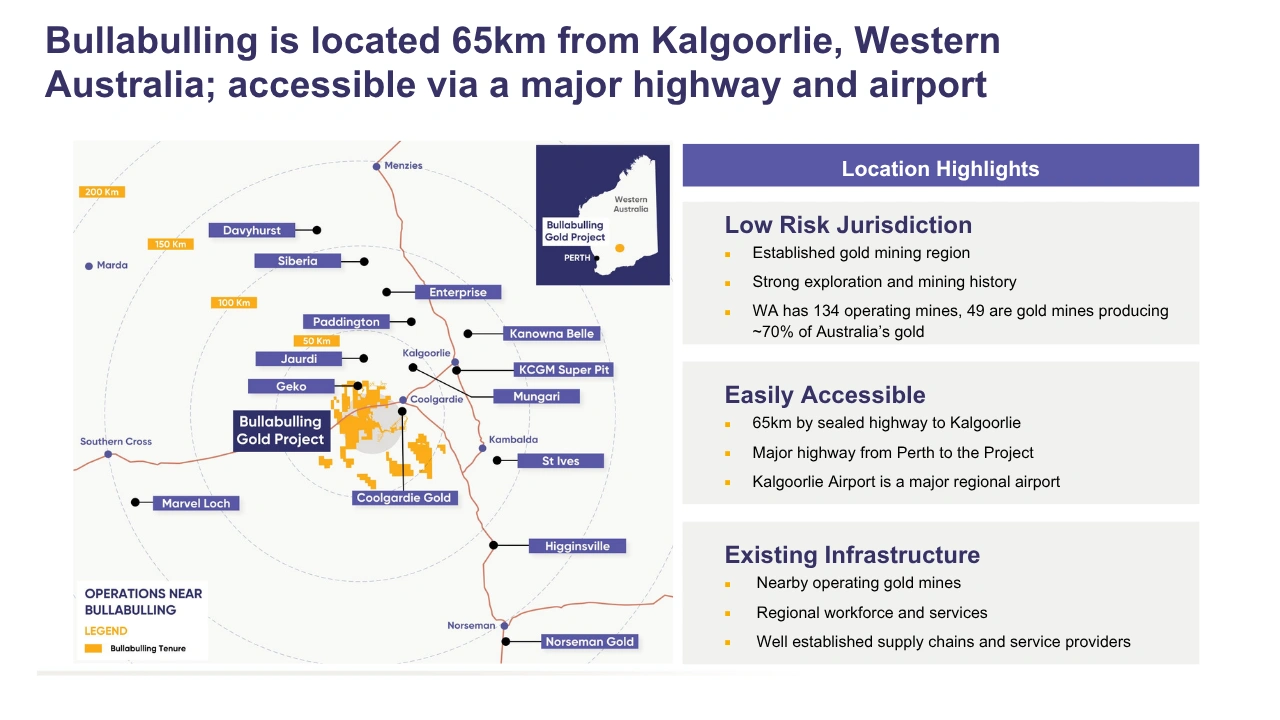 Bullabulling sits around 65km from Kalgoorlie, in the heart of WA’s Eastern Goldfields. [Minerals 260 Limited]
MI6 Shareholders Face Both Upside and a Dilution Question
Here’s where it gets interesting for anyone holding MI6 shares. The royalty piece doesn’t touch the share count at all. Franco-Nevada isn’t buying equity with that A$170 million. It’s buying a permanent slice of future gold sales.
The A$30 million equity piece works differently. That money comes with new shares attached, priced whenever the raise itself actually happens. Existing holders will feel some dilution once that pricing lands, even with Franco-Nevada anchoring the raise as a vote of confidence rather than a rescue placement.
Worth flagging too: the royalty step-down now needs 6 million ounces of production before the rate drops back down, up from the old 4 million ounce mark. That’s a longer stretch of the higher 3.90 per cent rate cutting into revenue, and it matters for anyone modelling Bullabulling’s long-term cash flow.
None of that erases the good news. A project Bullabulling’s size locking in most of its equity funding before a final investment decision is rare. It removes one of the biggest risks junior gold developers carry: running out of cash halfway through building a mine.
Chairman Tim Goyder, who also chairs Liontown Resources and holds a large personal stake in MI6, has staked plenty of his own credibility on Bullabulling working. So has Franco-Nevada, twice now in under a year. Repeat backing from a royalty major tends to say more than any single press release can.
For investors weighing up gold’s broader run through 2025 and 2026, Bullabulling now sits among the better-funded Western Australian gold stories heading into 2027. Anyone tracking other ASX gold stocks worth watching or scanning this week’s ASX mining stock movers will want MI6 on the list, especially once the definitive feasibility study lands.
It’s also worth revisiting the earlier Franco-Nevada royalty deal that cleared FIRB approval back in March. This latest package builds directly on those same terms.
First gold from Bullabulling is currently targeted for the second half of 2028, assuming the final investment decision is made as planned in early 2027. That is still some way off. That’s still a fair way off. But with Franco-Nevada now holding a bigger royalty, a bigger say, and a bigger reason to want this project built, the odds of it getting there just improved.
Also Read: BHP Group Analysis: Copper’s Record Year, One Rough Friday
FAQs
Q: What is the Bullabulling Gold Project?
A: Bullabulling is a large, near-production gold project in Western Australia. It is owned by Minerals 260 (ASX: MI6).
Q: How much has Franco-Nevada invested in MI6 in total?
A: A$420 million combined, across funding packages struck in February and September 2026.
Q: When could Bullabulling start producing gold?
A: As early as the second half of 2028, subject to a final investment decision expected in early 2027.
Q: What does a gross royalty mean for shareholders?
A: It’s a fixed cut of revenue paid to Franco-Nevada before costs are deducted, not a loan and not an equity stake.
Disclaimer:
This article is for general information only and does not constitute financial product advice. It does not take into account your objectives, financial situation or needs. Colitco accepts no responsibility for any loss arising from reliance on this information. Speak with a licensed financial adviser before making any investment decision. A conflict of interest may exist where commercial arrangements are in place between Colitco and companies mentioned.

Luke Carlino is a seasoned Copywriter, Content Strategist, and Social Media Manager specialising in Mining, Finance, and Business journalism. With more than a decade of industry experience, he brings rigorous editorial standards and commercial acuity to every project.