Yugo Metals Limited (ASX: YUG; FRA, DUS: L71) (“Yugo Metals” or “the Company”) has achieved a significant corporate milestone with confirmation of its dual listing on the Frankfurt and Dusseldorf Stock Exchange, while simultaneously delivering encouraging results from its maiden diamond drilling campaign at the Sinjakovo Project in Bosnia-Herzegovina. The Company intersected 1.8 metres of silver-lead-zinc mineralisation from 27.7 metres depth in drillhole KVDD001, marking a promising start to systematic exploration of the historically significant polymetallic district.
The dual developments position Yugo to access European capital markets at a time of heightened investor interest in base and precious metals projects that can potentially supply European demand.
Frankfurt and Dusseldorf Stock Exchange Listing Expands European Investor Access
Yugo has completed the dual listing of the Company’s ordinary shares on the Frankfurt and Dusseldorf Stock Exchange under ticker FRA, DUS: L71, while maintaining its primary listing on the ASX. The Frankfurt Stock Exchange is one of Europe’s largest stock exchanges and provides Yugo with direct access to European institutional and retail investors.
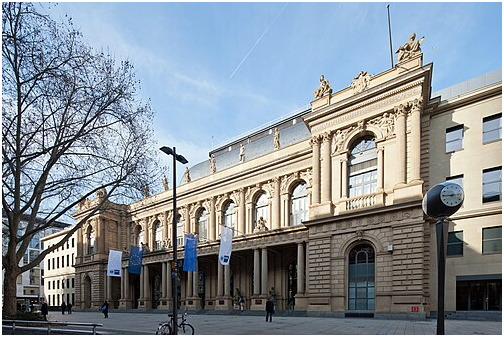
Figure 1: Frankfurt Stock Exchange
The timing of the listing aligns with strong European investor interest in base and precious metal projects, particularly those located within the European Union’s strategic supply corridors. Yugo’s projects in Bosnia-Herzegovina sit within the Western Tethyan metallogenic belt, a historically prolific mining region experiencing renewed exploration activity.
To support the expanded investor base, the Company has appointed Stefan Lindham, principal at Aktiencheck.de AG, as Yugo’s European investor relations advisor. Mr Lindham will assist in broadening the Company’s investor base across European capital markets.
Petar Tomašević, Yugo’s Executive Director and Interim CEO, commented on the strategic importance of the Frankfurt listing:
“The Frankfurt listing allows another pathway for investment and increases Yugo’s exposure to European investors who have strongly supported our recent capital raisings. The current European investment demand highlights their significant interest for growth opportunities in the base and precious metal sector that Yugo offers and we look forward to welcoming new European Company shareholders.”
Scout Drilling Delivers Immediate Results at Sinjakovo
The initial three drillholes have been completed for approximately 230 metres total, with drilling progressing steadily and without technical issues at the Kovacevac Prospect. Drillhole KVDD001, the most eastern of the three holes, delivered the standout intercept.
The mineralisation comprises dominant sphalerite and silver-rich galena with minor chalcopyrite and antimony-tetrahedrite. Significantly, 0.2 metres of semi-massive mineralisation containing 30 to 40 percent sulphides was intersected adjacent to a narrow core loss interval, suggesting potentially higher grades within the zone.
The central hole, KVDD002, intersected weaker mineralisation over 0.9 metres from 22.6 metres depth. The westernmost hole, KVDD003, encountered what appears to be an unrecognised medieval mining tunnel at target depth, highlighting the area’s extensive historical mining activity.
Host rocks to the mineralisation are carbonate sequences including marble, ankerite-limestone and limestone. The mineralisation displays a gentle south-westerly dip and is spatially associated with proximal barite-siderite-manganese alteration.
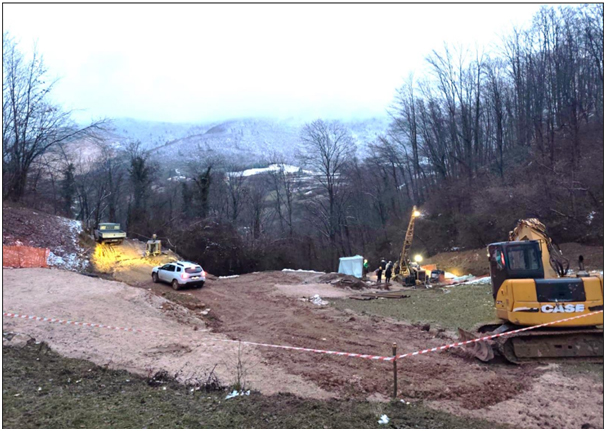
Figure 2: Kovacevac Prospect drilling operations at Yugo Metals’ Sinjakovo Project
Systematic Exploration Approach Continues
The Company has designed two additional drillholes from the same pad to further test the target near the successful KVDD001 intersection. These holes will commence immediately, with drilling expected to continue through multiple prepared pads across the Kovacevac Prospect.
Once the current pad is completed, the rig will move to the second of three prepared drilling pads to test the north-west extension of the Kovacevac mineralisation.
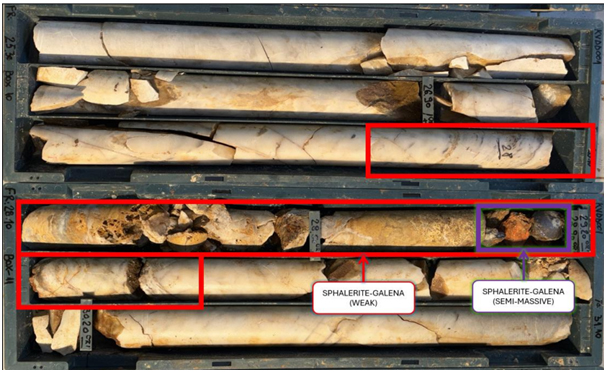
Figure 3: Drill core from KVDD001 showing sphalerite-galena mineralisation with weak to semi-massive sulphides
Petar Tomašević, Yugo’s Executive Director and Interim CEO, expressed confidence in the initial results:
“Even though it early-days, the initial scout drilling has intersected a promising zone of mineralisation, reinforcing our confidence in the potential for a significant polymetallic discovery at Sinjakovo Project. Building on initial encouraging intercepts, we are advancing with drilling along the most favourable trend, with the aim of unlocking further value and moving closer to a successful outcome.”
Samples from the completed holes are expected to be submitted to ALS Serbia by the end of December 2025, with first assay results anticipated in early February 2026.
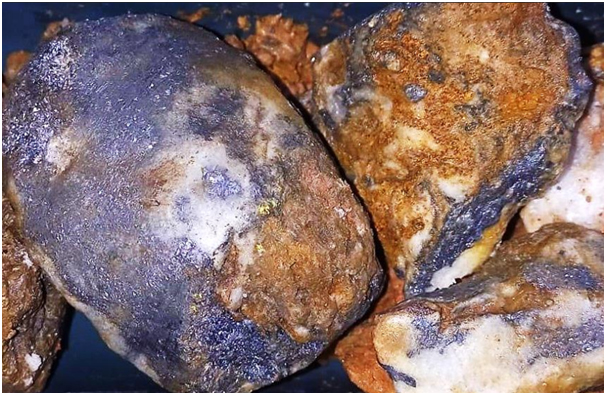
Figure 4: Drillhole KVDD001, drill core pieces (~10x5cm) showing blue-grey galena and sphalerite, with minor yellow chalcopyrite specs (interval 28.7-28.9m depth)
Strategic Location in Europe’s Emerging Polymetallic District
The Sinjakovo Project sits within Bosnia-Herzegovina’s Western Tethyan metallogenic belt, a historically prolific but under-explored region experiencing renewed interest from international mining companies. The jurisdiction gained significant attention in 2025 when Dundee Precious Metals acquired Adriatic Metals for approximately C$1.3 billion, highlighting the strategic value of polymetallic deposits in the region.
Adriatic’s Vareš Mine, located within the same metallogenic corridor, commenced commercial production in 2025 and is ramping toward nameplate capacity of 800,000 tonnes per annum. The operation extracts a similar polymetallic suite of silver, lead, zinc, antimony and gold from structurally controlled deposits.
Bosnia-Herzegovina offers several jurisdictional advantages for mining development, including established infrastructure, skilled local workforce, and proximity to European end-users of base and precious metals. The country holds EU candidate status and is progressively harmonising its legislative framework with European standards.
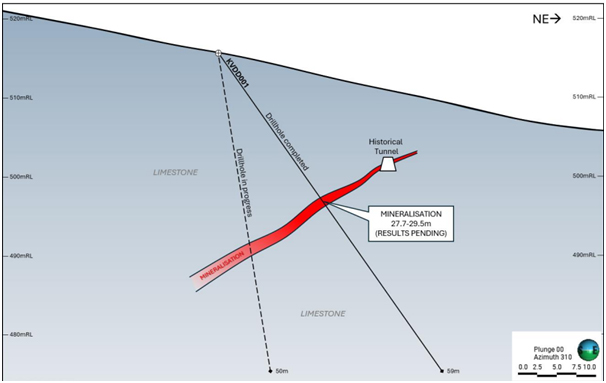
Figure 5: Cross-section showing KVDD001 intersection of silver-lead-zinc mineralisation at the Kovacevac Prospect
Robust Market Fundamentals for Silver-Lead-Zinc
Global demand for silver, lead and zinc remains strong, supported by traditional industrial applications and emerging clean energy sectors. The lead and zinc market was valued at USD 27.35 billion in 2024 and is projected to reach USD 39.53 billion by 2031, reflecting a compound annual growth rate of 5.20 percent.
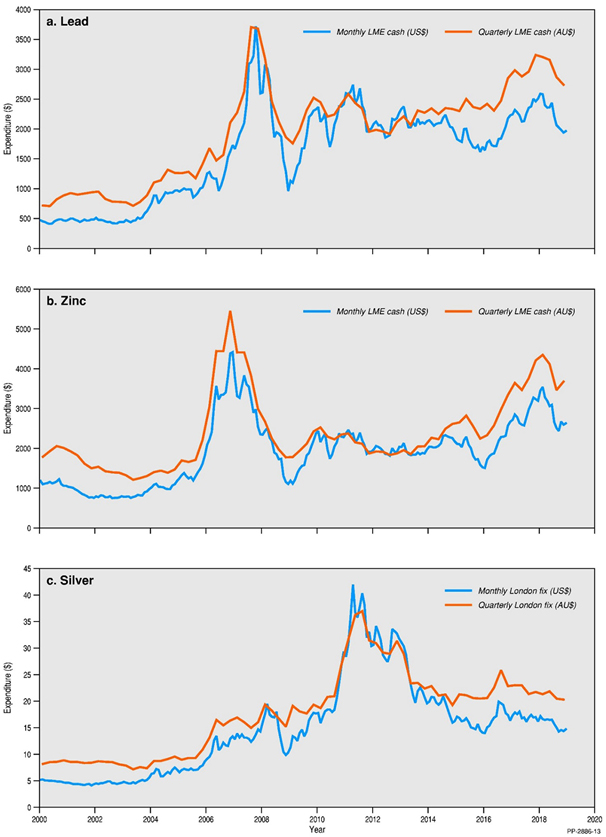
Silver demand continues to benefit from its dual role as both an industrial metal and investment asset. The electronics sector, solar panel manufacturing and electric vehicle production are driving incremental demand, while silver’s safe-haven status supports investment flows during periods of economic uncertainty.
Lead-acid batteries remain the dominant end-use for lead, with growing applications in electric vehicle auxiliary systems complementing traditional automotive and industrial battery markets. Industry analysts project lead demand to increase 2.2 percent in 2025 as falling interest rates improve battery demand.
Zinc consumption is similarly supported by galvanising applications in construction and infrastructure development, with additional growth expected from the battery metals sector as zinc-ion battery technology advances.
European Market Positioning and Strategic Timing
The dual listing on the Frankfurt Stock Exchange positions Yugo to access European capital at a critical juncture for the continent’s critical minerals strategy. The European Union has designated several base and precious metals as critical raw materials, with policy initiatives designed to reduce dependence on imports and build domestic supply chains.
Yugo’s projects in Bosnia-Herzegovina benefit from proximity to European manufacturing centres, existing transport infrastructure, and the jurisdiction’s EU candidate status. The combination of established geological potential, favourable location, and dual-market listing provides the Company with multiple pathways to funding and development partnerships.
The Frankfurt listing also positions Yugo alongside other European-focused mining companies that have successfully accessed German capital markets, providing the Company with increased visibility among institutional investors focused on strategic minerals supply.
What’s Next for Yugo Metals
The Company’s immediate focus remains on completing the current drilling programme at Kovacevac Prospect and awaiting assay results from the initial holes. Depending on results, the drilling rig will systematically test prepared pads across the broader prospect area.
The Sinjakovo Project comprises two tenements, Sinjakovo (50 square kilometres) and Jezero (31 square kilometres), providing substantial exploration upside beyond the current drilling area. Historical data from the district includes encouraging intercepts from previous exploration, though modern systematic drilling and sampling techniques are now being applied to define the full extent and grade of mineralisation.
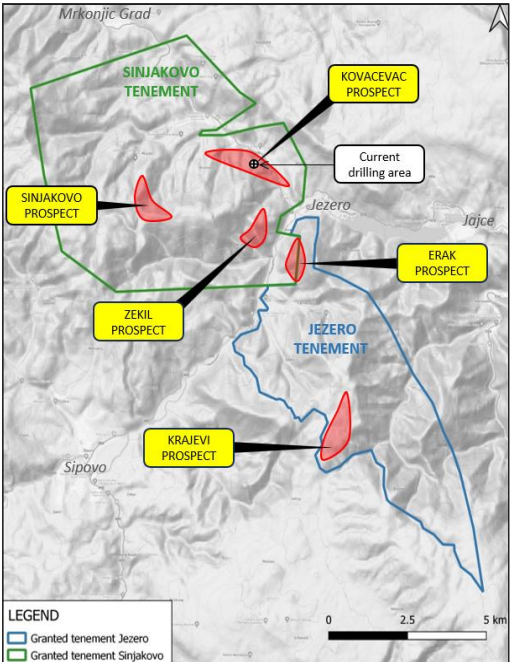
Figure 7: Sinjakovo Project, map showing current drilling area
With the successful maiden drilling campaign now underway and clear evidence of polymetallic mineralisation intersected, Yugo Metals is building a compelling exploration story in an increasingly recognised European mining jurisdiction.
Investor’s Outlook
Yugo Metals Limited (ASX: YUG) continues to generate interest as an emerging polymetallic explorer in Europe’s strategic minerals sector. The Company’s systematic approach to exploration at Sinjakovo, combined with the jurisdiction’s improving profile following recent major transactions, positions it well for potential value creation as drilling results are received.
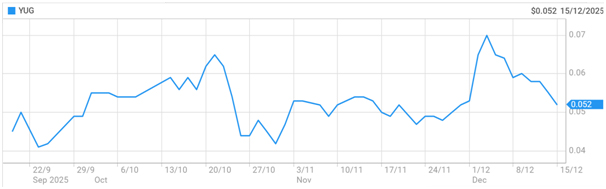
Figure 8: Yugo Metals Price Chart
Share price activity (as of 15th December, 2025):
- Last Price: AUD 0.05 per share (approximate, based on recent data)
- 52-Week Range: AUD 0.008 – AUD 0.070 per share
- Market Capitalisation: Approximately AUD17.61 million
The Company’s next catalysts include assay results from the maiden drilling programme expected in February 2026, continuation of the systematic drilling campaign across multiple pads, and potential expansion of the exploration footprint across the broader tenement package.