After sliding more than 2% on Tuesday, 17 Feb 2026, gold staged a firm recovery the very next day. Spot gold climbed as much as 2.4%, pulling back strongly from its one-week low of US$4,841.74. US gold futures for April delivery also settled notably higher. So, why gold rebounded is the question on every trader’s mind right now.
Figure 1: Gold bars stacked beside a laptop, symbolising investor demand and digital trading activity. [Source: Freepik]
The recovery was driven by a combination of simmering geopolitical tensions and uncertainty around the US Federal Reserve’s rate path. Investors sought refuge in gold as peace talks between Ukraine and Russia in Geneva ended without a breakthrough. US-Iran nuclear discussions also made only limited progress. These unresolved flashpoints kept safe-haven demand firmly alive.
Gold Price Today: Fed Division Keeps Traders on Edge
- Fed officials were nearly unanimous in keeping rates steady in January
- Several officials warned rates could rise again if inflation stays elevated
- Others debated whether and when further cuts might be needed
- Markets currently expect the Fed to cut rates in June, based on the CME FedWatch Tool
- Chicago Fed President Austan Goolsbee said a few more cuts are possible if inflation continues falling toward 2%
- Fed Governor Michael Barr noted rate cuts could come in future as inflation risks remain
- January consumer price inflation came in weaker than expected
- January job growth beat expectations, and the unemployment rate fell
- Investors are watching Friday’s US Personal Consumption Expenditures report, the Fed’s preferred inflation gauge
Why Gold Rebounded: Analysts Point to Technical Support and Geopolitics
Marex analyst Edward Meir noted there is nervousness around existing geopolitical tensions with both Iran and the US, though he cautioned that gold has been in a very tight trading range for much of February with no clear direction. Independent metals trader Tai Wong said gold is likely to retake US$5,000 despite slightly hawkish Fed minutes, noting that the vast majority of the market does not expect an interest rate move until June.
Figure 2: Gold coins spilling from a cloth bag, reflecting safe-haven demand during market uncertainty. [Source: Freepik]
Ajay Kedia, director at Kedia Commodities in Mumbai, described the move as a technical rebound after prices fell in the prior session due to easing geopolitical tensions. He noted that gold found support above US$4,850. Matt Simpson, senior analyst at StoneX, expects the rally to remain limited, with buyers likely to support dips and gold prices ranging between US$4,700 and US$5,100 in the short term.
Gold Market Update: Price Performance Across Timeframes
The gold market update across various timeframes shows the scale of the precious metal’s rally in recent times:
- Today: +US$20.19, up 0.40%
- 30 Days: +US$153.37, up 3.17%
- 6 Months: +US$1,642.16, up 49.08%
- 1 Year: +US$2,047.43, up 69.63%
- 5 Years: +US$3,176.79, up 175.41%
- 20 Years: +US$4,433.00, up 798.95%
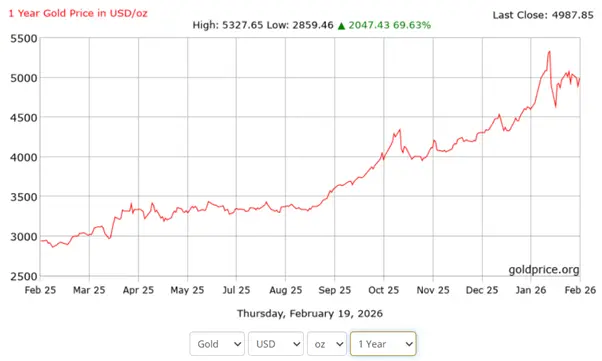
Figure 3: One-year gold price performance in US dollars per ounce, highlighting the metal’s strong rally. [Source: GoldPrice.org]
Gold’s six-month gain of nearly 50% underscores the strength of the structural bull market in the metal. The one-year gain of nearly 70% reflects a sustained re-rating driven by central bank buying, geopolitical risk and shifting rate expectations globally.
Silver Leads Gains as Entire Precious Metals Complex Bounces
The gold market update on 18 Feb 2026 was not limited to gold alone. The broader precious metals complex saw sharp recoveries after heavy losses on Tuesday.

Figure 4: Silver bars illustration representing the broader rebound across precious metals markets. [Source: Freepik]
- Spot silver rose between 3.2% and 5.2%, reaching between US$75.79 and US$77.24 per ounce
- Spot platinum gained between 2.2% and 3.5%, reaching between US$2,051.55 and US$2,078.28 per ounce
- Palladium rose between 1.2% and 2.3%, reaching between US$1,702.75 and US$1,722.01 per ounce
Silver’s strong rebound followed a decline of more than 5% on Tuesday, making it one of the sharpest single-day recoveries in the complex. The moves suggest broad risk appetite returning to the metals sector following Tuesday’s sharp selloff.
Why Gold Rebounded Matters: What Comes Next for the Gold Price
The gold price today remains below the psychologically important US$5,000 level, but the recovery suggests buyers remain active on dips. The key near-term catalyst is Friday’s US Personal Consumption Expenditures report for December. A softer-than-expected reading could reinforce June rate cut expectations, which would be supportive for gold. A stronger-than-expected reading could revive hawkish Fed concerns and pressure prices again.
Geopolitical developments also remain in focus. The lack of progress in both the Ukraine-Russia and US-Iran talks keeps the safe-haven case for gold intact. With gold market update signals pointing to continued range-bound trading between US$4,700 and US$5,100 in the short term, traders are watching both central bank commentary and global risk events closely for the next directional break.
Frequently Asked Questions
Q1. Why did gold rebound on 18 Feb 2026?
Ans. Gold rebounded due to simmering geopolitical tensions involving Ukraine, Russia and Iran, combined with uncertainty over the US Federal Reserve’s rate path following the divided January meeting minutes.
Q2. What is the gold price today?
Ans. Spot gold climbed as much as 2.4% to US$4,992.11 per ounce on 18 Feb 2026. US gold futures for April delivery settled at US$5,009.50. The current spot price stands at approximately US$5,009.25.
Q3. What do analysts say about why gold rebounded?
Ans. Analysts pointed to technical support above US$4,850, geopolitical risk and expectations that the Fed will not move on rates until June. Most see gold remaining in a US$4,700 to US$5,100 range in the short term.
Q4. What is the gold market update for the past year?
Ans. Gold is up approximately 69.63% over the past year, adding US$2,047.43 per ounce, reflecting sustained demand driven by central bank buying, geopolitical risk and shifting rate expectations.