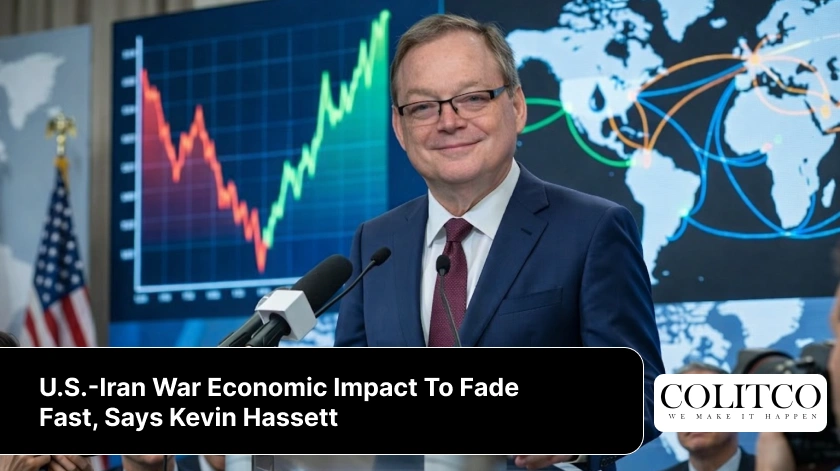
According to Kevin Hassett, the economic effect of the U.S.-Iran war is a temporary distraction. He said the effects will very, very soon fade away. His remarks were in the wake of increasing inflation levels and economic fluctuation in the market.
Hassett pointed out that long-term economic fundamentals are good. He had rejected any concerns of permanent inflationary pressure from the war. There was a cautious reaction on the part of investors after the statement.
Nevertheless, his perspective provided a put-your-mind-at-rest to markets. He proposed that disruptions in the short run are already being factored in.
This gets replaced by the speed of restoration to stability. Participants in the market are still keeping close attention to geopolitical developments to gain more insight.
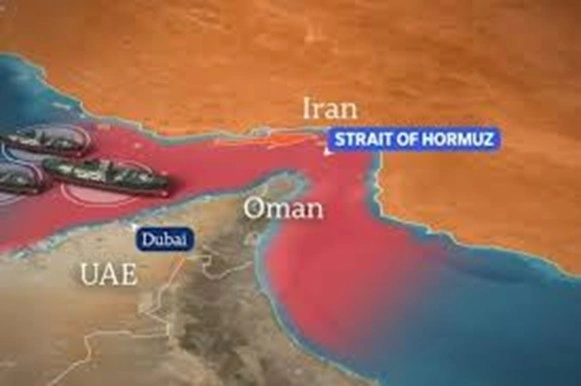
Kevin Hassett discusses the U.S.-Iran economic outlook. [Courtesy: The Hill]
Why Did Inflation And Sentiment Data Shock Markets?
Recent economic statistics had short-term impacts of the U.S.-Iran conflict. In March, the Consumer Price Index increased by 0.9 percent. This was the biggest rise in eight months since June 2022.
The major part of this growth was encouraged by the rising energy prices. In the meantime, the Index of Consumer Sentiment has fallen to 47.6 in April. This is a new low reading.
The fall illustrates the increasing consumer fears of inflation and uncertainty. The closure of the Strait of Hormuz had a strong impact on both indicators.
Disruption in supply drove the price of fuel upwards in the world market. These progressions instigated acute responses in financial markets.
Global Markets React To Strait Of Hormuz Disruptions
Closure of the Strait of Hormuz had a major effect on international trade. This is the route that is important in transporting oil all over the world. Limited traffic brought in supply issues in energy markets.
Oil prices increased because traders would price in the possibility of shortages. Gas prices were also high due to the low supply. Sea traffic was slowed down and made more expensive. The financial markets reacted by becoming more volatile.
Energy stocks performed well, and the more general indices performed mixedly. Investors changed to safe-haven assets in the short term. But hopes of a brief war inhibited extremes of market response.
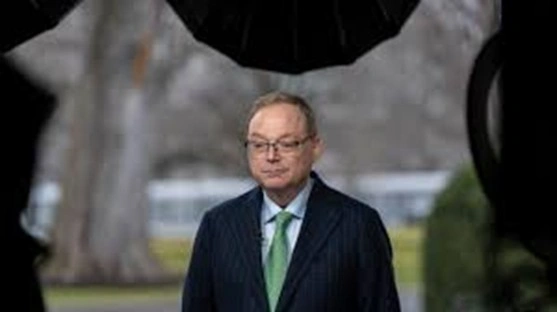
Strait of Hormuz disruption affects global oil trade. [Courtesy: Caspian Post]
How Could GDP Growth Remain Strong Despite Tensions?
Hassett was optimistic about the U.S. economic growth. He estimated a growth of between 4 and 5 per cent of GDP this year. He blamed this on deregulation and tax cuts. These policies will favour the growth of business.
Another area that was brought to light by Hassett was in the second-half recovery. It may pick up faster, provided the oil supply shock is addressed in the near future. The energy prices would be stable, and this would lower the inflationary pressure.
It may also enhance consumer confidence since there is a reduction in uncertainty. A major element that contributes to this prediction is economic resilience. These projections are being monitored by markets.
Where Do Diplomatic Talks Fit Into The Outlook?
Diplomacy is being done to tame the tensions between the U.S. and Iran. The officials will meet in Islamabad during the weekend. These negotiations are after a two-week ceasefire accord. The result may have an impact on the stability of the world economy.
Effective negotiations can help to reestablish normal trade flows. This would relieve energy markets in a short period of time. These discussions are being keenly followed by investors. Market sentiment could be stabilised by any positive development.
But until definite agreements are arrived at, there is uncertainty. Diplomatic results will be very instrumental in determining the near-term economic trends.
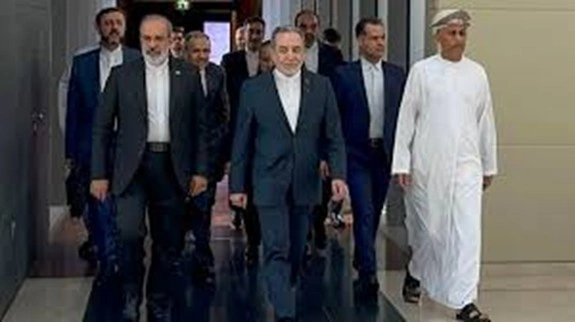
Diplomatic talks aim to ease U.S.-Iran tensions. [Courtesy: Al Jazeera]
What Should Investors Expect In The Coming Weeks?
A further short-term shaky period in world markets should be anticipated by investors. The prices of energy can be higher until the supply stabilises. During uncertainty, safe-haven demand might exist.
Nonetheless, the markets can stabilise when tensions are defused in a short time. By saying this, Hassett implies minimal harm in the long-term. Investors will be able to recover their confidence because there will be more clarity.
It will be important to monitor the data about inflation and oil prices. Government and central bank reactions to policies will also be significant.
Depending on geopolitical changes, market sentiment may change quickly. Being updated will become a key to coping with the present-day situation.
Also Read: US Stock Market Slides Amid Worries of Extended Middle East Conflict
FAQs
Q1. What caused the recent spike in inflation?
A1: The CPI rose 0.9% in March due to energy price increases. Supply disruptions from the conflict drove the surge.
Q2. Why did consumer sentiment fall to 47.6?
A2: Uncertainty and rising inflation fears impacted consumer confidence. The U.S.-Iran war worsened economic outlook concerns.
Q3. What is Hassett’s GDP growth forecast?
A3: Hassett expects U.S. GDP to grow between 4% and 5%. Growth may improve further if the oil supply stabilises.
Q4. How important is the Strait of Hormuz to global markets?
A4: It is a key oil transport route affecting global supply. Disruptions can significantly impact energy prices worldwide.
Disclaimer
This article is for informational purposes only and does not constitute financial advice. Economic projections and geopolitical developments are subject to rapid change. Readers should rely on independent research before making financial decisions. The information presented reflects publicly available data and expert commentary, which may not guarantee future outcomes or market performance.
Sources
- https://www.tipranks.com/news/u-s-iran-war-economic-impact-will-very-very-quickly-go-away-says-kevin-hassett
- https://www.washingtonpost.com/business/2026/04/10/inflation-march-iran-war/