
Perseus Mining Limited (ASX/TSX: PRU) has delivered a substantial resource update for its Nyanzaga Gold Project in Tanzania, announcing an Ore Reserve of 4.0 million ounces – a 73% jump from the 2.3 million ounces reported just 10 months ago in April 2025.
The update marks a pivotal step for what is shaping up to be Perseus Mining’s next major producing mine on the African continent.
What the Numbers Show
The updated JORC-compliant Ore Reserve now stands at 90.9 million tonnes grading 1.38 grams per tonne gold for a total of 4.046 million ounces.
The two deposits making up the reserve are:
- Tusker: 86.1 million tonnes @ 1.41 g/t = 3.9 million ounces
- Kilimani: 4.8 million tonnes @ 0.94 g/t = 146,000 ounces
The reserve is classified as Probable under the JORC Code (2012), based on Indicated Mineral Resources with pit designs optimised at a gold price of USD 2,300 per ounce.
The Combined Measured and Indicated Mineral Resource now sits at 110.4 million tonnes grading 1.33 g/t, containing 4.7 million ounces. A further 343,000 ounces are classified as Inferred.
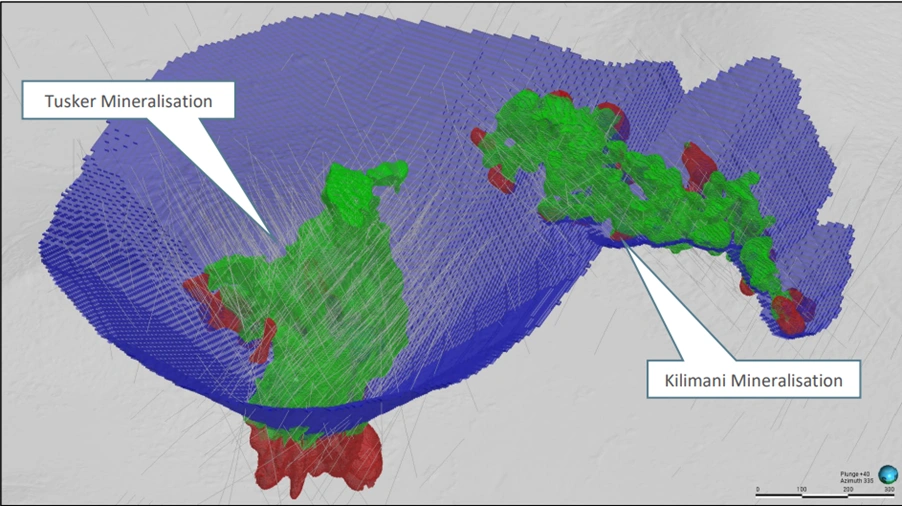
Oblique view from above looking northwest showing Indicated (green) and Inferred (red) mineralisation against the US$2,700/oz resource limiting shell.
Mine Life Stretched to 16 Years
The reserve expansion has extended the projected mine life at Nyanzaga to 16 years, with 14 of those years delivering production above 200,000 ounces annually. Gold output above that threshold is expected from FY28 through to FY41.
This is a significant lift from the earlier feasibility study parameters and positions Nyanzaga as a long-life, high-output asset within the Perseus portfolio.
Project Economics at a Glance
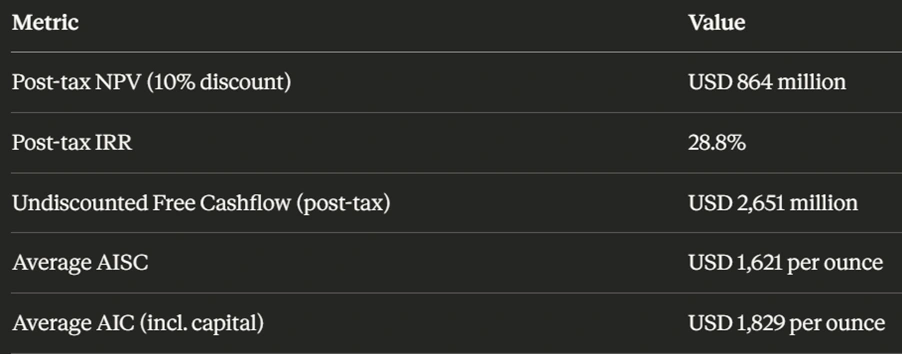
At a long-term gold price of USD 3,000 per ounce, the project’s updated financial metrics.
At a higher gold price of USD 4,000 per ounce, the post-tax NPV climbs to USD 1.877 billion with an IRR of 47.8%. If gold reaches USD 5,000 per ounce, the NPV pushes further to USD 2.889 billion.
The total life-of-mine operating cost is estimated at USD 5,577.8 million, with mining accounting for USD 3,168 million, processing at USD 1,214.8 million, and revenue costs – royalties, transport and refining – at USD 790.1 million.
Drilling Drives the Reserve Growth
The reserve expansion is backed by approximately 82,700 metres of reverse circulation and diamond drilling completed across the Tusker and Kilimani deposits since Perseus acquired the project in May 2024.
The drilling program focused on infill work to tighten up resource confidence and convert Inferred material to the Indicated category. Further geotechnical diamond drilling in 2025 – totalling 6,150 metres across 16 holes – also refined slope design parameters, feeding directly into the updated pit optimisation model.
This level of technical groundwork is consistent with what Perseus has done previously across its African operations.
Construction Already Under Way
Perseus confirmed construction at Nyanzaga has commenced. The project will use conventional open-pit truck-and-shovel mining with 10-metre bench heights and selective 2.5-metre flitches to reduce ore loss and dilution.
Processing will run through a carbon-in-leach circuit with a nameplate throughput of 5 million tonnes per annum. Metallurgical gold recovery is expected to average 85.8% across the life of mine, with oxide ore at Kilimani recovering up to 94.5%.
Power will come from Tanzania’s national grid, while raw water supply is drawn from Lake Victoria, supplemented by groundwater from dedicated boreholes.
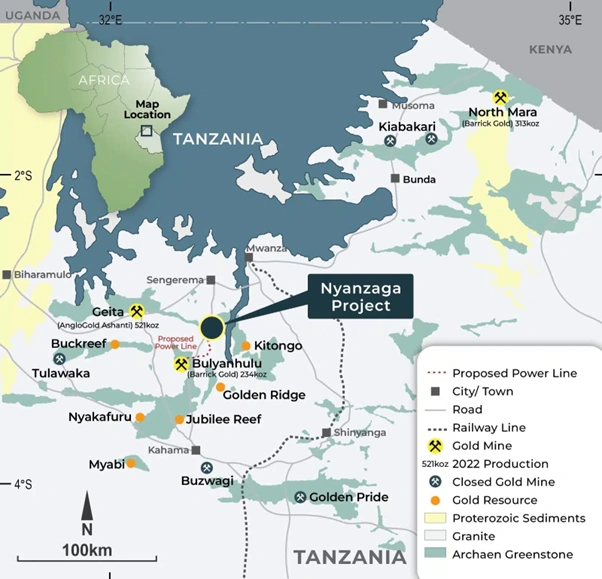
Nyanzaga Gold Project location plan, Mwanza Region, Tanzania. [Perseus Mining Limited]
Perseus’s Broader Growth Picture
The Nyanzaga update fits within Perseus’s broader five-year production strategy. The company previously outlined a target of 515,000 to 535,000 ounces per year across its portfolio to FY30, with Nyanzaga accounting for 28% of group output by the end of that period.
Perseus holds an 80% contributing interest in Nyanzaga through its subsidiary Nyanzaga Mining Company Limited. The Tanzanian Government holds the remaining 20% as a non-contributing free carried interest.
In parallel, the company has been advancing the CMA underground project at its Yaouré Gold Mine in Côte d’Ivoire, which received presidential approval in September 2025. Together, these two development projects form the backbone of Perseus’s next production phase through to the early 2030s.
Gold Market Context
Gold prices remain well-supported. As of the date of this announcement, spot gold is trading above USD 2,900 per ounce – comfortably above the USD 2,300 figure used in Perseus’s pit designs, and approaching the USD 3,000 assumption underpinning project economics. That gap is meaningful for project returns.
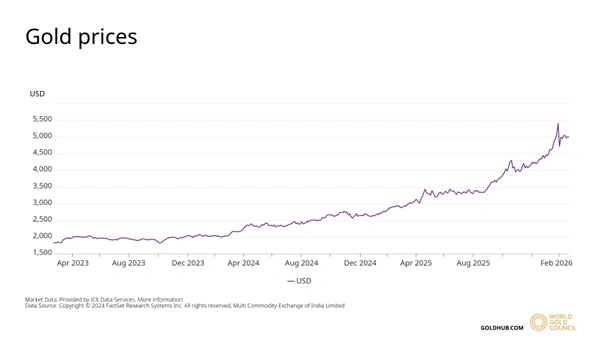
Gold Price Chart [World Gold Council]
Global uncertainty, central bank buying, and ongoing geopolitical tensions have kept demand firm. For mid-tier producers with scalable assets like Perseus Mining, the current price environment strengthens the case for capital deployment in long-life projects.
Investor Outlook
As of 20th February 2026, Perseus Mining shares last traded at approximately AUD 5.965 per share, with a market capitalisation of around AUD 7.64 billion. The 52-week range for Perseus Mining stands at AUD 2.81 to AUD 6.6 per share.
The Nyanzaga reserve update removes a key uncertainty that had been hanging over the project since acquisition. With construction now underway, a funded mine plan, and a 16-year mine life confirmed, the focus will increasingly shift toward first production timelines and commissioning milestones.