
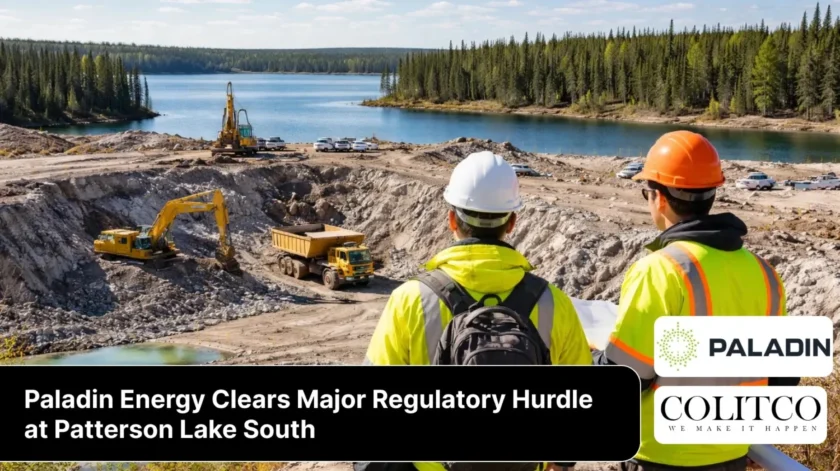
Paladin Energy Ltd (ASX: PDN, TSX: PDN, OTCQX: PALAF) has secured a pivotal regulatory win in Canada, receiving Ministerial approval for its Environmental Impact Statement (EIS) for the Patterson Lake South (PLS) Project in Saskatchewan’s Athabasca Basin. The announcement marks one of the most consequential milestones in the project’s path to becoming a producing uranium mine.
Saskatchewan’s Minister of Environment formally approved the EIS under The Environmental Assessment Act, clearing the way for Paladin to pursue provincial and federal construction permits and licences.
What the EIS Approval Actually Means
The EIS is not just a box-ticking exercise. Under Saskatchewan law, a positive environmental assessment decision is a prerequisite before the Canadian Nuclear Safety Commission (CNSC) can consider any licensing decision on the PLS Project.
Without it, construction cannot legally proceed. With it, Paladin can now advance the construction licensing process with the CNSC in earnest.
The approval followed a rigorous multi-stage process:
- Technical acceptance of the EIS document in June 2025
- An extensive public review period running from July to September 2025
- Scrutiny by a panel of subject matter experts
- Substantial public and Indigenous consultation
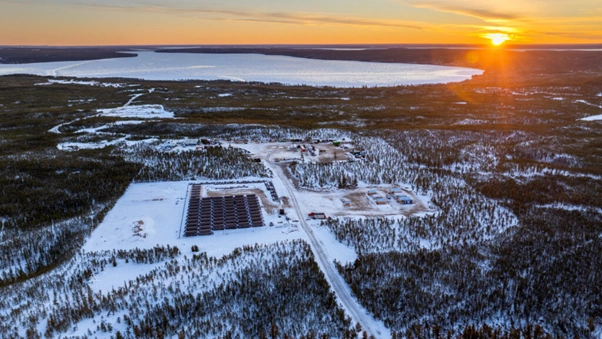
Location of the Patterson Lake South Project in the Athabasca Basin, Saskatchewan, Canada. [Paladin Energy]
What Officials Said
Saskatchewan Premier Scott Moe welcomed the outcome, noting the province’s commitment to world-class uranium production and the project’s alignment with Saskatchewan’s Growth Plan.
Minister of Environment Darlene Rowden said the PLS Project has undergone a robust Environmental Assessment process, including review by subject matter experts and considerable public and Indigenous consultation. She expressed satisfaction with the environmental safeguards in place.
Paladin’s Managing Director and CEO, Paul Hemburrow, described the approval as recognition by the Saskatchewan Government that the company’s approach to development is both environmentally and socially appropriate. Hemburrow confirmed the company will now press forward with the construction licensing process at the CNSC.
The Asset Behind the Milestone
The PLS Project hosts the Triple R deposit, described as one of the largest high-grade, near-surface uranium deposits in the Athabasca Basin. Key project characteristics include:
- Probable Mineral Reserve: 93.7 million lb U3O8 at 1.41% grade
- Shallow deposit: Mineralisation begins just 50 metres from surface
- Mine design: Underground mine with an onsite mill processing approximately 1,000 tonnes of ore per day
- Tailings management: Underground tailings management facility with effluent treatment infrastructure
- Updated NPV: USD 1,325 million (8% real discount rate, post-tax) at USD 90/lb U3O8
- Production target: First uranium output expected in 2031
These figures stem from the Engineering Review released in August 2025, which built on the 2023 Feasibility Study and incorporated updated capital and operating costs from ongoing Front-End Engineering and Design (FEED) work.
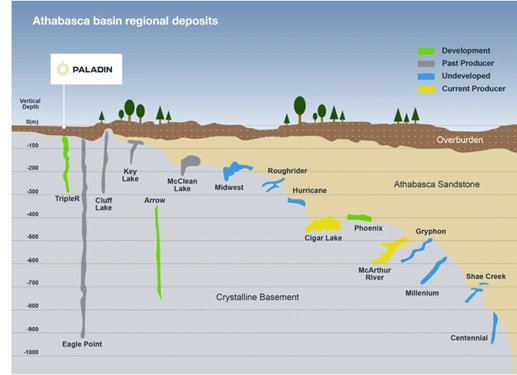
The Basin’s only shallow, high-grade, undeveloped project. [Paladin Energy]
How Paladin Got Here
Paladin Energy acquired the PLS Project through its December 2024 takeover of Fission Uranium Corp., which has since been renamed Paladin Canada. That acquisition created a dual-listed uranium producer operating across Namibia and Canada, with production at the Langer Heinrich Mine and a development pipeline anchored by PLS.
The Langer Heinrich operation in Namibia has been ramping up through 2025, with full mining and processing plant operations planned for 2027. The PLS Project adds a second major production source, with the potential to significantly lift Paladin’s annual output once operational.
With the Athabasca Basin already home to world-class operations such as Cigar Lake and McArthur River, PLS sits within a proven and infrastructure-rich uranium jurisdiction.
The Uranium Market Backdrop
The EIS approval arrives as global uranium demand continues to build. ASX uranium stocks have rallied sharply through 2025, driven by growing nuclear energy programmes across Asia and Europe and a tightening supply outlook.
Nuclear energy has re-entered mainstream policy conversations in multiple major economies, supported by energy security concerns and net-zero emission targets. Countries including South Korea, Japan, France, and the United States have either restarted previously dormant nuclear programmes or committed to expanding existing capacity.
The World Nuclear Association projects global uranium demand to rise by 28% by 2030.
For Paladin, the timing strengthens the investment case for PLS considerably. A project with a post-tax NPV exceeding USD 1.3 billion, located in a tier-one mining jurisdiction, with Ministerial environmental clearance now in hand, represents a meaningful step toward production in the back half of this decade.
Also Read: Alcoa Hit with Australia’s Largest Conservation Fine After Six Years of Illegal Forest Clearing
What Comes Next
The immediate next step is advancing through the CNSC’s construction licensing process. This is a separate federal regulatory stream from the provincial EIS approval Paladin just received.
The company must also continue engaging with Indigenous Nations, local communities, and other stakeholders as it progresses toward construction readiness. Paladin has already established a community funding programme in the Patterson Lake area to support locally run educational and social initiatives.
Based on the current schedule, Paladin is targeting first uranium production from PLS in 2031. Achieving that timeline will depend on successfully navigating CNSC hearings and obtaining the necessary federal construction and operating licences.
Investors will be watching CNSC hearing dates closely in the months ahead as the next major catalysts on the PLS regulatory timeline.