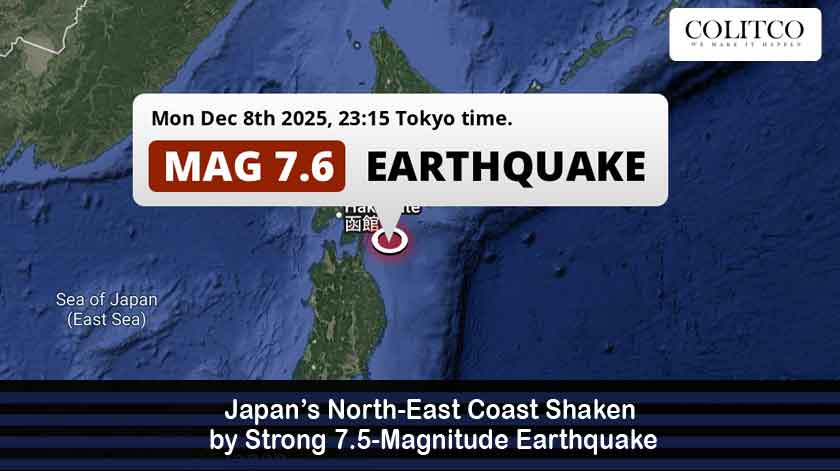
A strong earthquake measuring magnitude 7.5 has struck off Japan’s north-eastern coast late Monday night. The Japan Meteorological Agency (JMA) reported the tremor at 11:15 p.m. local time, or 2:15 p.m. GMT. The earthquake’s epicentre was located about 80 kilometres off Aomori Prefecture at a depth of 54 kilometres.
Tremors with an intensity of upper 6 on Japan’s seismic scale were recorded in Aomori’s Hachinohe City. Such an intensity can cause heavy furniture to collapse and damage buildings. The JMA initially estimated the quake at magnitude 7.6 and a depth of 50 kilometres before revising it.
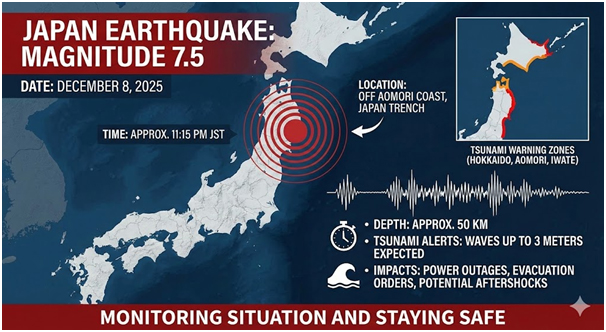
A strong 7.5 magnitude earthquake strikes Japan
Tsunami Warnings Downgraded to Advisories
Authorities issued tsunami warnings for Hokkaido, Aomori, and Iwate prefectures after the quake struck offshore. Waves between 20 and 50 centimetres reached several coastal ports. The JMA warned of a possible tsunami up to three metres high along the north-eastern coast before downgrading the alert to a tsunami advisory.
Officials urged residents to stay away from the coastline and river mouths while remaining alert for further tremors. It marked the first tsunami warning issued since July when an offshore quake near Kamchatka, Russia, triggered alerts for Japan’s Pacific coast.
So far, there have been reports of a 60-70 centimeter tsunami, but the initial fears of a 1-3 meter tsunami near Tōhoku and Kanto Prefectures appear to be waning (good news)!
We have seen two aftershocks of magnitude 5.0 or greater so far.
An update on the situation in Japan: pic.twitter.com/kQ021iBUCh
— Matthew Cappucci (@MatthewCappucci) December 8, 2025
Residents Ordered to Evacuate
Local governments ordered evacuations across parts of Hokkaido and the Tohoku region following the tsunami warnings. Reuters reported that about 90,000 residents received orders to evacuate low-lying areas. Local media said that in Hachinohe, a hotel employee confirmed multiple injuries but noted that all affected individuals were conscious.
Authorities warned that significant damage could occur and advised residents to remain in safe locations. The JMA reminded communities to expect further tremors and long-period ground motions following the main quake.

Safety and Evacuation measures for residents
Long-Period Ground Motions Recorded
The JMA detected long-period ground motions during the quake, which can heavily sway tall structures. Class-3 tremors, the second strongest level on a four-point scale, were recorded in Rokkasho village, Aomori Prefecture. Such motions make it difficult for people in high-rise buildings to remain standing. Experts said these ground waves are typical during large offshore quakes and pose a risk to modern city structures.
The moment of impact of a 7.2-magnitude earthquake is captured on camera at Aomori Asahi Broadcasting’s Hachinohe branch office in Hachinohe City, Aomori Prefecture, Japan.
A tsunami warning is in effect. pic.twitter.com/HfrIRqeYUp
— Weather Monitor (@WeatherMonitors) December 8, 2025
Government Launches Emergency Response
The Japanese government established a task force at the Prime Minister’s crisis management centre minutes after the quake. Prime Minister Takaichi Sanae arrived at the office shortly before midnight. She instructed officials to prioritise evacuation efforts and quickly assess potential damage.
Takaichi said, “The central government will work closely with local governments and make the utmost effort to carry out measures, such as emergency response, including rescue for the affected people.” She directed cabinet members to supply accurate information on tsunami conditions and coordinate relief operations immediately.
Chief Cabinet Secretary Kihara Minoru announced that the government had activated national disaster response units. “We are making every effort to assess the damage and implement emergency disaster response measures, including rescue and relief operations,” Kihara said. He confirmed that emergency services, including police, fire departments, and the Self-Defense Forces, were assisting affected localities.
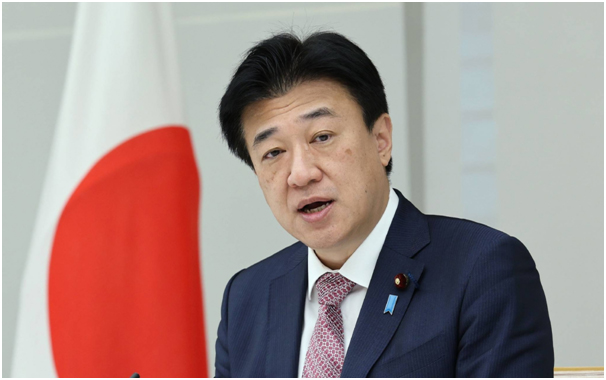
Chief Cabinet Secretary Kihara Minoru
Transport and Infrastructure Disruptions
The earthquake halted multiple train services as East Japan Railway suspended outbound Tohoku Shinkansen operations between Fukushima and Shin-Aomori stations. Three trains stopped along the line, and safety crews began track inspections. Local lines in Iwate Prefecture faced suspension, with two trains making emergency stops. The extent of rail damage remains under review.
East Nippon Expressway Company reported full traffic closures across several Hokkaido interchanges. Sections between Shiraoi and Shinchitose Airport and between Tomakomai Higashi and Numanohata Nishi remained closed. Highways will reopen after authorities verify road safety.
At New Chitose Airport, near Sapporo, officials conducted runway inspections shortly after 11:40 p.m. to check for cracks or irregularities. Airport management said no delays had been reported as inspections continued.
POWERFUL M7.6 EARTHQUAKE causes intense shaking in Japan
Nearly 100,000 ordered to EVACUATE — NERV pic.twitter.com/bIHE51X9PQ
— RT (@RT_com) December 8, 2025
Power and Nuclear Facilities Remain Stable
Regional power firms reported no irregularities at key nuclear stations. Tohoku Electric Power confirmed stable conditions at the Higashidori and Onagawa nuclear plants. Hokkaido Electric Power said inspections at its Tomari plant showed no issues.
Tokyo Electric Power Company (TEPCO) said it halted treated water discharge from Fukushima Daiichi plant as a precaution at 11:42 p.m. The company added that some staff members evacuated designated areas. No injuries or radiation-related incidents were recorded. TEPCO continues to monitor the Fukushima Daiichi and Daini plants.
Tohoku Electric reported that thousands of households lost electricity following the tremor. Restoration efforts began early Tuesday morning, with field teams deployed to assess transmission systems.
Also Read: Paramount Skydance Launches Hostile Takeover Bid For Warner Bros. Discovery
Expert Analysis on the Earthquake
Professor Sakai Shinichi of the University of Tokyo’s Earthquake Research Institute described the quake as a likely plate-boundary event. “If this was a shallow earthquake centered in the sea, there is a high possibility that a tsunami has already occurred,” Sakai said. “People should stay away from the coast. It is important to evacuate and to take measures to stay warm.” He added that the epicentre was north of the 2011 Great East Japan Earthquake area and may lead to further seismic reviews.
No Threat to Nuclear Safety
The International Atomic Energy Agency confirmed that Japanese authorities reported no abnormalities at nuclear power sites, including Fukushima. Routine checks continue under Japan’s nuclear safety protocols, ensuring containment remains secure.
Japan accounts for about 20 per cent of the world’s earthquakes of magnitude 6 or greater. Located within the Pacific “Ring of Fire,” the country records tremors every few minutes. Monday’s quake revived memories of the 9.0 magnitude disaster on 11 March 2011, which triggered a tsunami that killed over 18,000 people and devastated coastal towns.
Authorities Maintain High Alert
The JMA warned residents to remain cautious as aftershocks may continue. Emergency agencies continue rescue operations, support coordination, and infrastructure checks across northern Japan. The government confirmed that information updates and safety guidance would remain available through official channels as investigations into the event progress.