
The Albanese government is preparing to overhaul two of Australia’s most controversial property tax concessions.
The proposed changes to negative gearing rules and the capital gains tax (CGT) discount are already dividing economists, landlords, renters, and first-home buyers. Treasurer Jim Chalmers has flagged the upcoming budget as “ambitious”, with Treasury reportedly modelling a cut to the CGT discount and a cap on negative gearing deductions.

Australian Treasurer Jim Chalmers speaking at a press conference [Bloomberg]
CGT Discount Cut and Negative Gearing Limits: What’s on the Table
Rather than scrapping these benefits outright, the government is modelling more targeted adjustments. Under the proposals, negative gearing would be capped at a maximum of two investment properties per person, and the CGT discount could be wound back from 50% to 33% for assets held longer than 12 months.
A separate proposal from independent senator David Pocock goes further. His plan would offer a reduced CGT discount of 25% on new homes built after 1 July 2026, provided they are held for longer than three years, while removing negative gearing for an investor’s second or subsequent investment properties.
In short, the options on the table range from minor tweaks to a significant overhaul of how investment properties are taxed in Australia.
Australia’s Housing Crisis Has Made Reform Unavoidable
Australia’s housing crisis has been festering for years. It now takes an average of 10 years to save for a 20% deposit on a median-priced home, and rents have climbed 36.1% since the start of the COVID-19 pandemic.
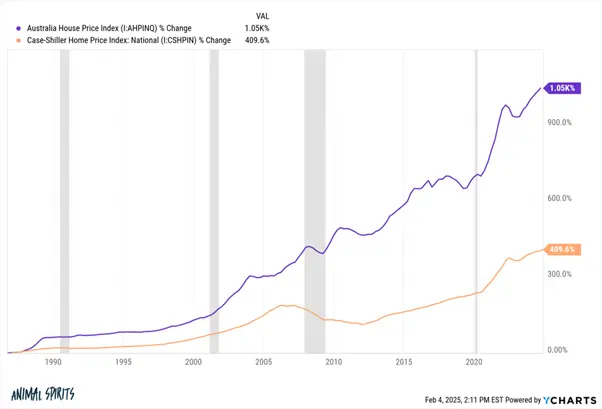
House prices in Australia have grown more than 1,000% since the 1980s, far outpacing wages. [A Wealth of Common Sense]
The current tax settings are widely seen as tilting the scales. A Senate inquiry into the CGT discount found evidence it has “skewed the ownership of housing away from owner-occupiers and towards investors” when combined with negative gearing.
The fiscal case is also hard to ignore. Treasurer Chalmers has pointed to a $22 billion annual revenue cost attributed to these concessions, money that could instead be directed toward social housing or supply programs.
Key Players in the Australian Housing Tax Reform Debate
The debate cuts across party lines and income brackets:
- Jim Chalmers is pushing for reform, framing it as an issue of intergenerational fairness ahead of the May budget.
- PM Anthony Albanese has remained cautious, preferring to focus on housing supply as the primary fix.
- The Greens fully back the changes. Senator Barbara Pocock has described the concessions as “massive handouts” to wealthy property investors that the next budget should address.
- The Opposition Coalition opposes the changes entirely. Liberal senators argue that “supply is the key” and that reducing the CGT discount would not deliver more homes or higher homeownership rates.
- Landlords and investors fear that reducing tax incentives will push rents higher as their costs increase.
- First-home buyers and renters are cautiously optimistic, hoping reduced investor competition could ease prices.
Sydney, Melbourne, and the Markets Feeling the Most Pressure
The changes would play out nationwide but would be felt most sharply in Sydney and Melbourne, where investor activity is heaviest and prices are furthest out of reach for ordinary Australians. According to PropTrack, the national median house price hit a record $805,000 in April 2025, with values up 48.6% since March 2020.
Outer suburbs and regional rental markets could also see disruption if investors exit and rental stock tightens.
When Could It Happen?
The timeline is firming up:
- March 2026: Senate inquiry tabled its findings on the CGT discount, with Labor senators signalling openness to reform.
- May 2026: Federal budget is the most likely vehicle for any formal announcement.
- From July 2026: Changes could take effect if legislated through the budget.
Advocates, including independent MP Allegra Spender and a range of economists, have called the 2026 budget Labor’s best opportunity for tax reform in decades, given the government’s strong parliamentary majority and the long runway before the next election.
CGT Discount Cut Would Change the Numbers for Investors
If the CGT discount is cut from 50% to 33%, an investor who sells a property with a $400,000 capital gain would face a larger taxable amount than before. The savings that made holding investment properties so attractive would shrink considerably.
Capping negative gearing at two properties would still allow most everyday investors to claim losses. But multi-property portfolios that currently generate substantial tax deductions against wages would no longer receive that benefit for properties beyond the cap.
The government is expected to pair these moves with supply-side measures, including zoning reforms, to ensure that reduced investor demand doesn’t simply translate into fewer rentals without a corresponding increase in new stock.
Australia’s 2025 economic outlook already flagged housing affordability as one of the nation’s greatest structural challenges, and these reforms are being designed to attack it from the demand side.
What Happens Next?
The May budget will tell the full story. Chalmers has said that while the extent of the reforms will depend on what the government can afford and how global developments play out, his fifth budget “will be full of ambition.”
For buyers, renters, and property investors alike, the next few weeks are worth watching closely.
Also Read: Australian fuel shortage threatens food supply chain
FAQs
Q: What is the CGT discount cut being proposed in Australia?
A: The government is considering reducing the CGT discount from 50% to between 25% and 33% for investment properties. This would increase the amount of tax investors pay when selling a property for a profit.
Q: Will negative gearing be abolished in Australia?
A: Full abolition is not currently on the table. The proposal being modelled would cap negative gearing deductions to a maximum of two investment properties per person from 1 July 2026.
Q: How will these tax changes affect renters?
A: Opinion is divided. Supporters argue that fewer tax incentives will cool investor demand, easing competition for properties. Critics warn it could reduce rental supply and push rents higher.
Q: When will Australia’s housing tax reform take effect?
A: Any changes would most likely be announced in the May 2026 federal budget and, if legislated, take effect from July 2026.
Q: Are these reforms supported by the opposition?
A: No. The Coalition has released a dissenting report arguing that supply, not tax changes, is the answer to Australia’s housing crisis.
Disclaimer: This article is for informational purposes only and does not constitute financial or investment advice. Property markets are subject to risk. Readers should consult a qualified financial adviser before making any investment decisions.
Source:
Last modified: March 23, 2026