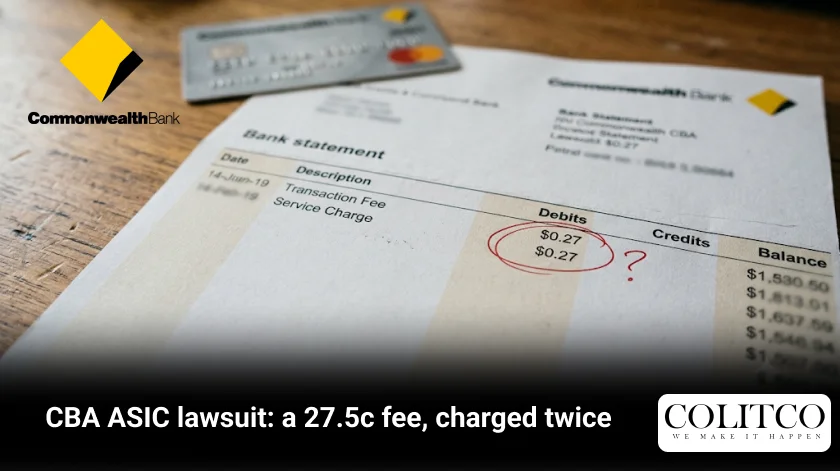
The CBA ASIC lawsuit was filed in the Federal Court late on Wednesday 11 November 2026. The bank replied with an ASX statement the next morning.
The fee at the centre is 27.5 cents. Small number, big case.
Two fees for one payment
CommBiz is CBA’s online banking platform for business customers. Its terms said each direct credit or direct debit cost 27.5 cents, GST included.
ASIC says the bank also charged the same amount again for the leg touching the customer’s own account. It calls these “contra leg” fees.
Here is ASIC’s own example. A small business pays 10 staff from two CommBiz accounts. The terms pointed to 10 fees. The bank charged 12.
That extra 55 cents per pay run is Colitco’s maths, not ASIC’s. Over 26 fortnights it comes to about $14.30 a year.
Nobody rings the bank over $14.30. That is exactly why a charge like this can sit unnoticed for years.
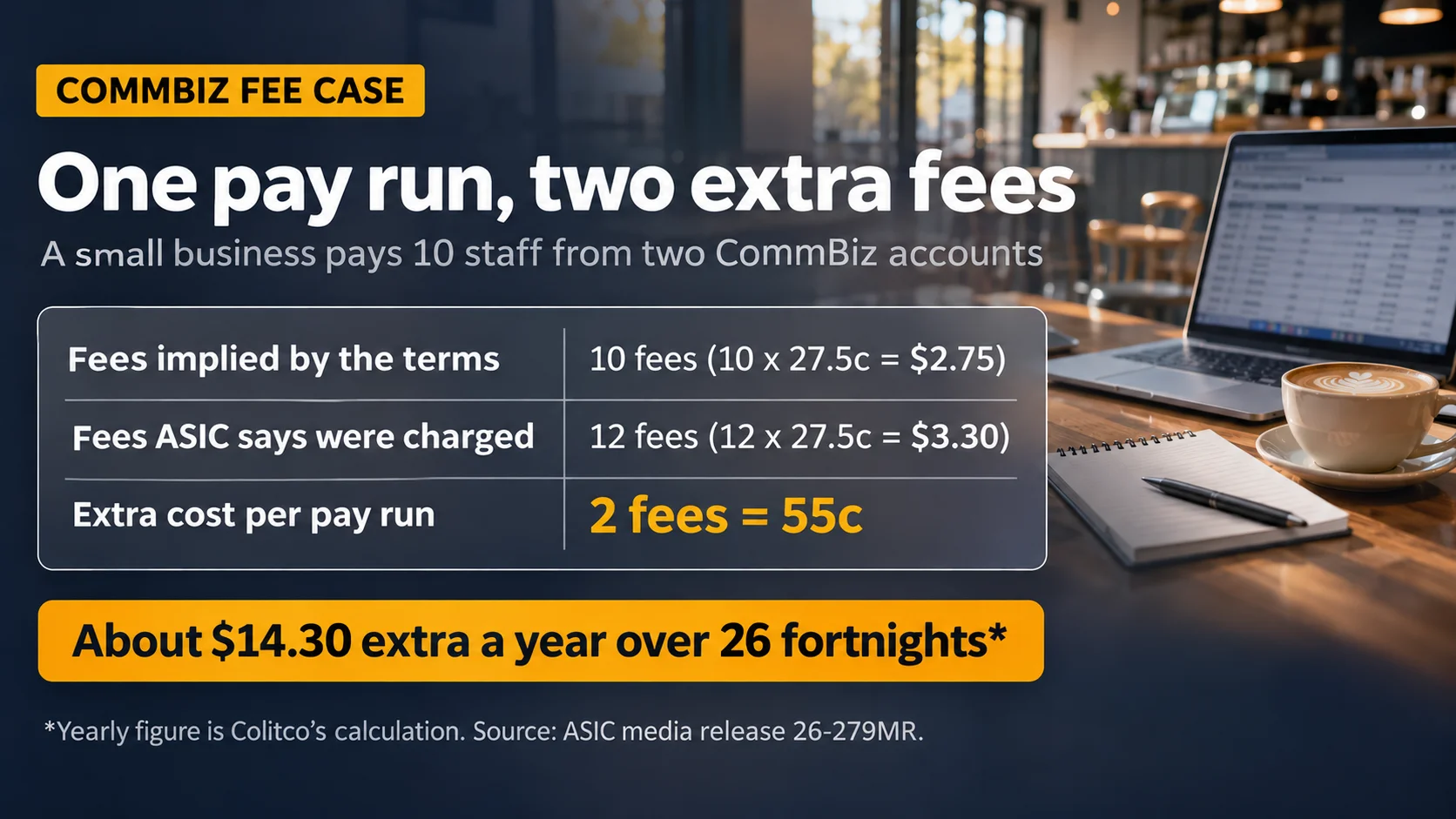 ASIC’s example of a small business paying 10 staff from two CommBiz accounts. The yearly figure is Colitco’s calculation.
ASIC puts the overcharging inside its penalty window, November 2020 to May 2025, at about $8.5 million across 42,000 customers. The concise statement carries a wider figure too. About $21 million across 93,000 customers, going back to December 2006.
Two numbers, one case. Most headlines used the smaller one.
ASIC Commissioner Alan Kirkland says the bank “broke a basic promise” to business customers, according to ASIC’s release. That promise was simple: the fee on the page is the fee on the statement.
The paper trail is what ASIC is leaning on
The dollars are small. The paper trail is not.
In April 2016, an internal audit gave the CommBiz controls a red rating. It asked for corrective action by 31 October 2016 and customer repayments by 31 July 2017. ASIC says neither happened, and the charging ran until 31 May 2025.
Complaints piled up in the meantime. The filing lists 13 serious ones from February 2015 onwards.
One treasurer rang twice in May 2020 and got $1.38 back. A month later, the same customer wrote in to say the problem was back. The bank closed that one with a $1 goodwill payment.
In December 2022, a customer-relations specialist flagged that the terms did not explain per-line charging. The systemic issue was then closed as “no bank error”.
On 14 May 2024, a senior manager sent an email marked urgent. It warned the bank might be seen as double charging, and that she knew of no other bank charging that way.
Three months later, an internal incident was marked not reportable to ASIC. The file counted one complaint. The complaint record held at least 13.
CBA lodged its first report with ASIC on 23 June 2025.
Read in order, this looks less like a scheme and more like a bank where each team held one piece of the puzzle. Nobody held the whole picture. That is a governance problem, and governance is what ASIC has pleaded.
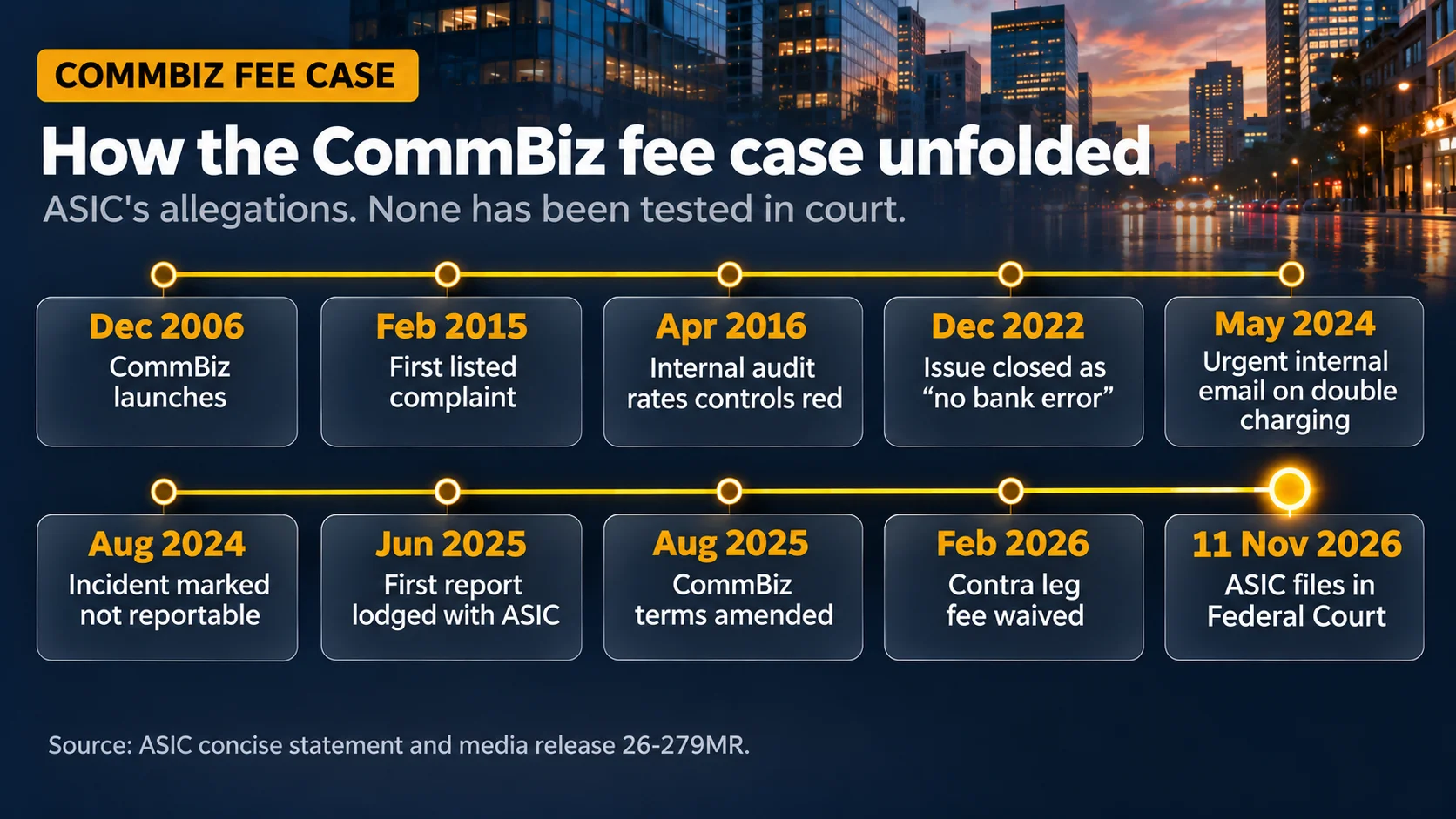
Key dates in ASIC’s allegations against CBA.
All of this is allegation. None of it has been tested in court.
Commonwealth Bank fees look tiny next to a $10.91 billion profit
CBA’s statutory profit for the year to 30 June 2026 was $10.91 billion, according to the filing. That is about $30 million a day.
The $26.4 million the bank has already repaid is less than one day of it.
So the market shrugged. Reuters had CBA shares up between 1.2% and 1.6% on Thursday, while the banking index rose about 0.2%. A company valued near $282 billion does not blink at $8.5 million.
The penalty is the open question. ASIC counts about 2.4 million occasions on which the CommBiz fee pages were viewed, and treats each as a separate misleading statement. The court sets the penalty, and no case management hearing has been listed yet.
One detail from the filing explains the $8.5 million figure. The penalty window opens on 12 November 2020, exactly six years before filing. That appears to match a time limit on penalty claims, though the filing does not say so. The earlier years look like background, not penalty ground.
CBA’s side is a mix of apology and pushback. It accepts it “did not get things right”, but disputes how some allegations are framed.
Its explanation is that the fee was applied consistently. The problem, it says, came when terms were rewritten to simplify them and the new wording missed how the fee was charged. ASIC says the misleading terms go back to the 2006 launch. Which version the court prefers decides how long the conduct looks.
The bank also says it found the issue itself and told ASIC. Both things can be true. The filing says the investigation began on 25 July 2024, and the first report landed 11 months later.
The read here is a negotiated outcome. CBA has left the door open by saying it will defend parts of the claim or keep working with ASIC to resolve it. Banks rarely want a trial over a fee table.
What business owners can check on their own statements
Since 1 August 2025, the CommBiz terms say the fee applies to each debit and each credit, with a minimum of two per payment. CBA has waived the contra leg fee since February 2026.
ASIC says anyone who thinks they were affected and has not been repaid should contact CBA.
CBA’s ASX statement hints at who got what. At 20 October 2026, the median repayment was about $85. The mean was about $442, interest included. A few customers received far more than the typical one.
The check is simple. Count the payments sent in a month. Count the fee lines on the statement. If the second number is higher than the terms allowed at the time, ask why. The same count works at any bank with per-payment pricing, and ASIC’s wider push on financial reporting and audit quality shows the regulator is checking more than fee tables.
ASIC lists misleading pricing as a 2026 enforcement priority. It would be a surprise if CBA were the only bank whose fee table gets a second look. WiseTech’s run-in with ASIC is another case where the regulator’s reach has been in focus.
The 27.5 cents was never the real test. Whether anyone at the bank owned the price list is what the court will weigh.
Also Read: Genesis-Vault Combination: What Changes for Western Australia’s Gold Mining Landscape?
FAQs
Q: What is the CBA ASIC lawsuit about?
A: ASIC alleges CBA charged undisclosed second fees on CommBiz direct debits and direct credits.
Q: How many customers were affected?
A: About 42,000 in the penalty window and about 93,000 from 2006 to 2025, per ASIC.
Q: Has CBA repaid customers?
A: Yes, more than $26.4 million to about 93,000 customers.
Q: Is CBA fighting the case?
A: It expects to defend parts of the claim or work with ASIC to resolve it.
Q: Is CBA still charging the fee?
A: CBA has waived the contra leg fee since February 2026.
Q: When is the first hearing?
A: The Court has not yet listed a case management hearing.
Disclaimer: This article is general information only and is not financial advice. It does not consider your objectives, financial situation or needs. ASIC’s claims are allegations and have not been proven in court. Consider seeking advice from a licensed adviser before making investment decisions.

Luke Carlino is a seasoned Copywriter, Content Strategist, and Social Media Manager specialising in Mining, Finance, and Business journalism. With more than a decade of industry experience, he brings rigorous editorial standards and commercial acuity to every project.