
The DroneShield $23.2 million European contracts came through a familiar face. COBBS BELUX BV, a reseller the Sydney company has worked with in the Benelux region for years, will pass the gear on to a European military buyer it won’t name. The kit is vehicle-mounted counter-drone hardware, plus subscriptions, warranties and services.
Of that total, about $21 million lands inside this year’s committed revenue. The rest trickles in later as subscription income.
Here’s the bit worth chewing on. DroneShield says it doesn’t think the end-customer’s identity would move the share price. That’s a careful line. Companies only write sentences like that when they’ve thought hard about what they legally have to tell the market. Read it as a nod to how closely this stock is being watched right now.
Why the DroneShield counter-drone contracts in Europe keep coming
Europe has become the company’s engine room. Back in December it booked a $49.6 million European deal, its biggest at the time. This new package is smaller, but it fits the same story: NATO-aligned buyers moving from testing drones defences to actually buying them at scale.
The war in Ukraine did that. Cheap drones now do real damage, and every army near the fighting wants a way to knock them down or jam them. DroneShield sells exactly that.
The company opened a European factory in June and set up a Polish supply chain a fortnight later. Poland spends more than 4% of its GDP on defence. Sitting close to that money is the whole point.
So the contract isn’t a shock. It’s the tempo that matters. Deals this size have gone from rare to routine, and that changes how the numbers stack up.
RfAI-3 and the shift from selling boxes to selling software
The second announcement got less attention but might mean more over time. DroneShield unveiled RfAI-3, the third version of its radio frequency detection engine.
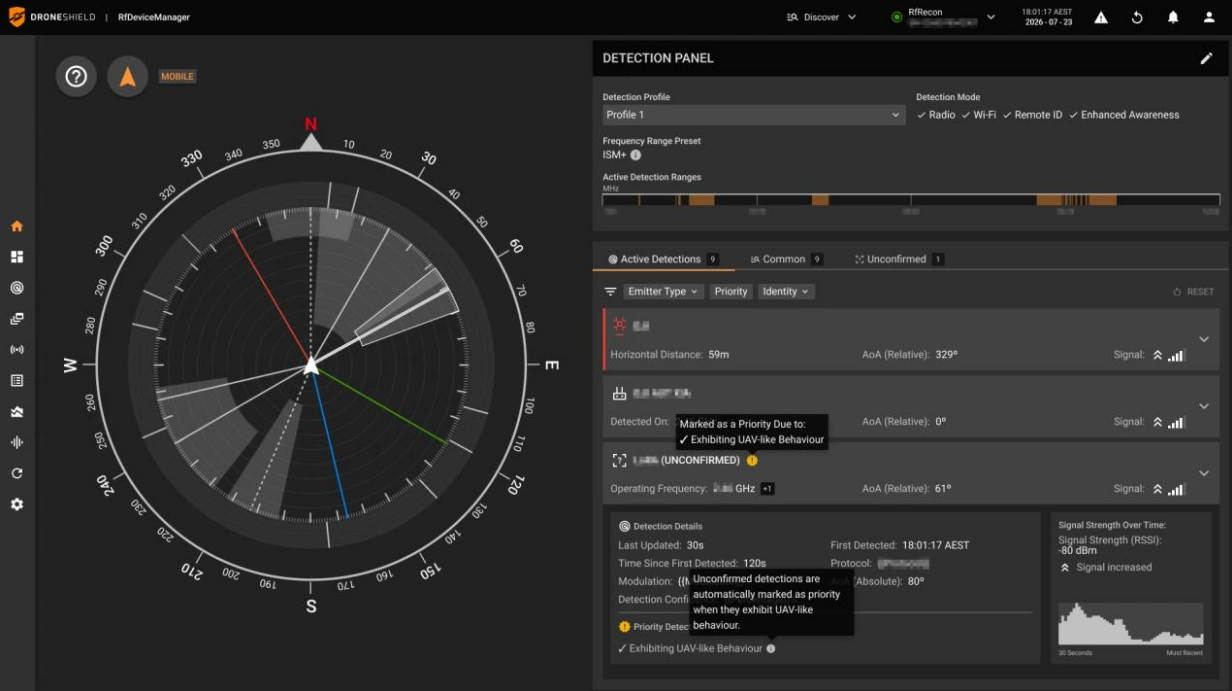
Visual output from RfAI-3 [Droneshield]
The clever part is what it does with drones it has never seen. Older systems only spot an aircraft if it’s already in a library, catalogued and named. RfAI-3 scans wide across the spectrum, compares an unknown signal against past ones, then builds a fresh signature on the spot with a confidence score for the operator.
CEO Angus Bean put it bluntly. “The threat that matters most is the one we have not yet encountered, and by the time we encounter it a second time, it will have changed again,” he said. He called software-defined radio a “genuinely dynamic battlespace” and framed RfAI-3 as the answer.
That quote tells you where the head office is pointing. Bean took the top job in April after a decade inside the business, replacing Oleg Vornik. His plan leans on software and subscriptions rather than one-off hardware sales. RfAI-3, built for hardware that ships from late 2026, is that plan taking shape.
The trading update hides a margin story
Now the money. First-half 2026 revenue is tipped at $125.8 million, up 74% on the year before. Committed revenue for the year sits at $206 million, near what the whole of 2025 brought in, with five months still to run. Full-year guidance is $250 million to $270 million.
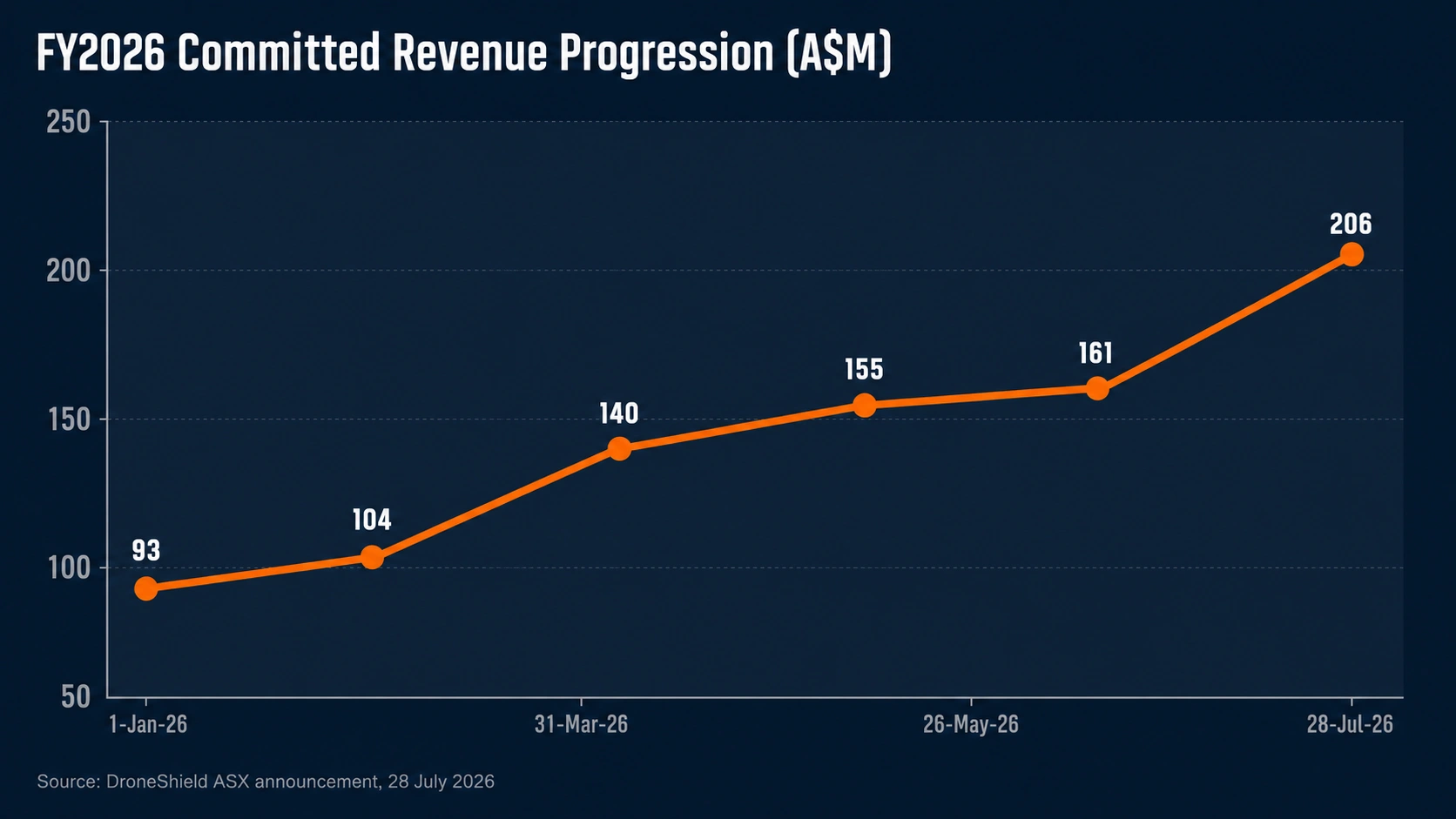
Committed revenue nearly doubled in seven months, hitting $206 million by late July.
Big numbers. But run your eye down to the margin line.
- 1H 2026 gross margin: about 60%
- Same period last year: 65%
- Full-year target the company still wants: around 65%
Five points off the gross margin is the detail most headlines skip. DroneShield blames the sales mix, because it had to buy third-party hardware to fill these contracts, plus currency swings and a raw-material write-down tied to moving factories and switching on new software.
None of that is fatal. Growing this fast costs money, and margins wobble when a business is bolting on capacity. But it’s the kind of thing that bites at results time on 26 August if it drifts lower instead of recovering. Bean is banking on the company’s own next-gen hardware and more subscription income to pull the margin back up in the second half. That’s a promise, not a result yet.
The market has stopped clapping
Here’s the awkward truth an investor takeaway has to face. Wins like this used to send DRO flying. In 2024 it was the best performer on the ASX 200. Lately the stock has done the opposite, sliding through much of 2026 even as the order book swelled past $2 billion.
Two clouds explain a lot of it. One is price. The stock still trades on a rich multiple, so any hiccup gets punished hard. The other is trust. An ASIC investigation into a November 2025 announcement and some director share sales has hung over the register for months. DroneShield itself isn’t accused of wrongdoing, but the probe left a mark.
That’s why the “not material by omission” language in this announcement reads like a company minding its every word.
For a reader weighing this up, the question isn’t whether DroneShield can win contracts. It plainly can. The question is whether it can turn a $2 billion-plus pipeline into cash without the margin leaking or another governance stumble. The 26 August results are the next real test.
Also Read: Dexus finishes its $2 billion divestment a year early
FAQs
Q: How much are the new DroneShield European contracts worth?
A: $23.2 million, with about $21 million landing in FY2026 committed revenue.
Q: Who is the buyer?
A: A European military end-customer, unnamed, supplied through reseller COBBS BELUX BV.
Q: What is RfAI-3?
A: DroneShield’s third-generation RF detection engine that can identify drones not yet in its signature library.
Q: What is DroneShield’s full-year revenue guidance?
A: Between $250 million and $270 million for FY2026.
Q: When are the half-year results due?
A: Wednesday 26 August, with an investor call the next morning.
Q: Why did gross margin fall?
A: Sales mix with third-party hardware, currency moves and a raw-material write-down from a factory relocation.
Disclaimer:
This article is for general information only and does not constitute financial or investment advice. It does not account for your personal objectives, financial situation or needs. Figures are drawn from DroneShield’s ASX announcement dated 28 July 2026 and are preliminary and unaudited. Share price and market data must be verified against live sources before acting. Investing in shares carries risk, including loss of capital. Seek advice from a licensed financial adviser before making any investment decision.
Source:
https://www.droneshield.com/investor-relations

Elizabeth Jones is a finance and mining content specialist with over 10 years of experience creating clear, SEO-driven content across fintech, investing, banking, insurance, cryptocurrency, and resource markets. She transforms complex financial data and industry trends into engaging, reader-focused articles that improve understanding and audience engagement.