Australian Jurisdictions Reclaim Global Standing
The Fraser Institute released its 2025 Annual Survey of Mining Companies, ranking 68 jurisdictions worldwide. Australia achieved a strong collective performance with five states and territories placing within the global top 35. This result signals a major turnaround for the nation’s resources sector.
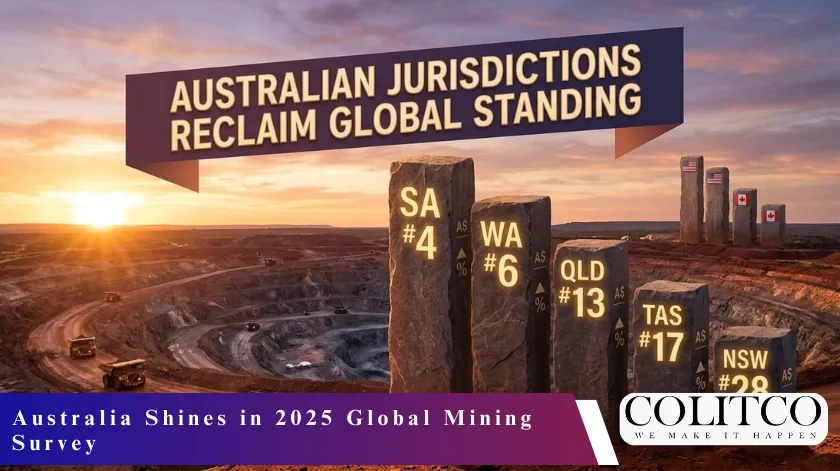
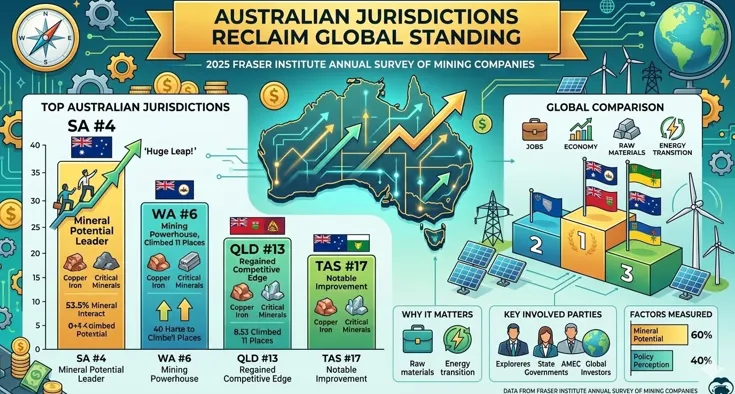
South Australia secured the fourth position globally, representing a leap of 31 places from its previous rank. The state also claimed the top spot for mineral potential worldwide. This surge reflects a 26-point increase in the state’s Investment Attractiveness Index.
Western Australia climbed 11 positions to reach sixth place in the global rankings. This improvement restores the state’s reputation as a flagship mining powerhouse. It successfully overturned a disappointing result from the 17th position recorded in the 2024 survey.
Queensland returned to 13th place globally after a previous drop to 39th. The state remains a major contributor to the national mining investment profile. The result validates recent efforts to restore investor confidence in the region.
Australian States in The Global Ranking
- South Australia: 4th (up from 35th)
- Western Australia: 6th (up from 17th)
- Queensland: 13th (up from 39th)
- Tasmania: 17th (up from 71st)
- New South Wales: 28th (up from 62nd)
- Northern Territory: 33rd (up from 38th)
- Victoria: 49th (up from 63rd)
Economic Impacts of High Investment Rankings
The rankings directly influence where global mining companies spend billions of dollars on exploration and development. High scores attract mobile capital that creates thousands of jobs across regional Australia. This investment supports the broader economy through taxes and infrastructure development.
Mining projects provide the raw materials essential for the global energy transition. South Australia holds 65% of the nation’s copper resources, a metal critical for electrification. The survey results suggest that the global market views Australia as a reliable partner for these strategic supply chains.
Stability in the mining sector ensures long-term economic security for the country. Investors seek jurisdictions that offer low sovereign risk and predictable regulatory environments. Australia’s strong performance keeps the nation competitive against rivals like Canada and the United States.
Australian jurisdictions reclaim global standings
Key Stakeholders Driving the Resources Sector
The Fraser Institute surveyed by polling roughly 2,300 managers and executives in the mining industry. These professionals evaluate jurisdictions based on geological potential and government policy. Their feedback forms the basis of the Investment Attractiveness Index used by global financial markets.
The Association of Mining and Exploration Companies (AMEC) monitors these results closely. Chief Executive Officer Warren Pearce noted that the rise in rankings reflects improving policy perceptions. He credited the strong performance of the copper sector as a key factor in South Australia’s success.
State governments play a central role in shaping the investment landscape through policy decisions. Queensland Minister for Natural Resources and Mines Dale Last stated the results endorse the government’s agenda to cut red tape. He emphasised the focus on delivering certainty for mining families and regional communities.
- Fraser Institute: Report author and research body
- AMEC: Peak industry body for mineral explorers and miners
- State Governments: Responsible for regulatory and fiscal frameworks
- Global Mining Executives: Survey respondents and capital allocators
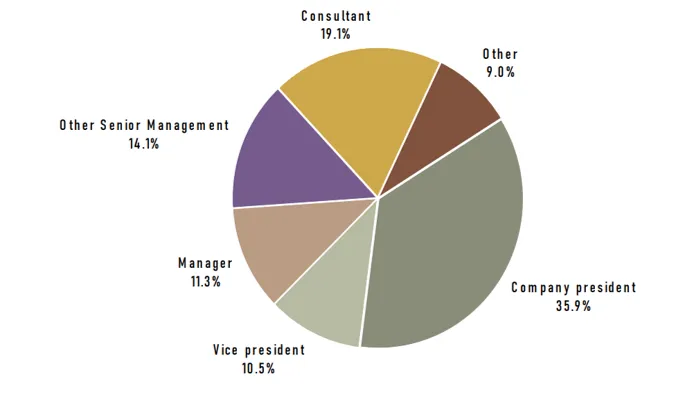
The Position Survey Respondents Hold in Their Company, 2025 [Fraser Institute]
Geographical Distribution of Mineral Potential
The survey evaluated 68 jurisdictions across every continent except Antarctica. Nevada in the United States secured the top overall position in the 2025 rankings. Ontario and Saskatchewan in Canada followed in second and third place, respectively.
Within Australia, the geographic spread of high-ranking jurisdictions spans most of the continent. South Australia’s dominance in copper and uranium projects drives its fourth-place standing. Western Australia continues to rely on its vast iron ore, gold, and lithium endowments.
Queensland remains the country’s largest producer of coal while growing its critical minerals portfolio. Tasmania recorded one of the most notable improvements by reaching 17th place. Even Victoria, the lowest-ranked Australian state at 49th, showed progress from its previous standing.
Timeline of Industry Sentiment and Reporting
The Fraser Institute surveyed between August and December 2024. The final report for the 2025 period became available in early 2026. This timeline allows industry stakeholders to assess the current state of the global mining market.
The data reveals rapid shifts in investor sentiment over a single year. South Australia’s move from 35th to 4th occurred within a compressed 12-month timeframe. Queensland similarly regained its 13th rank just one year after falling to its lowest point.
The results highlight how quickly political and regulatory changes impact international perceptions. Past surveys from 2019 ranked Australia as the most attractive region globally. The 2025 data suggest the country is successfully regaining that lost ground.
- 2019: Australia ranked as the top global region
- 2024: Australian jurisdictions fell out of the global top 10
- 2025: Five Australian states reached the top 35
- 2026: Official report release and industry analysis
Also Read: St George Mining Enters ASX All Ordinaries Index on the Back of Major Resource Upgrade at Araxá
Future Operational Landscape for Australian Mining
The 2025 results provide a roadmap for policymakers seeking to maintain Australia’s competitive edge. Governments will likely focus on streamlining approvals and reducing regulatory duplication. These measures aim to translate high survey scores into actual ground exploration.
Competition for exploration capital will intensify as other nations improve their policy settings. Saudi Arabia and Botswana have already entered the global top ten, challenging traditional mining hubs. Australian states must continue to reform land access frameworks and environmental standards.
The focus on critical minerals will drive future investment patterns across the states. Projects involving rare earths, lithium, and copper will receive priority in government strategies. Investors will continue to monitor policy stability and infrastructure access before making final investment decisions.
Mining companies will use these rankings to justify their portfolio allocations to shareholders. Continued high performance in the Fraser Institute survey will likely lead to increased drilling activity. This cycle of investment supports the long-term viability of the Australian resources sector.