
The historic rally that has seen gold rise to unprecedented heights has been turned on its head due to panic selling by the global investors and the new questions that are raised over the stability of the financial market.
The precious metal has just hit an intra-day peak of $US5,608 ($8,094), and then the mood deflation took place. The result has been a fall in the prices of up to 17 per cent in days as traders scrambled out of positions.
Silver was next to drop to a steeper price by about 35 per cent of its high of 121 in the US dollar. Analysts indicate that the swift change is among the quickest adjustments in a long time and underscores the volatility of the safe-haven properties when policy expectations shift abruptly.
The presence of gold bars depicts market volatility because of weak demand for safe havens. [GOLDMARKET.fr]
Panic Selling Sweeps Precious Metals Markets
The gold price crash in 2026 was hastened when a former Federal Reserve board member, Kevin Warsh, was nominated as the new central bank chairperson in the US.
Investors also think that he is less likely to reduce interest rates aggressively. That perception supported the US dollar and diminished the attractiveness of non-yielding assets such as gold.
Money started to roll out of positions as the metals and crypto markets suffered liquidations due to margin calls. Analysts opined that borrowed money had increased gains in the rally and increased losses in the downturn.
The sell-off was widespread in a short period, with institutions and retail traders being out of the market at the same time.
Are Fed Leadership Changes Driving The Gold Price Drop Explained?
Players of the market are attributing the fall to anticipations of tightening of the monetary policy with new leadership. When Jerome Powell is no longer in the office in May, Warsh will take over his position.
The appointment is viewed by traders as an indicator that the Federal Reserve would focus less on stimulus and more on stability. Increased rates normally increase the yield of bonds and decrease the relative demand for gold.
This increased the cost of international buyers as the dollar strengthened, which caused further demand to go down. Analysts explained that the commodities run was hence policy-based as opposed to pure speculation, albeit that momentum selling aggravated the trade.
Investors follow Federal Reserve indications that affect the world demand of bullions. [Metals Edge]
Retail Investors Flooded The Market During The Boom
Before the crash, there were long queues at mints and bullion dealers in most of the major cities, such as Perth and Sydney.
Gold was considered by many buyers as a hedge against inflation and low currency values. Online trading sites were easy to use, and the new entrants could trade on the spot.
This increased access, said researchers, made the volumes and swings heavier and sharper than those of earlier cycles. Chinese and Indian retail investors were very active during the surge. That rush aided in driving the prices u,p but also increased the vulnerability when the sentiment went down.
Could A Regime Change Hit Global Financial Markets?
Other fund managers caution that the downturn could herald more profound regime change throughout the markets and not just a correction. They conclude that investors are abandoning momentum trades to invest in an asset that has a quantifiable yield.
The central bank of Poland supposedly added its reserves of gold to 543 tonnes of gold, or 30 per cent of its reserves. India has also been a consistent purchaser to cushion the rupee.
But still others will be confident in growth and will be able to support equities rather than bullion. This discussion maintains the volatility at high levels with traders reconsidering the risk and opportunity.
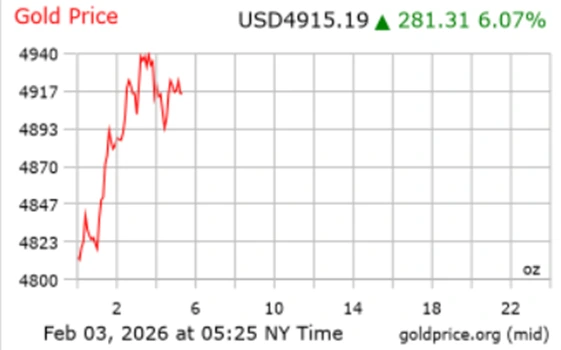
The gold price chart shows a sharp surge to USD 4,915 amid volatility. [GoldPrice.Org]
Analysts Remain Divided On The Outlook
Opinions have now divided widely about the future of gold. Other strategists believe that the worst scenario has been experienced and markets would stabilise with more direction on policy.
Other people predict further downfalls in case the dollar becomes stronger and rates remain high. The safe-haven demand might need a new round of geopolitical pressure or slower growth to kick-start a sustained recovery.
Experts explain that the drop in the price of gold until then is still explained by signals in policies and positioning of investors. At least, traders are shy and seek clarity.
Also Read: Stock Market Crash Warning Signs Emerge As Gold Surges And Tech Valuations Stretch In 2026
FAQs
Q1: Why is gold falling in 2026?
A1: Gold is falling due to panic selling, stronger US dollar expectations, and tighter Federal Reserve policy signals.
Q2: How much has gold dropped from its peak?
A2: Gold has declined as much as 17 per cent from its recent record high.
Q3: Why did silver fall more sharply?
A3: Silver dropped roughly 35 per cent because speculative positions were larger and more leveraged.
Q4: Could gold recover later this year?
A4: Recovery depends on rate cuts, weaker dollar trends, or renewed global uncertainty.


