
Astronomers have identified a unique black hole that challenges current space theories. The James Webb Space Telescope (JWST) captured data from a formation known as the Infinity Galaxy. This galaxy possesses a shape resembling a sideways figure eight. Researchers found a massive black hole positioned between two galactic nuclei.
Lead author Pieter van Dokkum from Yale University heads the study. His team released findings in The Astrophysical Journal Letters. The discovery suggests a new pathway for black hole formation. Scientists traditionally expect black holes to reside within galactic centres. This object sits in a region of gas between colliding disks.
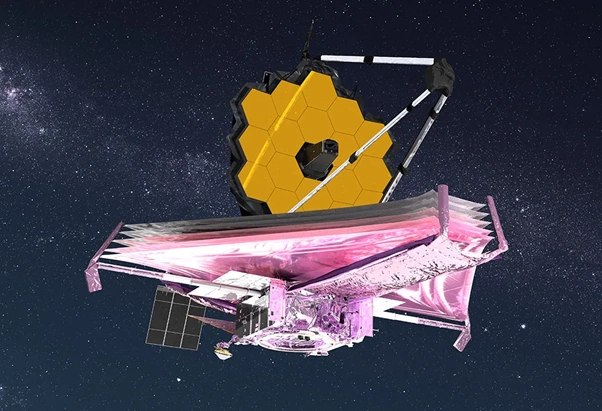
The James Webb Space Telescope captured data from a formation known as the Infinity Galaxy [NASA]
Unexpected Location of Cosmic Object
The Infinity Galaxy formed from a head-on collision of two disk galaxies. Each original galaxy contains its own central black hole. The JWST detected a third black hole in the middle of the system. This central object weighs approximately one million times the mass of the Sun. Astronomers noted that the black hole does not occupy a nucleus.
The research team utilised NASA’s Chandra X-ray Observatory to confirm activity. Radio data from the Very Large Array also supported the find. Ionised hydrogen gas surrounds the growing black hole. This gas has been stripped of its electrons. The location of the object between two nuclei surprised the observers.
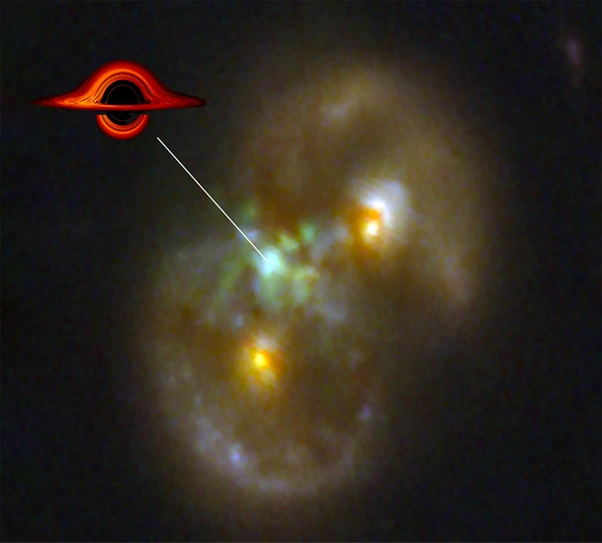
A third massive black hole between the Infinity Galaxy [NASA]
Direct Collapse Theory Gains Evidence
The discovery supports the “heavy seed” hypothesis for black hole growth. This theory proposes that massive gas clouds collapse directly into black holes. This process skips the traditional stage of a dying star. Most black holes begin as “light seeds” from supernova explosions. Direct collapse allows black holes to reach large sizes very quickly.
- Direct collapse requires extreme gas compression.
- The galactic collision provided the necessary force.
- A dense knot formed within the gas clouds.
- The knot collapsed into a million-solar-mass object.
- This pathway explains black holes in the early universe.
Scientists measured the velocity of the surrounding gas. The black hole moves at a similar speed to this material. This evidence suggests the black hole formed exactly where it currently sits. It did not travel from another location. The system now contains three confirmed active black holes.
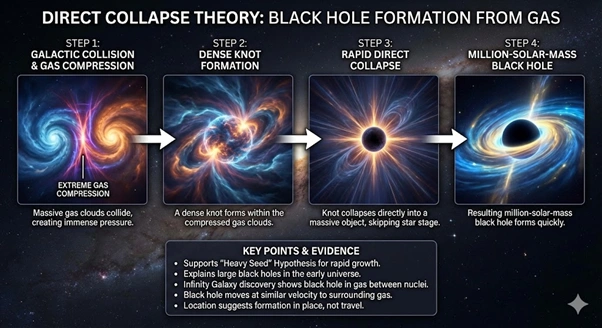
Direct Collapse Theory
Scientific Team Responses to Findings
The researchers expressed surprise at the data during the analysis. Pieter van Dokkum commented on the strange positioning of the object. He stated the following during the announcement:
“The biggest surprise of all was that the black hole was not located inside either of the two nuclei but in the middle. We asked ourselves: How can we make sense of this?”
The team also considered alternative explanations for the phenomenon. The object could have been a runaway black hole. Another possibility involved a hidden third dwarf galaxy. However, dwarf galaxies rarely host such massive black holes. The data strengthens the case for a newborn direct-collapse black hole.
Also Read: Ticketmaster Faces Legal Action Over “Abusive” Service Fee Structure
Impact on Universal Models
The JWST continues to provide data that contradicts old models. Astronomers see supermassive black holes just 500 million years after the Big Bang. Standard growth models require at least one billion years. Direct collapse solves this problem by providing a head start. The Infinity Galaxy offers a rare view of this birth process.
- The system acts as a cosmic laboratory.
- Researchers will continue to investigate the data.
- Future observations will refine the mass estimates.
- New instruments will track the gas movements.
- The discovery alters the understanding of galactic evolution.
The team plans to use deeper radio observations in the future. These will determine if a second black hole causes a wobble. Such a find would identify a binary black hole system. For now, the Infinity Galaxy remains a primary focus for cosmologists. The scientific community awaits further confirmation of these formation processes.
Disclaimer