
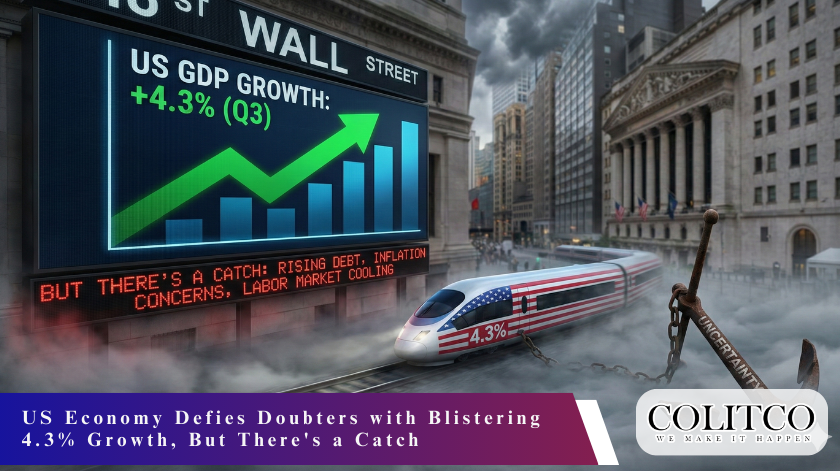
The US economy roared ahead at its fastest clip in two years during the third quarter, leaving economists scrambling to explain how growth accelerated even as warning signs flash across the labour market.
Fresh data released Tuesday showed America’s GDP expanded at an annualised rate of 4.3% between July and September. The figure crushed expectations of 3.2% growth and marked a sharp uptick from the 3.8% pace recorded in the second quarter.
The Commerce Department’s delayed report, postponed two months due to the government shutdown, painted a picture of an economy still firing on multiple cylinders despite persistent headwinds.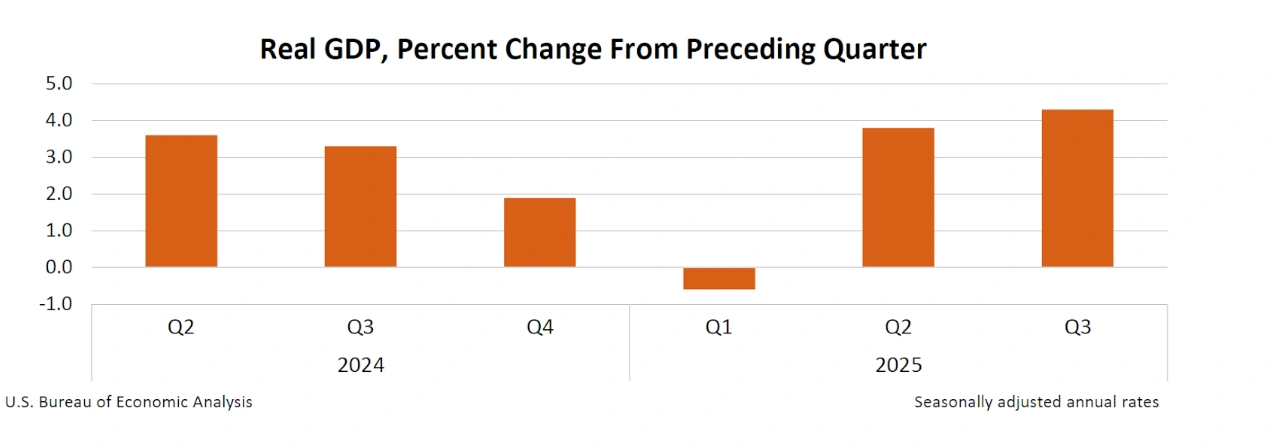
US GDP growth accelerated to 4.3% in Q3 2024, the fastest pace in two years
Americans Keep Spending Despite Economic Anxiety
Consumer spending jumped to a 3.5% annual rate in the third quarter, up a full percentage point from the previous period. That acceleration came as Americans continued opening their wallets across multiple categories.
The spending surge covered both goods and services. Motor vehicle purchases climbed ahead of anticipated tariffs. Prescription drug spending also contributed to the growth, according to the Bureau of Economic Analysis.
Household spending accounts for roughly 70% of US economic activity. Its continued strength provided the primary engine behind the quarter’s robust performance.
Trade and Government Boost Growth Picture
Exports surged 8.8% during the period while imports dropped 4.7%. That combination added significantly to the GDP figure.
Net trade contributed 0.9 percentage points to overall growth. Government spending also accelerated, adding further momentum to the expansion.
The breakdown of Q3 contributors:
- Consumer spending: +2.40 percentage points
- Exports: +0.90 percentage points
- Government spending: notable increase
- Private investment: smaller decline than previous quarter
Inflation Measures Tick Higher
The growth acceleration came with an unwelcome companion—rising inflation readings.
The Fed’s preferred inflation gauge, the Personal Consumption Expenditures price index, climbed to 2.8% annually. That represented an increase from 2.1% in the second quarter.
Core PCE inflation, which excludes volatile food and energy prices, rose to 2.9% from 2.6% previously. The uptick suggests underlying price pressures built as growth strengthened.
The GDP Price Index jumped 3.7%, well above the forecast of 2.7% and the previous reading of 2.1%.
Labour Market Weakness Creates Puzzle
The stellar GDP number creates a confusing picture when viewed against recent employment data.
Unemployment rose to 4.6% in November, the highest level since 2021. Monthly job creation averaged just 22,000 during the three months through November, down sharply from the 168,000 average through 2024.
“The solid GDP figure in the third quarter is at odds with a sluggish labour market that has prompted the Federal Reserve to cut interest rates three times this year,” analysts noted.
Strong economic growth typically fuels robust hiring. But that connection appears broken in the current environment.
Similar economic tensions have played out in other major economies, including Australia’s recent growth rebound and Canada’s slowing expansion.
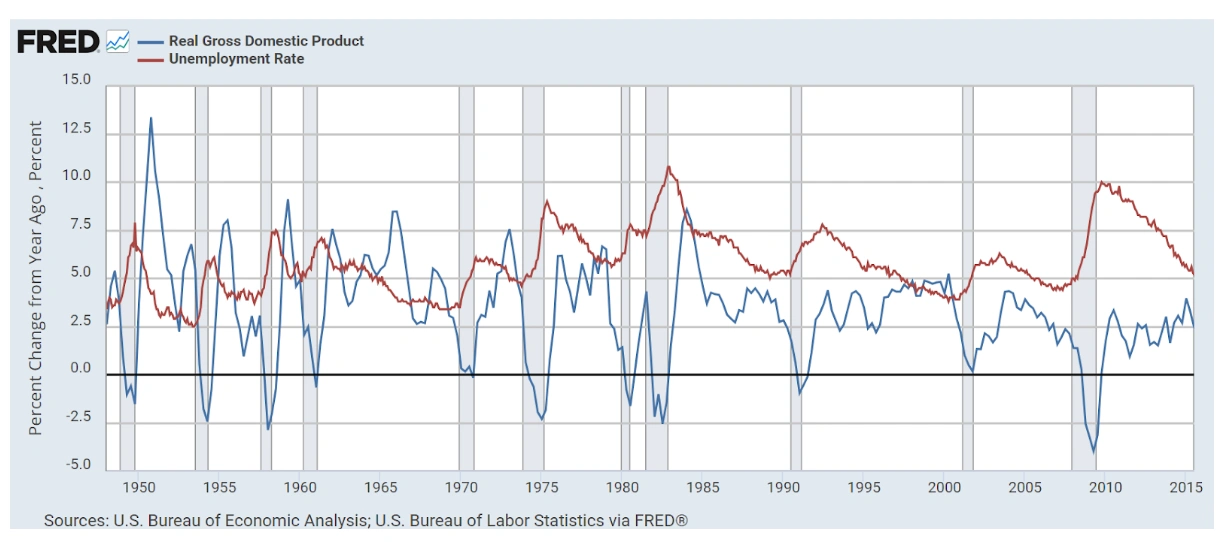
The disconnect between strong GDP growth and rising unemployment presents a puzzle for economists
Two-Month Delay Dims Report’s Relevance
The government shutdown pushed the GDP data release back by two months. The report originally scheduled for 30th October finally arrived just days before the end of the fourth quarter.
“There’s a lot of action in the rearview mirror, isn’t there?” remarked Vincent Reinhart, former Fed economist, during a Bloomberg interview.
The timing means the data captures economic conditions from July through September, months that feel increasingly distant given recent developments.
Market Reactions and Expert Commentary
Financial markets showed muted reactions to the surprise upside. The US Dollar Index fell 0.25% on the day as traders weighed the implications.
Bret Kenwell from eToro offered perspective: “While worries surrounding the jobs market, tariffs and inflation continue to swirl, the economy continues to defy its doubters by chugging higher.”
Treasury Secretary Scott Bessent predicted the US would finish 2025 with 3% GDP growth despite the government shutdown disruption.
Bloomberg economist Tatiana Darie called it “a very solid print albeit very lagged,” noting bond traders viewed it as reassuring evidence of consumer resilience before the shutdown.
What This Means for the Economy
The 4.3% expansion represents the strongest quarterly performance since mid-2023. It follows a volatile year that saw the economy contract 0.6% in the first quarter before rebounding.
An underlying measure of growth, which strips out volatile categories like inventories and trade, rose 3% in the third quarter. That figure increased slightly from 2.9% in the previous period, confirming genuine momentum beyond temporary factors.
The UK economy also experienced tariff-driven acceleration as firms rushed to beat deadlines.
Also Read: Trump Unveils ‘Trump-Class’ Battleships: Golden Fleet Set to Sail in 2.5 Years
Looking Ahead
Economists caution the robust third-quarter pace won’t continue. Several factors cloud the outlook for coming months.
The weak labour market suggests consumer spending may moderate. Business uncertainty around tariffs could weigh on investment decisions. And the delayed nature of the data means current quarter dynamics remain unclear.
The Federal Reserve faces a delicate balancing act. Strong growth argues against aggressive rate cuts, but the weakening employment picture suggests the economy needs support.
The Bureau of Economic Analysis will release revised estimates as more complete data becomes available. The final third-quarter reading will provide a clearer picture of how the economy performed during those critical summer months.
For now, GDP data today confirms the US economy entered the final quarter with considerable momentum, even if the path ahead looks considerably more uncertain.