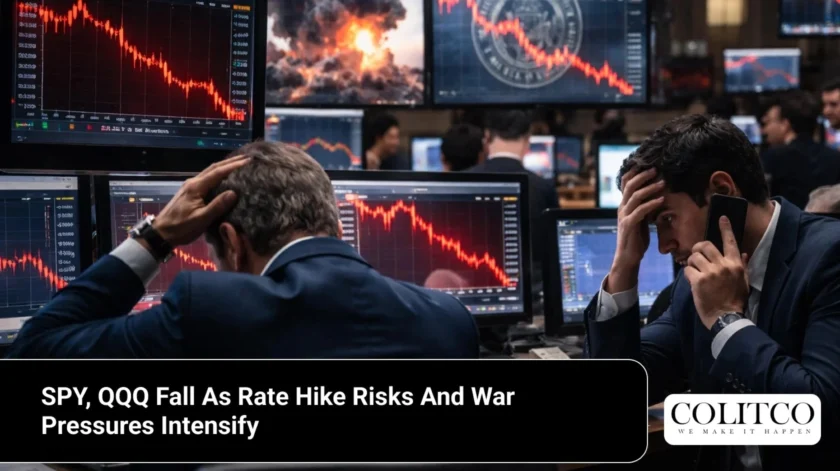
The SPY and QQQ decline indicates increasing fears due to the possibility of hiking interest rates in 2026. The S&P 500 ETF and the Nasdaq 100 ETF both ended the week in a lower manner, with investors estimating the monetary policy tightening.
The escalating inflation expectations that were triggered by a rise in the cost of energy compelled markets to re-evaluate previous expectations of a rate cut. The US-Iran war, which is already in its third week, has further increased uncertainty.
Investors responded by de-exposing themselves in risky investments, especially those that were heavy in technology. The move resulted in a drop in the key indices, showing weak market confidence.
SPY and QQQ charts reflect market declines amid rising rate fears. [Courtesy: Validea’s Guru Investor Blog]
What Is Driving Market Volatility Right Now?
The geopolitical conflict, coupled with macroeconomic strain, is pushing market volatility. The war between the US and Iran has derailed the oil supply channels, forcing a rise in the price of crude and elevating the risk of inflation.
Meanwhile, there has been an increased yield of bonds as investors expect a tightening of monetary policy. This climate has lowered the liquidity and strained equity values.
This trend has been reflected in the global markets, where there has been a massive depreciation in all parts of the world.
The ambiguity of decisions on the part of the central bank has led to investors being cautious, which has augmented short-term volatility.
SPY QQQ Fall Reflects Shift Towards Defensive Investing
The SPY QQQ drop is an indication of a wider investor behaviour change towards defensive behaviour. The investors are shifting the money out of the high-growth industries to the less risky investments like energy and utilities.
It is worth noting that energy stocks have been doing better with a growing oil price, whereas utilities have experienced the opposite. The slowing economic growth and continued inflation are a concern, as reflected by this rotation.
The cash positions are also rising with the institutional investors in order to deal with risk. The Nasdaq-based QQQ has been hit especially because it is sensitive to changes in interest rates.

Investors rotate into defensive sectors as market uncertainty grows. [Courtesy: Mint]
How DoesThe US-Iran War Impact Financial Markets?
The US-Iran war has greatly affected the financial markets across the world by exposing the world to geopolitical risks and interfering with the energy supply chain.
The war broke out at the end of February 2026 and already caused sharp increases in oil prices. Such upheavals have led to inflationary pressure in the world.
Increase in energy prices impacts business, consumers and economic growth prospects. The markets have reacted by being more volatile and falling equity values. The war has also made central banks rethink their monetary policy position.
SPY QQQ Fall Signals Broader Economic Concerns
The SPY QQQ fall is not only a short-term response but also an indicator of a deeper economic issue.
There is a growing concern among investors that stagflation may occur where the inflation rate is high and the growth rate is slow. The central banks are now in a tough situation of balancing between inflation and economic growth. Growing oil prices and disruption in supply still burden the world markets.
Observers caution that a long war might lead to more crises in financial systems, and the recovery process will take time before it is achieved.
Economic uncertainty rises as inflation and growth concerns intensify. [Courtesy: SME United]
What Lies Ahead For SPY, QQQ, and Markets?
The future of SPY and QQQ is not clear with the continued changes in monetary policy and geopolitics. Markets could go down further in case inflation is high, and a rate increase becomes a reality.
On the other hand, alleviation of tensions or stabilisation of energy prices may be helpful in recovery. The investors are very vigilant on the Federal Reserve indicators and news of the conflict all over the globe.
Cautious positioning and diversification are likely to be one of the strategies in this environment. The next few weeks are going to determine the direction of the market.
Also Read: 4 ASX Shares Investors Should Watch as AI Reshapes Software Sector
FAQs
Q1. Why are SPY and QQQ falling?
A1: SPY, QQQ fall is driven by rate hike fears and US-Iran war tensions.
Q2. How does war affect stock markets?
A2: War raises uncertainty, increases oil prices, and pressures global economic growth.
Q3. Which sectors are benefiting currently?
A3: Energy stocks are gaining due to rising oil prices amid supply disruptions.
Q4. Will the market recover soon?
A4: Recovery depends on inflation trends and geopolitical stability in the coming weeks.
Disclaimer:
This article is for informational purposes only. It is based on announcements and market developments related to SPDR S&P 500 ETF Trust and Invesco QQQ Trust. It does not constitute financial advice. Investors should conduct independent research before making investment decisions.
Sources: